

No. 10 on our checklistPool Frog (Pelophylax lessonae)
Meet the Pool Frog, the smallest and scarcest green frog of the Danube Delta: how to recognize it, where it lives and why it matters for the Edible Frog.
The Pool Frog (Pelophylax lessonae) is the smallest of the three green frogs of the Danube Delta. It lives among its two larger relatives, the Marsh Frog and the Edible Frog, and is easily overlooked in a landscape full of green frogs.
It is also one of the two parent species of the Edible Frog, so understanding it helps explain how water frogs in the Danube Delta are related to one another.
Quick facts
Quick facts
- Scientific name Pelophylax lessonae (Camerano, 1882)
- Common name Pool Frog
- Family Ranidae (true frogs)
- Order Anura (frogs and toads)
- Length females up to about 9 cm; males noticeably smaller
- Diet mainly terrestrial invertebrates, especially insects; tadpoles feed mostly on algae
- Habitat calm, well-vegetated standing water such as small lakes, ponds and marshes
- Activity spends much of the warm season in or near water, often basking; males call loudly in the breeding season
- Breeding late spring, with warm nights; small clumps of eggs in the water
- Conservation status Least Concern in Europe and EU27, European Red List published in 2025; Habitats Directive Annex IV
When to see it in the Danube Delta and Dobrogea
- JanWinter rest
- FebWinter rest
- MarWinter rest
- AprWeather-led
- MayCalling season
- JunCalling season
- JulActive
- AugActive
- SepActive
- OctWeather-led
- NovWinter rest
- DecWinter rest
- Status here
- Indicative seasonal pattern; emergence and calling depend on spring temperatures. No abundance estimate.
- IUCN Red List
- Least Concern in Europe and EU27 (European Red List published 2025)
- Our checklist
- No. 10 of 30 · see the full checklist
Description and identification
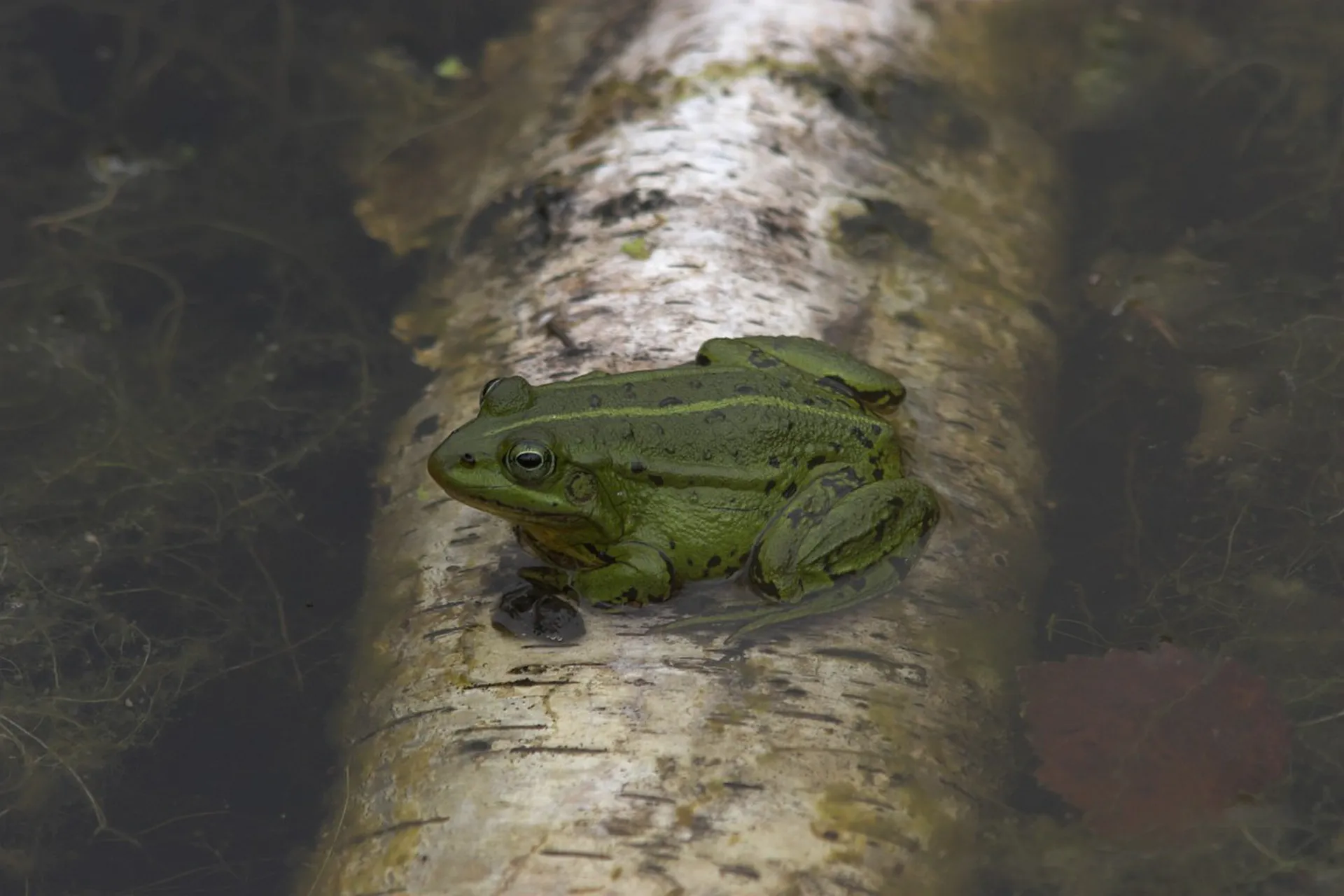
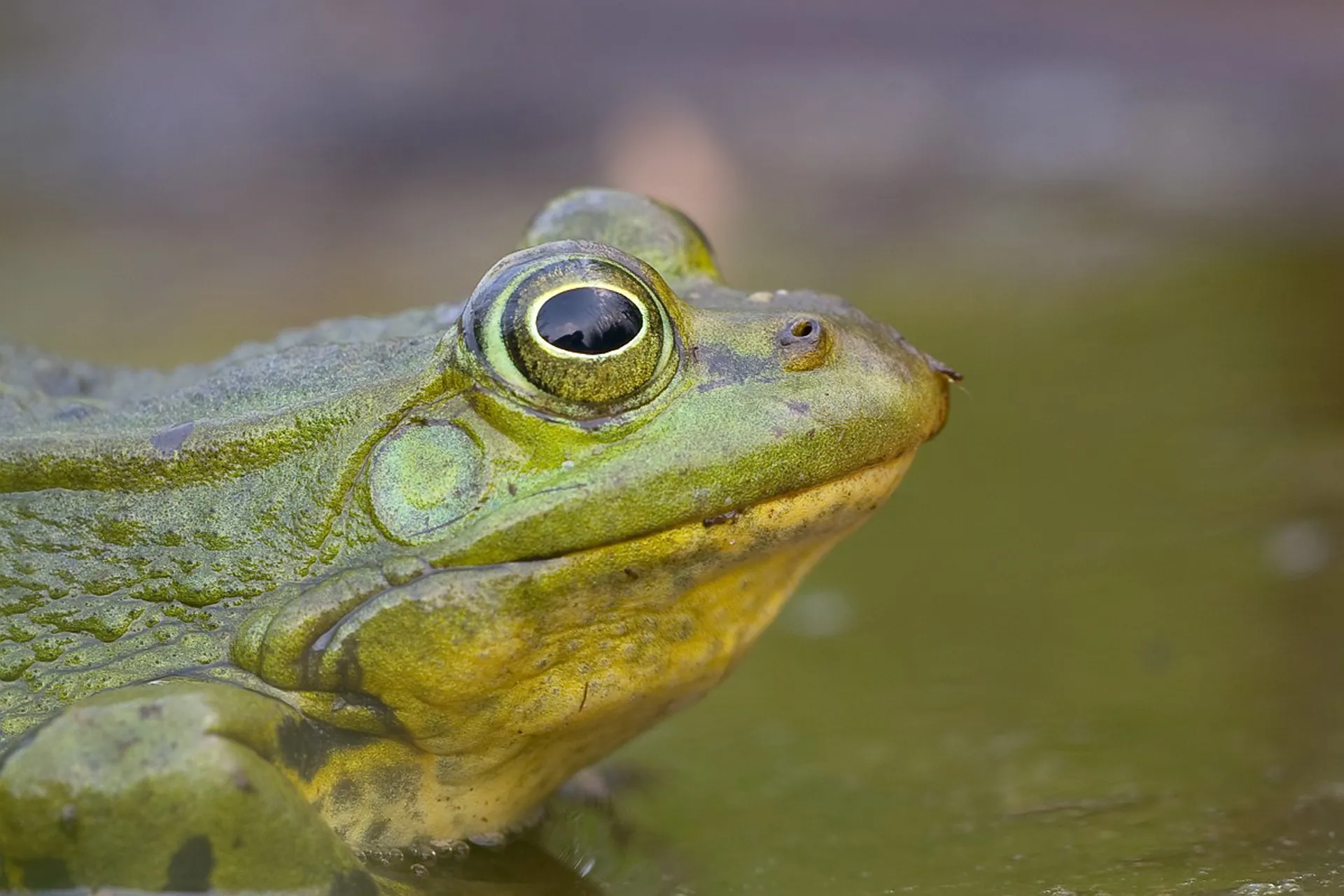
The Pool Frog is a compact green or brownish frog with dark blotches on the back and often a pale yellowish or greenish stripe along the spine. The backs of the thighs usually show a strong yellow and black pattern. In the breeding season, males can become bright yellowish-green.
The most reliable field feature is on the hind foot. At the base of the innermost toe there is a hard bump, the metatarsal tubercle. In the Pool Frog it is large, high and almost symmetrical, like a half-circle, and usually longer than half the length of that toe. In the Edible Frog it is smaller and asymmetrical; in the Marsh Frog it is smaller still.
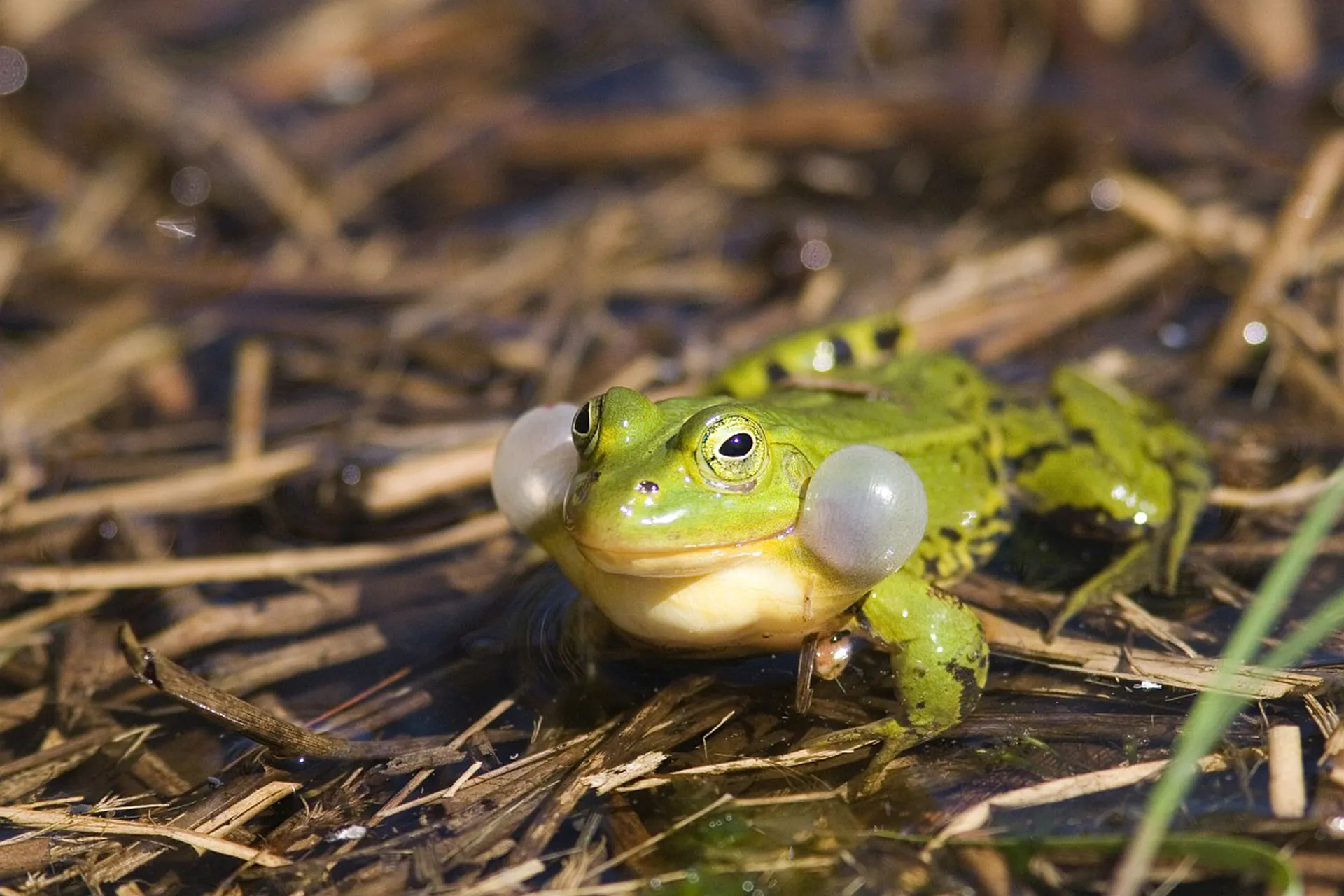
Calling males inflate a pair of vocal sacs at the corners of the mouth. These are white in the Pool Frog, pale gray in the Edible Frog and dark gray in the Marsh Frog. Romanian field photographs show that some Edible Frogs also have whitish sacs, so the vocal sacs alone are not proof.
The species is named after the Italian zoologist Michele Lessona, and many publications still use the older name Rana lessonae.
A scarce green frog in a green-frog landscape
Water frogs are everywhere in the Danube Delta, but the Pool Frog is not the common one. A 2009 record list for Dobrogea found it in only 14 locations, all in the northern part of the region, including the Danube Delta. The localities included the Sulina branch at Crișan and Maliuc, Lakes Obretinul Mare and Obretinul Mic, Rotundu and Telincea, the Erenciuc channel, Sfântu Gheorghe, Sulina and Tulcea.
The same authors treated the Pool Frog separately from the other green frogs because it is easier to recognize and because there were several reliable recent records. A Romanian review published in 2008 also notes that the Pool Frog appears to have the most limited distribution of the three water frogs in Romania.
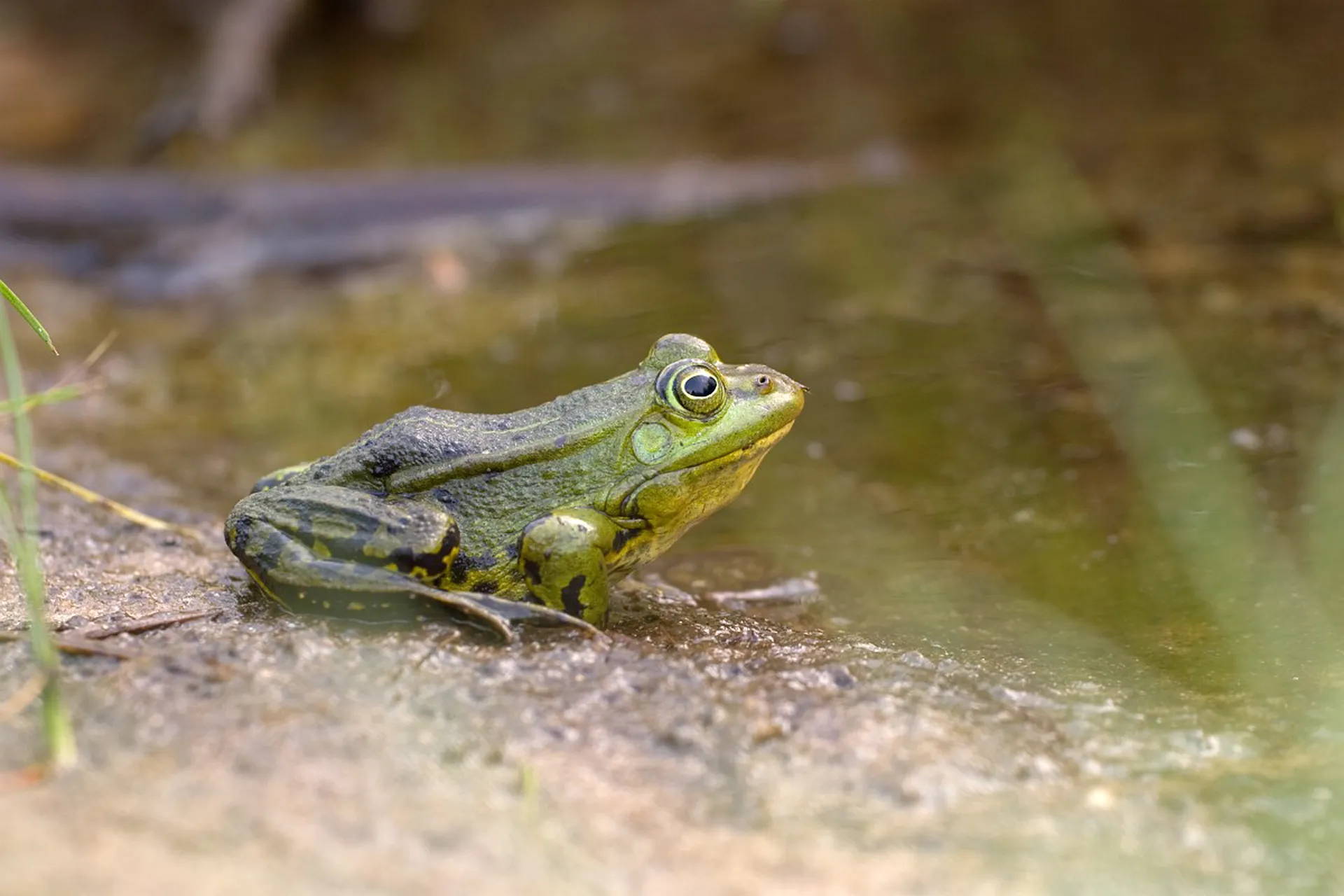
Calm, well-vegetated water suits it better than open channels with current. It spends much of the warm season in or near the water and often basks at the edge, even in strong sunshine.
Calling, breeding and tadpoles
Pool Frogs breed later than many other amphibians, when nights become warm in late spring. The call is a loud, rapid series of notes, often compared to quacking or laughter. Females lay small clumps of eggs in the water, and the eggs are brown above and yellowish below.
The tadpoles feed mainly on algae. Adults eat mostly terrestrial invertebrates, especially insects, and sometimes climb plant leaves up to about half a meter to catch prey. Water insects usually form less than half of the diet. The species is described as less voracious than the Marsh Frog.
The Pool Frog usually spends the winter on land.
Parent of the Edible Frog
When a Pool Frog mates with a Marsh Frog, the offspring are Edible Frogs. These hybrids can continue to reproduce by mating with one of the parent species, through a process called hybridogenesis that is explained in our article on the Edible Frog.
This relationship has conservation consequences. The 2008 Romanian review explains that where Marsh Frogs become dominant, mixed populations can gradually shift towards pure Marsh Frog populations. Pure Pool Frog populations are therefore considered worth special attention.
Conservation and responsible observation
The European Red List published in 2025 assesses the Pool Frog as Least Concern in Europe and the EU27, using a broader taxonomic concept that also covers some related water frogs. It is listed in Annex IV of the EU Habitats Directive, which provides strict protection.
Habitat alteration and loss are recognized threats.
Do not catch frogs to check their feet. A sharp photograph of a calling male or a frog resting in the open is a better way to share a possible record with a specialist. The calendar above shows seasonal activity, not how many frogs are present.
Listening for it on a nature tour
On multi-day nature tours in the Danube Delta, the chorus of green frogs is a familiar sound on late-spring boat trips. Many of the voices belong to Marsh Frogs. Picking out a Pool Frog requires patience, a good look at a basking animal and an acceptance that many green frogs will remain unidentified.
See it with us
Slow open boats, small groups and a guide who knows the places and the wildlife. From a few hours on the water to a week in the Danube Delta and Dobrogea.
Keep reading
Keep reading
More from the blog
5 min read
Smooth Newt (Lissotriton vulgaris)
Discover the Smooth Newt in the Danube Delta and Dobrogea: identification, leaf-wrapped eggs, seasonal habitats and responsible wildlife watching.
4 min read
Spur-thighed Tortoise (Testudo graeca)
The Spur-thighed Tortoise is the only native land tortoise of eastern Romania, living in the dry grasslands, hills and scrublands of Dobrogea. Discover how...
5 min read
Smooth Snake (Coronella austriaca)
Discover the Smooth Snake in the Danube Delta and Dobrogea: identification, live-bearing reproduction, dry refuges and responsible wildlife watching.