

No. 13 on our checklistGreater White-fronted Goose (Anser albifrons)
Meet the Greater White-fronted Goose, the most numerous wintering goose in Romania: identification, migration from the Arctic, winter life in Dobrogea, numbers and status.
The Greater White-fronted Goose (Anser albifrons) is the most numerous goose in Romania in winter. Every autumn hundreds of thousands arrive from the Arctic tundra of Russia, and from November to March their flocks fill the sky over the lagoons of the southern Danube Delta and the fields of Dobrogea.
Among them travel most of the world’s Red-breasted Geese, which makes the white-fronted goose flocks one of the great winter wildlife spectacles of Europe.
Quick facts
Quick facts
- Scientific name Anser albifrons (Scopoli, 1769); the birds wintering in Romania belong to the nominate subspecies, Anser albifrons albifrons
- Common name Greater White-fronted Goose; also White-fronted Goose
- Family Anatidae (ducks, geese and swans)
- Order Anseriformes (waterfowl)
- Length 65–76 cm
- Wingspan 140 cm
- Weight 2.5 kg
- Diet plants; in winter mainly young winter wheat and other cereals, grasses and spilled grain in the fields
- Habitat in winter, open farmland and steppe around large lakes and lagoons, where the geese feed by day and roost on the water at night
- Breeding does not breed in Romania; nests in the Arctic tundra, usually laying 4–6 eggs
- Conservation status Least Concern (global IUCN Red List); a game species in Romania
When to see it in the Danube Delta and Dobrogea
- JanWinter flocks
- FebWinter flocks
- MarFlocks, departure
- AprLast birds
- MayIn the Arctic
- JunIn the Arctic
- JulIn the Arctic
- AugIn the Arctic
- SepIn the Arctic
- OctFirst arrivals
- NovMain arrival
- DecWinter flocks
- Status here
- Winter visitor, very common from November to March; absent in summer, when it breeds in the Arctic.
- IUCN Red List
- Least Concern
- Our checklist
- No. 13 of 385 · see the full checklist
How to recognize it
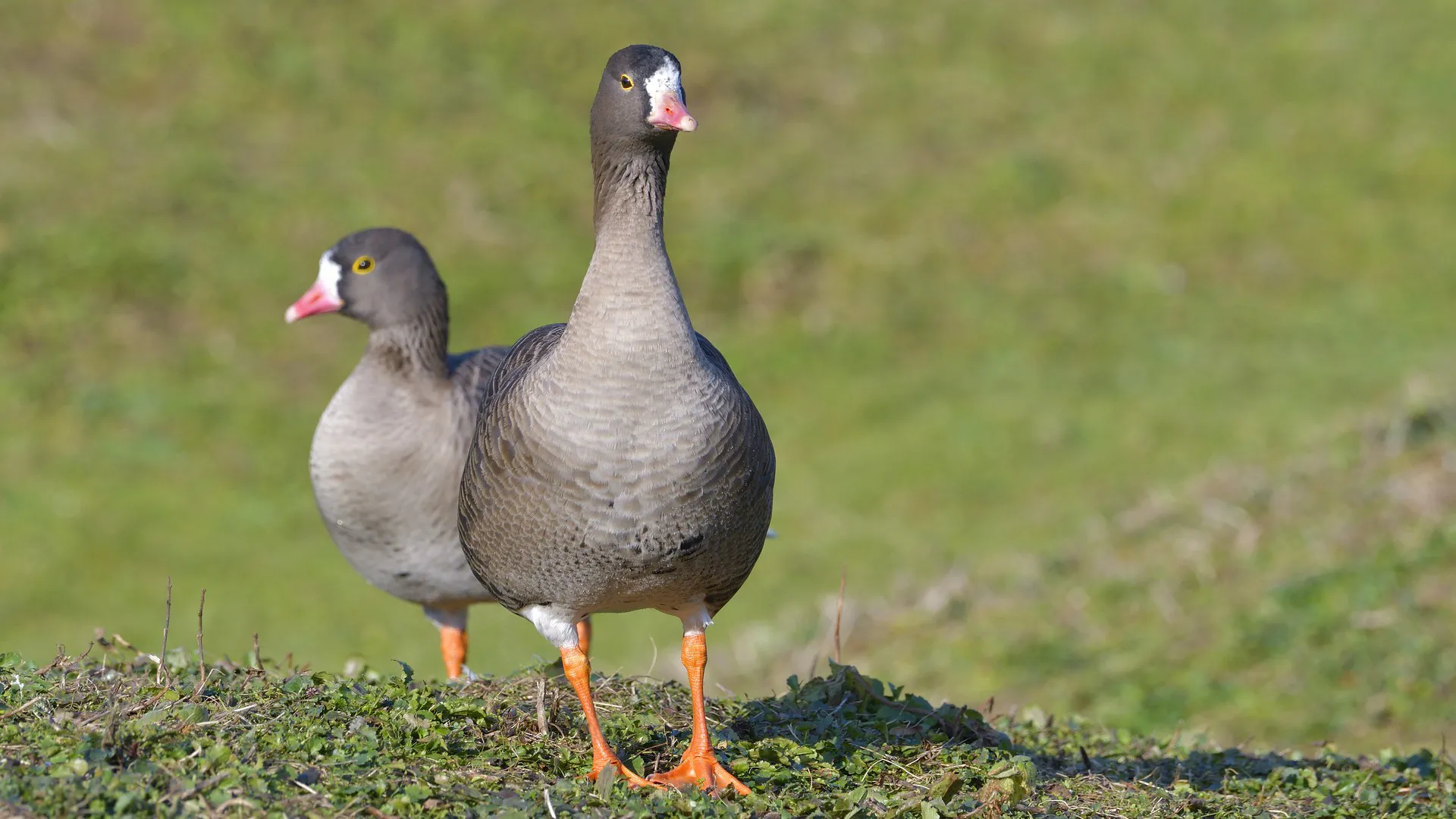
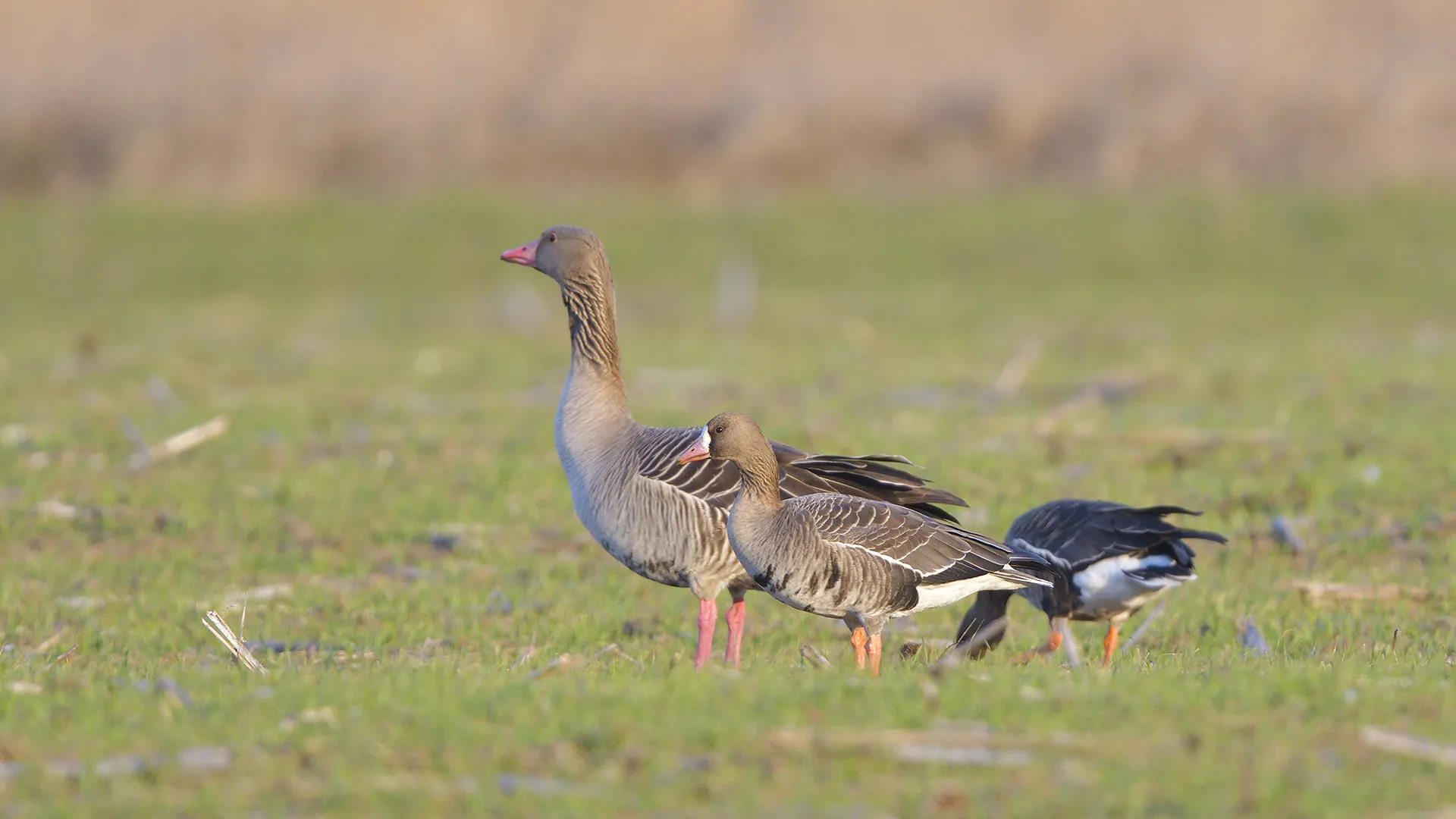
This is a medium-sized, gray-brown goose, smaller and darker than the Greylag Goose. Adults have a white blaze at the base of the bill, which gives the species its name, and irregular black bars across the belly. The bill is pink in the birds that winter in Romania, and the legs are orange.
Juveniles have no white blaze and no black bars on the belly. They acquire both gradually during their first winter, so in December and January many young birds show only a little white around the bill.
The rare Lesser White-fronted Goose, a globally threatened species, also appears in small numbers among the flocks. It is smaller, with a shorter, brighter pink bill, a white blaze that reaches higher onto the forehead and a yellow ring around the eye. Separating the two needs good views and some experience. The call of the Greater White-fronted Goose is a high, musical, laughing cackle, quite different from the deep voice of the Greylag Goose. A large flock can be heard long before it is seen.
From the tundra to Dobrogea
Greater White-fronted Geese breed in the Arctic tundra of northern Russia, where they nest on the ground and raise their young during the short Arctic summer. In autumn the birds that use the Black Sea and Pannonian flyway travel southwest to the plains around the western Black Sea. The first birds reach Romania in October, the main arrival takes place in November and December, and the flocks leave in February and March. Families migrate together, and the young learn the route and the wintering places from their parents.
Daily life in winter
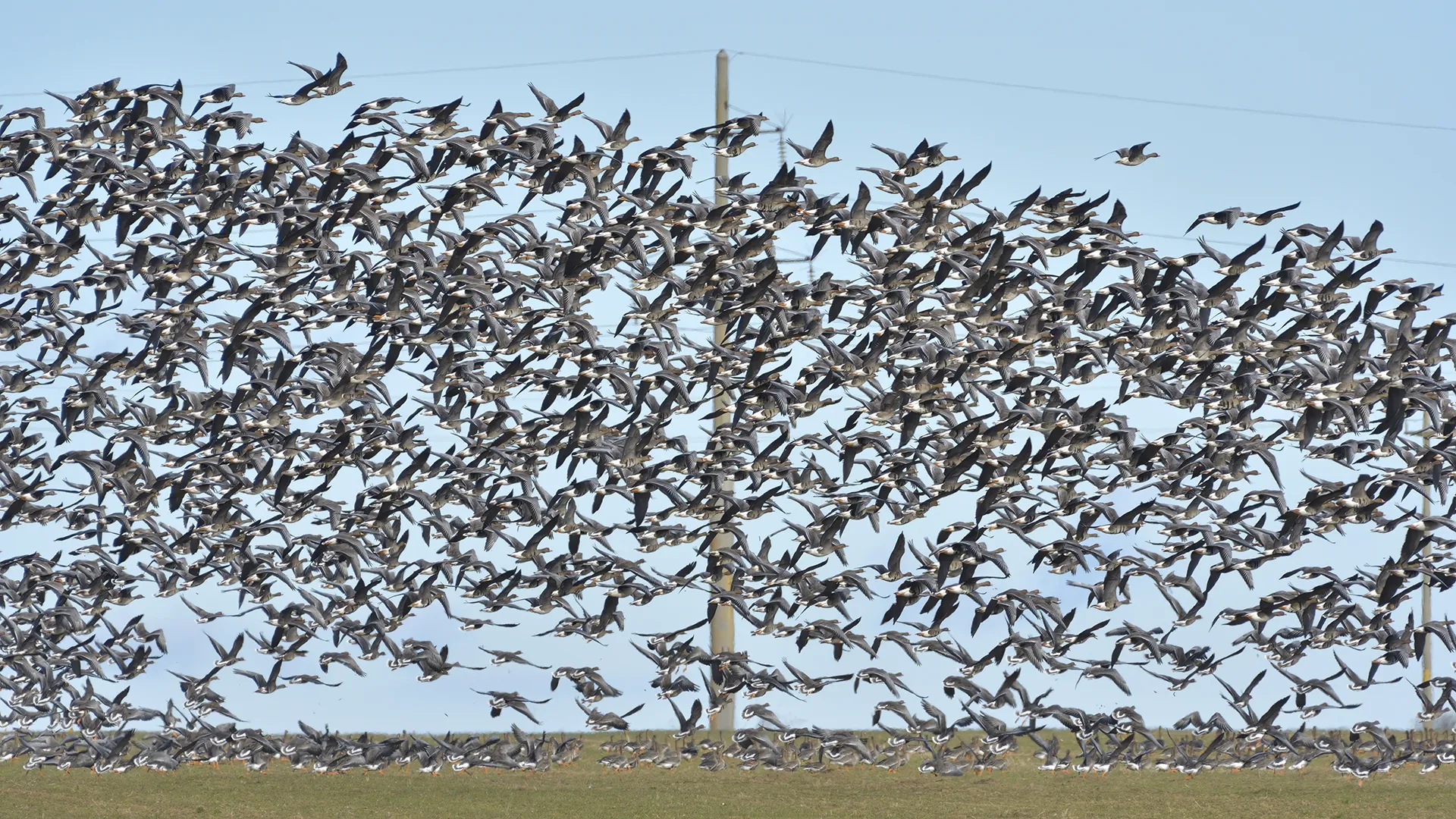
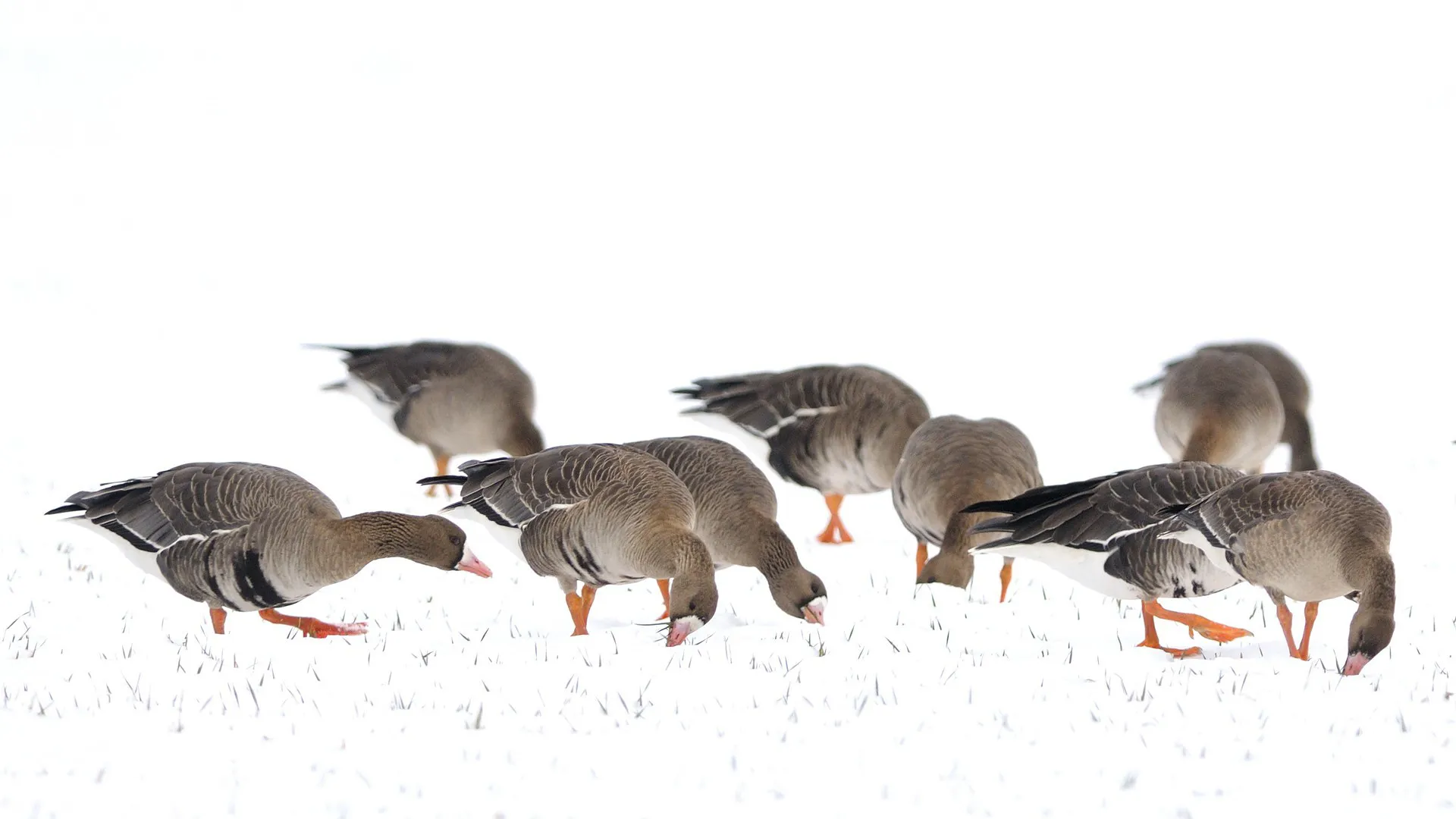
In winter the geese follow a regular rhythm. They spend the night on the water of large lakes and lagoons, where they are safe from foxes and other predators. At dawn, flock after flock rises from the water and flies to the fields to feed, mostly on young winter wheat and other crops. In the evening they return to the roost. Many birdwatchers consider these morning and evening flights the most memorable part of a winter visit to Dobrogea.
Snow and frost change the picture quickly. When the fields are covered or the lakes freeze, the geese may move to other feeding areas, so local numbers can change from one week to the next.
How many come to Romania
Coordinated counts on the northwestern Black Sea coasts in the winters from 2017/18 to 2021/22 found an average annual maximum of more than 385,000 Greater White-fronted Geese across Romania, Bulgaria and Ukraine. On average about 77% of them were in Romania, where numbers usually peaked in December. The first national goose census in Romania, in November 2020, recorded 348,858 birds. The goose census carried out in parallel with the January waterbird count in southeastern Romania found 262,784 in January 2026 and 414,024 in January 2025.
The main roosts are on the lagoons and lakes of the south and east, including the Razim-Sinoie complex in the southern Danube Delta, and lakes such as Balta Albă and Strachina farther inland. Around these roosts the geese feed on the farmland of Dobrogea and the eastern Romanian Plain.
Partners of the Red-breasted Goose
The globally threatened Red-breasted Goose almost always travels and feeds with Greater White-fronted Geese, using their large flocks for safety. Scanning a white-fronted goose flock patiently is the best way to find its small, colorful companion.
Interesting facts
- A name written on its face. The scientific name albifrons comes from the Latin albus, “white”, and frons, “forehead”, after the white blaze at the base of the bill.
- Families that last for years. The family bond is unusually long. Young birds can stay with their parents for several years, and even grandparents have been seen with family groups. This is possibly unique among ducks, geese and swans.
- Pink bills and orange bills. The geese that winter in Romania belong to the European subspecies, with a pink bill. The darker Greenland White-fronted Goose, which winters mainly in Ireland and Scotland, usually has an orange bill.
- Thousands of kilometers twice a year. The geese that winter in Dobrogea fly several thousand kilometers between the Arctic tundra of Russia and the Black Sea coast, stopping to rest and feed along the way.
Status and conservation
The Greater White-fronted Goose is widespread in the Arctic and listed as Least Concern on the global IUCN Red List. In Romania it is a game species, hunted legally in winter outside strictly protected areas. Because Red-breasted Geese feed and fly in the same flocks, shooting and disturbance at feeding and roosting sites also affect this threatened species. Quiet roosts and undisturbed feeding areas are the most important conditions for the geese in winter.
When watching geese, stay at the edge of the fields, use vehicles as hides where possible and never drive the flocks into the air.
Winter goose watching on our tours
On our multi-day birdwatching tours in the Danube Delta and Dobrogea, the winter program is built around the geese. We watch the morning flights from the roosts, scan the feeding flocks for Red-breasted and Lesser White-fronted Geese and combine the goose fields with the lagoons of the southern Danube Delta, where raptors and other waterbirds also gather in winter.
See it with us
Our birding guides are biologists and ornithologists who are on the water every day of the year. Small groups, open boats, the best hours of the day.
Keep reading
Keep reading
More from the blog

7 min read
Dalmatian Pelican (Pelecanus crispus)
The Dalmatian Pelican, the largest pelican in the world: how to tell it from the Great White Pelican, fishing, breeding, migration and where to...
5 min read
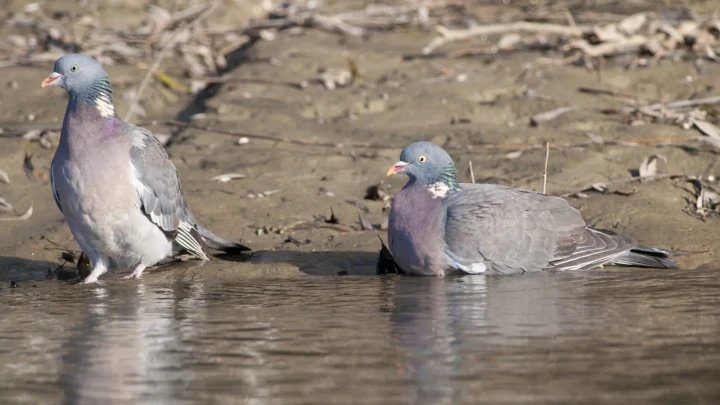
Common Wood Pigeon (Columba palumbus)
The Common Wood Pigeon, Europe's largest pigeon, in the forests and fields of the Danube Delta and Dobrogea: identification, breeding, migration and status.

5 min read
White-tailed Eagle (Haliaeetus albicilla)
The White-tailed Eagle is the largest bird of prey in Romania. How to identify it, its American cousin the Bald Eagle, the unique DNA...