

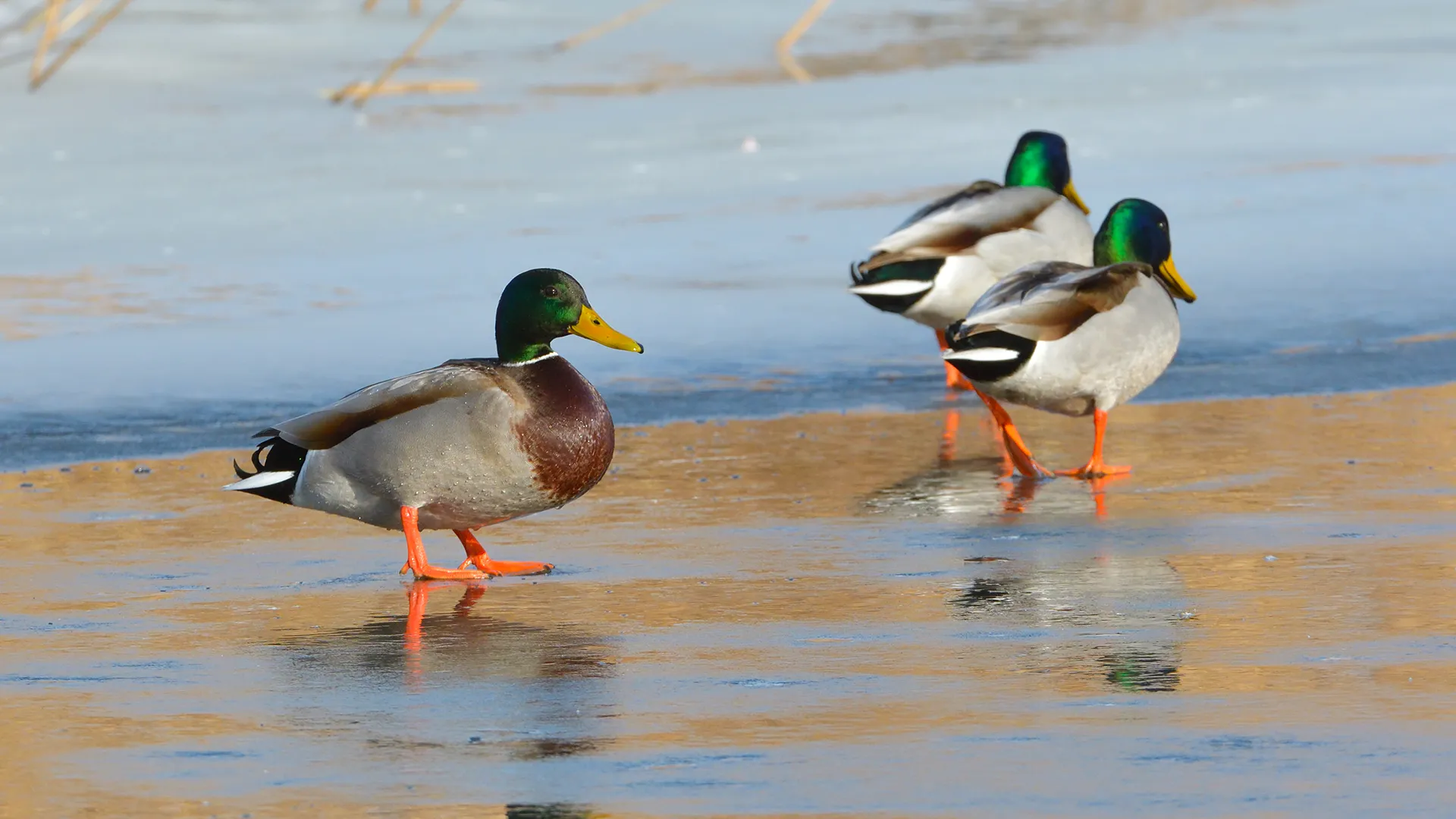
No. 37 on our checklistMallard (Anas platyrhynchos)
The Mallard, the most common duck in the Danube Delta and the ancestor of farmyard ducks: identification, breeding, numbers, one-eyed sleep and changing bills.
The Mallard (Anas platyrhynchos) is the most familiar duck in the world and the most numerous duck in the Danube Delta. It is present all year, on every channel, lake and flooded meadow, and it is the wild ancestor of almost all farmyard ducks.
Because it is so common, it is easy to overlook. Yet the Mallard has a few surprises, from the way it sleeps to the way its bill is changing.
Quick facts
Quick facts
- Scientific name Anas platyrhynchos Linnaeus, 1758
- Common name Mallard
- Family Anatidae (ducks, geese and swans)
- Order Anseriformes (waterfowl)
- Length 55–62 cm
- Wingspan 90 cm
- Weight 970 g–1.2 kg
- Diet omnivorous: seeds, grain, aquatic plants, insects and their larvae, snails and other small animals
- Habitat almost any fresh or brackish water: channels, lakes, marshes, fishponds, flooded meadows, and fields near water
- Breeding one brood a year; usually 11–14 eggs, incubated by the female for 27–28 days; the young fly at 50–60 days
- Conservation status Least Concern (global IUCN Red List); a game species in Romania
When to see it in the Danube Delta and Dobrogea
- JanWintering flocks
- FebWintering flocks, pairs
- MarPairs, first nests
- AprNesting
- MayFemales with ducklings
- JunDucklings, males in eclipse
- JulMoult
- AugYoung on the wing
- SepAutumn migrants arrive
- OctAutumn flocks
- NovWintering flocks
- DecWintering flocks
- Status here
- Present all year: breeds throughout the Danube Delta; numbers increase in autumn and winter with birds from the north.
- IUCN Red List
- Least Concern
- Our checklist
- No. 37 of 385 · see the full checklist
How to recognize it
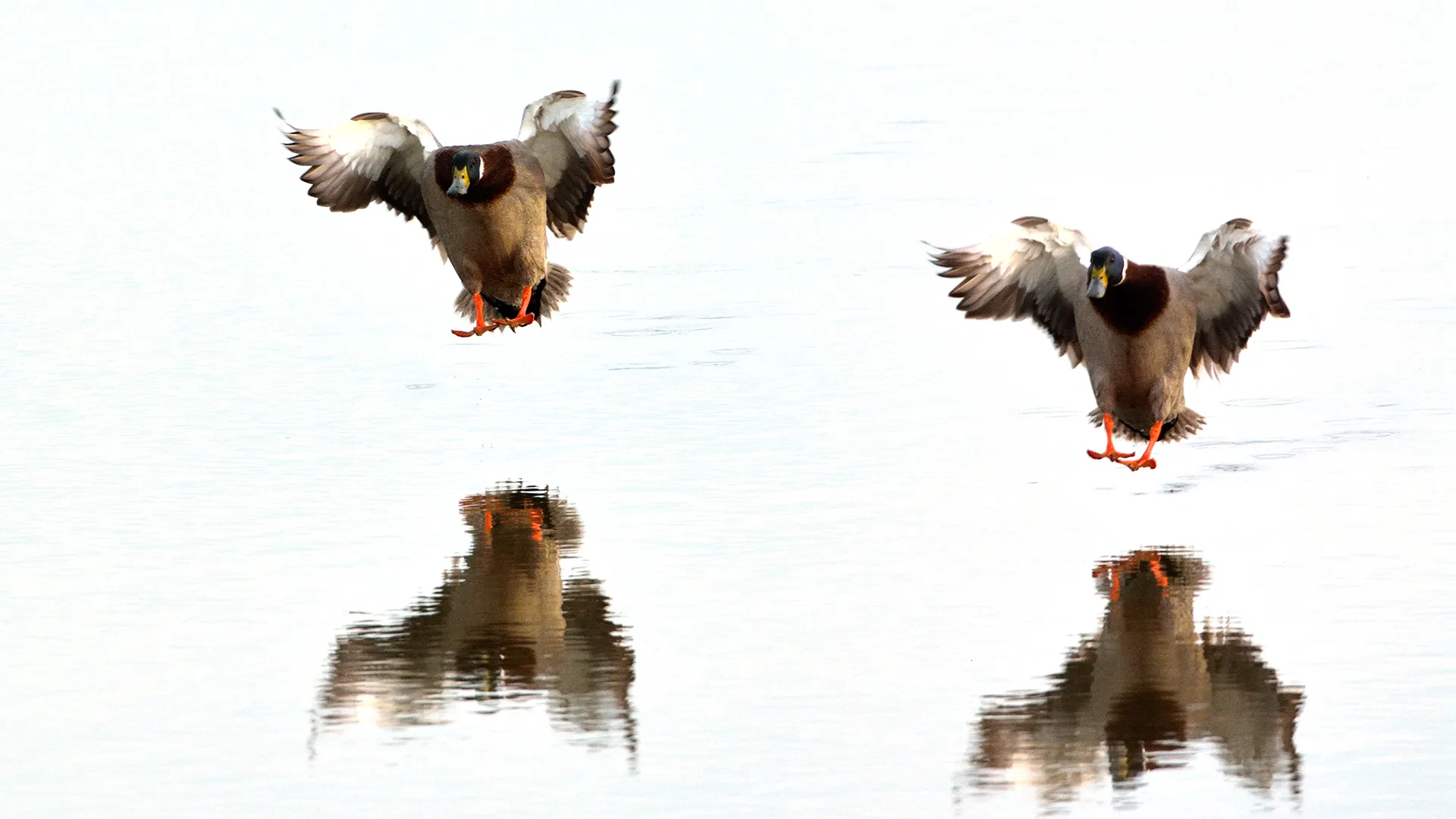
The drake has a glossy green head, a narrow white collar, a chestnut breast, a pale gray body and a yellow bill. The black, curled feathers above the tail are unique to the male. The female is mottled brown, with a dark line through the eye and an orange bill marked with dark.
Both sexes show a blue speculum, bordered with white in front and behind, which is visible on the water and in flight. In summer, after breeding, the drakes molt into a dull “eclipse” plumage and look much like the females for a few weeks. The yellow bill still gives them away.
The loud, descending series of quacks that most people think of as the “duck call” is given only by the female. The drake has a quieter, nasal voice.
Life in the Danube Delta
Mallards use almost every wet habitat in the Danube Delta, from the large lakes to the smallest ditches. They feed at the surface and by upending, taking seeds, plants and small animals, and in autumn and winter they often fly out at dusk to feed on the fields around the Danube Delta and in Dobrogea.
Romania reported 76,600–147,000 breeding pairs for 2013–2015, with an increasing trend, and 54,300–229,000 wintering birds for 2013–2018. In winter many Mallards from northern and eastern Europe join the local birds. During the January 2026 waterbird count, 183,086 Mallards were recorded in Romania, compared with 292,272 in January 2025, making it the most numerous waterbird in the count, apart from the geese, which were counted separately.
Breeding
Pairs form in autumn and winter, long before nesting. The female builds the nest on the ground, usually well hidden in reeds, grass or under bushes, sometimes in a hollow tree or on an old stump. She incubates alone, and soon after the eggs hatch she leads the ducklings to the water. The drake leaves the female during incubation and joins other males to molt.
During the main molt, Mallards lose all their flight feathers at once and cannot fly for about a month. In this period they stay hidden in dense vegetation.
Interesting facts
- Sleeping with one eye open. In a famous experiment published in Nature in 1999, Mallards sleeping in a row slept more often with one half of the brain awake and one eye open when they were at the exposed end of the row. The open eye was usually turned away from the other ducks, towards possible danger.
- Ancestor of the farmyard duck. Almost all domestic duck breeds, including the Pekin duck, descend from the Mallard. Only the Muscovy Duck has a different wild ancestor. Genomic studies suggest that the ancestors of domestic ducks separated from wild Mallards thousands of years ago.
- Bills that are changing. In parts of Europe, huge numbers of farm-reared Mallards are released every year for hunting; in France alone more than one million. A study in Sweden, Norway and Finland found that today’s wild Mallards have shorter, higher and wider bills than museum birds collected before 1971, shifting towards the shape of farmed birds.
- Long life for a duck. The longevity record for a ringed Mallard in Britain is more than 20 years, although the typical life expectancy of an adult is about three years.
- “Flat-billed”. The scientific name platyrhynchos comes from Greek and means “broad” or “flat-billed”.
Status and conservation
The Mallard is one of the most widespread birds in the world and is listed as Least Concern on the global IUCN Red List. In Romania it is a game species, hunted from 1 September to 15 February. Its large populations depend on the same healthy wetlands as many rarer species, and the release of farm-reared birds for hunting is now seen as a risk for the genetic quality of wild populations.
See it on our tours
On our multi-day photo tours in the Danube Delta, Mallards are often the first birds in front of the lens. In the soft light of early morning, the drakes’ green heads and the females leading their ducklings along the reed edges make excellent subjects for practising bird photography.
See it with us
Our birding guides are biologists and ornithologists who are on the water every day of the year. Small groups, open boats, the best hours of the day.
Keep reading
Keep reading
More from the blog
2 min read
Black-tailed Godwit (Limosa limosa)
A long-billed wader with a bold wing stripe. Black-tailed Godwit occurs on passage and is a very rare breeder in the Danube Delta region.
5 min read
Common Pochard (Aythya ferina)
Meet the Common Pochard, a red-headed diving duck now Vulnerable worldwide: identification, feeding, breeding in the Danube Delta, migration and status.
3 min read
Little Bustard (Tetrax tetrax)
The Little Bustard, a rare steppe bird that once bred in Dobrogea: identification, its leaping courtship display, diet and where it still appears in...