


No. 52 on our checklistCommon Cuckoo (Cuculus canorus)
The Common Cuckoo in the Danube Delta: how to recognize it, how females trick reed warblers into raising their young, migration to Africa and status.
The Common Cuckoo (Cuculus canorus) is heard far more often than it is seen. From late April to July its two-note call carries across the reed beds, willow forests and sandy ridges of the Danube Delta, where it is one of the most common summer visitors.
It is also one of the most remarkable birds in Europe: the female never builds a nest, and every young cuckoo is raised by foster parents of another species.
Quick facts
Quick facts
- Scientific name Cuculus canorus Linnaeus, 1758
- Common name Common Cuckoo; also Eurasian Cuckoo
- Family Cuculidae (cuckoos)
- Order Cuculiformes (cuckoos)
- Length 32–34 cm
- Wingspan 58 cm
- Weight 110–130 g
- Diet mainly large insects, especially hairy caterpillars that most other birds avoid; also beetles and other invertebrates
- Habitat reed beds, wetlands with scattered trees, forest edges, riverine woods, orchards and open country with bushes
- Breeding a brood parasite: the female lays one egg in each host nest, usually removing one host egg; the cuckoo chick hatches after about 12 days and evicts the host eggs or chicks
- Conservation status Least Concern (global IUCN Red List); Least Concern on the Romanian Red List (2022)
When to see it in the Danube Delta and Dobrogea
- JanIn Africa
- FebIn Africa
- MarIn Africa
- AprFirst arrivals, calling males
- MayCalling, egg-laying
- JunEgg-laying, young in host nests
- JulYoung cuckoos fed by hosts
- AugAdults leave, juveniles follow
- SepLast juveniles
- OctIn Africa
- NovIn Africa
- DecIn Africa
- Status here
- Summer visitor and breeder, from late April to August; winters in Africa south of the Sahara.
- IUCN Red List
- Least Concern
- Our checklist
- No. 52 of 385 · see the full checklist
How to recognize it
The Common Cuckoo is about the size of a small pigeon, with long, pointed wings and a long, rounded tail spotted with white. Males are blue-gray above and on the breast, with fine dark barring on the white belly. Most females look similar, but some are rufous-brown and heavily barred all over. Juveniles are brown or gray-brown, barred, with a small white patch on the nape.
In flight the cuckoo looks surprisingly like a small hawk, especially a Eurasian Sparrowhawk, but its wingbeats stay below the level of the body and its head is small. The famous “cuck-oo” call is given by the male. The female has a completely different, bubbling call.
Life in the Danube Delta
Cuckoos arrive in the Danube Delta in the second half of April and are heard everywhere by early May. They perch on willows, poplars, dead trees and wires above the reed beds, watching the hosts building their nests below. The rich reed beds of the Danube Delta, full of warblers, make it ideal cuckoo country.
In Romania, the Common Cuckoo is a widespread breeding bird. National estimates based on the Common Bird Monitoring programme give 300,000–600,000 pairs, with a stable trend in recent years.
A life raised by others
The female cuckoo watches the host nests, waits until the host has started laying and then visits the nest when the owners are away. She removes one host egg and lays one of her own in a matter of seconds. Each female specializes in one host species, and her eggs often resemble the eggs of that host in color and pattern.
In reed beds like those of the Danube Delta, the Great Reed Warbler and the Eurasian Reed Warbler are typical hosts. In a heavily parasitized population of Great Reed Warblers in central Hungary, about 64% of the nests received a cuckoo egg.
The cuckoo egg usually hatches before the host eggs. Within one to three days, while still blind and naked, the cuckoo chick pushes every host egg or chick over the edge of the nest. From then on the foster parents feed only the cuckoo, which soon grows much larger than they are.
Migration
Adult cuckoos leave early: many depart in July and August, as soon as the females have finished laying. The young cuckoos stay behind in the care of their foster parents and set off later, alone. Without ever meeting their real parents, they find their way to the wintering grounds in Africa south of the Sahara. Satellite tracking of cuckoos from western Europe has shown how long these journeys are, with stopovers in southern Europe and in the Sahel before the final crossing to the rainforest belt of Africa.
Interesting facts
- Disguised as a hawk. Experiments with Eurasian Reed Warblers showed that the barred underparts of the cuckoo, similar to those of a Sparrowhawk, make the hosts more cautious about approaching and mobbing it. The female’s bubbling call also resembles the call of a Sparrowhawk, which distracts the hosts while she lays.
- Egg types passed down the female line. Cuckoo females form host-specific “races”, called gentes, each laying a distinctive type of egg. Genetic studies have shown that these races are limited to female lineages, and that the blue egg color of some cuckoos is inherited from mother to daughter. Cuckoos from Romania were among the birds sampled.
- An egg that is already developing. The female keeps each egg inside her body for about 31 hours before laying it, so the embryo has already started to develop at the body temperature of the mother. This internal incubation gives the cuckoo chick a head start and helps it hatch before the host chicks.
- A taste for hairy caterpillars. Adult cuckoos eat many hairy and brightly colored caterpillars that other birds avoid because of their irritating hairs or toxins.
- Five cuckoo eggs in one nest. Where cuckoos are very common, several females may use the same host nest. Researchers once found a Great Reed Warbler nest containing five cuckoo eggs.
Status and conservation
The Common Cuckoo is listed as Least Concern on the global IUCN Red List and on the Romanian Red List (2022). In western Europe, especially in Britain, it has declined strongly, and studies link the decline to changes on the migration routes and the wintering grounds as well as to a lack of large caterpillars. In Romania numbers appear stable. The health of the cuckoo depends directly on its hosts, and the reed beds of the Danube Delta, rich in warblers, are among the best places for the species in Europe.
See it on our tours
On our multi-day birdwatching tours in the Danube Delta and Dobrogea, the cuckoo is a constant companion from late April to July. We often watch females on the reed edges, looking for warbler nests, and later in the season we see young cuckoos being fed by their much smaller foster parents.
See it with us
Our birding guides are biologists and ornithologists who are on the water every day of the year. Small groups, open boats, the best hours of the day.
Keep reading
Keep reading
More from the blog
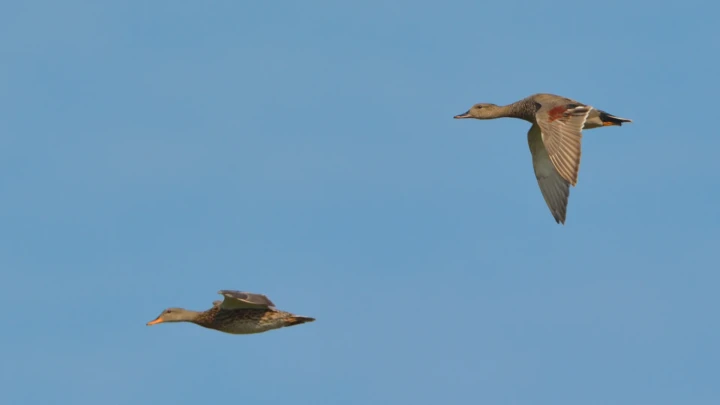
4 min read
Gadwall (Mareca strepera)
Meet the Gadwall, a plant-eating dabbling duck that steals food from coots: identification, breeding in the Danube Delta, autumn migration and status.
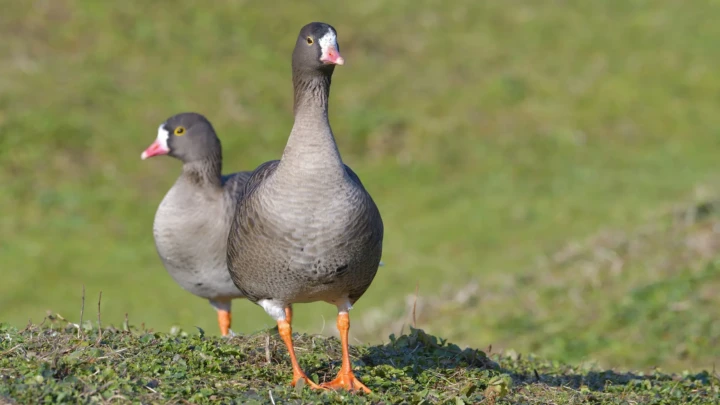
3 min read
Lesser White-fronted Goose (Anser erythropus)
The Lesser White-fronted Goose, one of the most threatened geese in the world, hiding among wintering flocks in Dobrogea: how to find and identify...
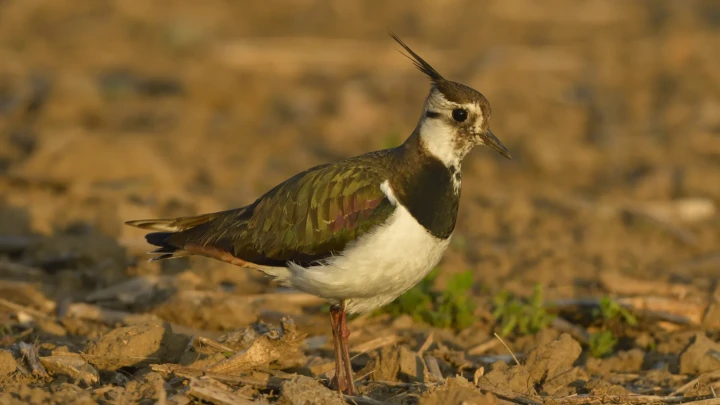
2 min read
Northern Lapwing (Vanellus vanellus)
A long crest and broad rounded wings identify the Northern Lapwing, present all year in the Danube Delta and Dobrogea.