

No. 209 on our checklistEuropean Bee-eater (Merops apiaster)
The European Bee-eater, one of the most colourful birds in Europe: identification, how it disarms bees, colonies in sand banks and where to see it in Dobrogea.
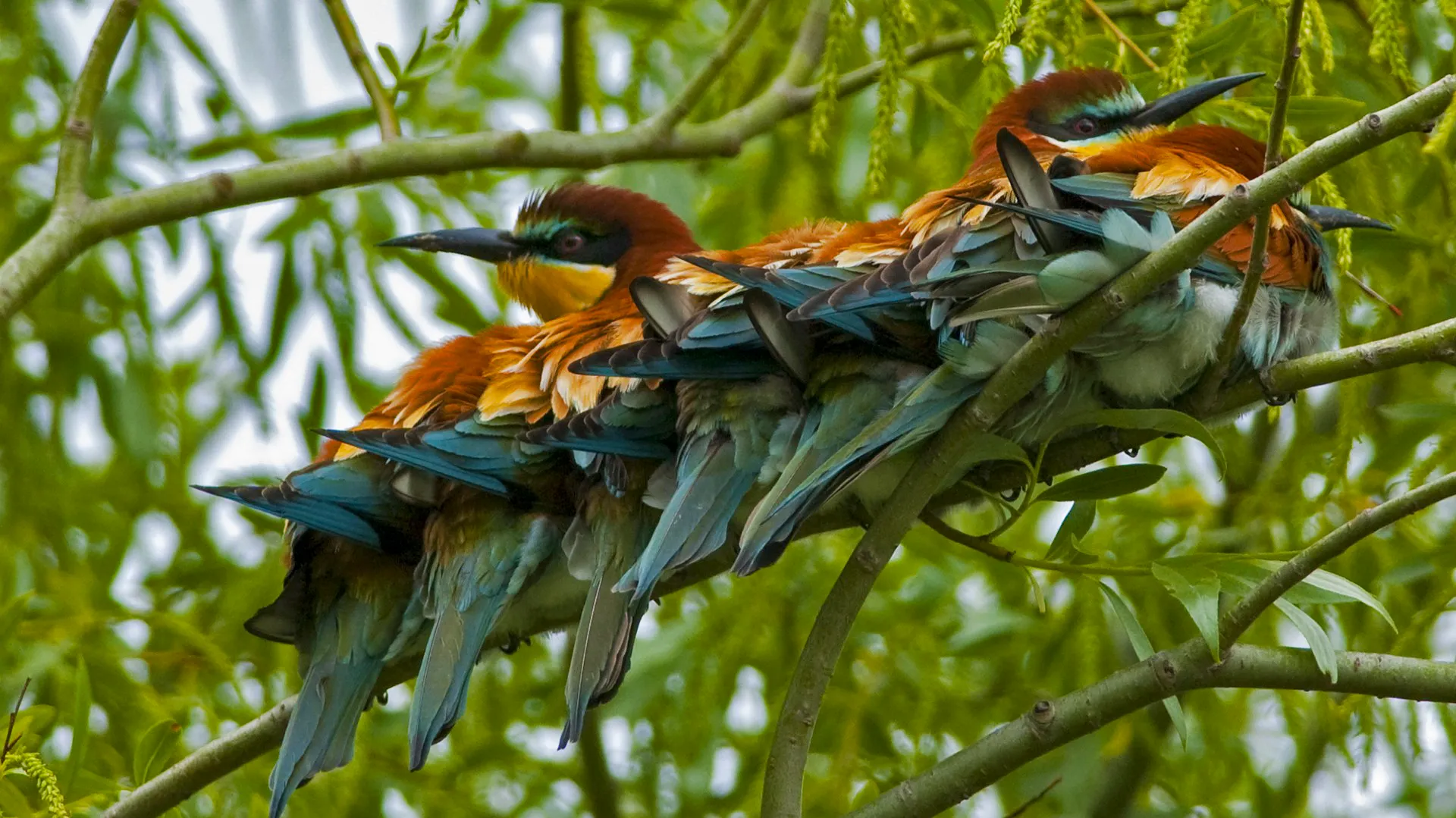
A liquid “prruup prruup” comes from above, and only then do you see the flock: birds of almost tropical colours, yellow, chestnut and turquoise, gliding and wheeling after insects. The European Bee-eater is one of the most colourful birds in Europe and a familiar sight of summer in Dobrogea and around the edges of the Danube Delta.
Quick facts
- Scientific name Merops apiaster
- Family Meropidae (bee-eaters)
- Length 25-29 cm, including the long central tail feathers
- Wingspan 36-40 cm
- Weight about 45-78 g
- In Dobrogea and the Danube Delta summer breeder, May to September
When to see it in the Danube Delta and Dobrogea
- JanAbsent
- FebAbsent
- MarAbsent
- AprRare
- MayModerate
- JunModerate
- JulModerate
- AugModerate
- SepModerate
- OctAbsent
- NovAbsent
- DecAbsent
- Status here
- Summer breeder. Common in summer.
- IUCN Red List
- Least Concern
- Our checklist
- No. 209 of 385 · see the full checklist
Identification
The adult has a chestnut crown and back, yellow shoulders, a golden yellow throat bordered by a black line, a black mask through the eye, a turquoise blue breast and belly, and a bluish green tail with two long, pointed central feathers. The bill is long, black and slightly curved. The female has more green on the back. Juveniles are duller and lack the long tail feathers.
Hunting
The bee-eater catches insects in flight: bees, wasps, bumblebees, dragonflies, butterflies and flying beetles. From a wire or a dead branch it sallies out after an insect, snaps it up and returns to its perch. Before swallowing a bee or a wasp, it beats it against the branch and rubs it on the wood until the sting and venom are removed. It eats up to 200 insects a day.
Nest and young
Bee-eaters nest in groups, in sand and loess banks, on the edges of gullies, quarries and riverbanks. Male and female dig together, with bill and feet, a tunnel one or two metres long ending in a nest chamber. The female lays five to seven white eggs, incubated by both parents for about 20 days. Many pairs have a “helper”, usually a young male related to the pair, who also brings food to the chicks.
Where and when to see it
Bee-eaters arrive from Africa at the beginning of May and leave at the end of August and in September. You see them all over Dobrogea, especially where there are loess and sand banks, on wires along roads and over grasslands, and in the Danube Delta on the sandy levees at Letea and Caraorman. For photographers, our private photo tour from hides for bee-eaters, rollers and Little Owls in Dobrogea runs from early May to the end of July, and there are also self-guided bee-eater photo hides.
Interesting facts
- It removes the bee’s sting. The bee-eater has a precise routine for stinging insects: it beats and rubs them on a branch until the venom is squeezed out, then swallows them.
- Families with helpers. Cooperative breeding, with helpers at the nest, is rare among European birds; the bee-eater is one of the few examples.
- Moving north. In recent decades the bee-eater has spread into northern Europe and now breeds in Poland and even England.
- Pellets. The hard parts of insects, wings and chitin, are coughed up as small pellets, which you can find under their favourite perches.
Status and threats
The European Bee-eater breeds in southern and central Europe, North Africa and western Asia and is listed as Least Concern (LC) by the IUCN. The main threats are the destruction of the banks it nests in, concreting and levelling of gullies, pesticides that remove its insect prey, and persecution by some beekeepers.
See it with us
Our birding guides are biologists and ornithologists who are on the water every day of the year. Small groups, open boats, the best hours of the day.
Keep reading
Keep reading
More from the blog

5 min read
Purple Heron (Ardea purpurea)
The heron of the reed beds: once the most common heron of the Danube Delta, now second to the Grey Heron, and the reason...
2 min read
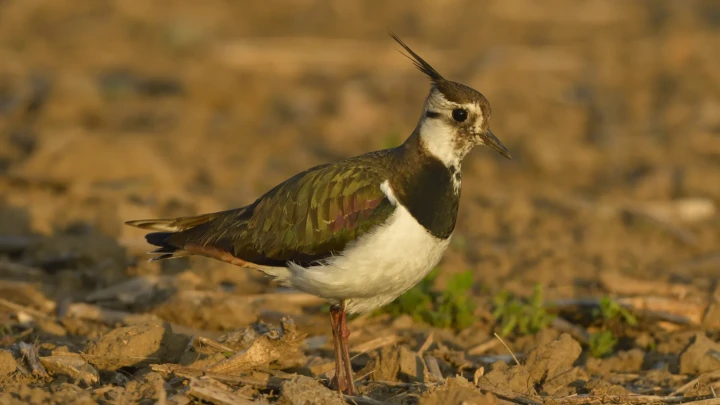
Northern Lapwing (Vanellus vanellus)
A long crest and broad rounded wings identify the Northern Lapwing, present all year in the Danube Delta and Dobrogea.

4 min read
Isabelline Wheatear (Oenanthe isabellina)
A pale sandy wheatear that sings from the top of a mound and often nests in an old ground squirrel burrow.