

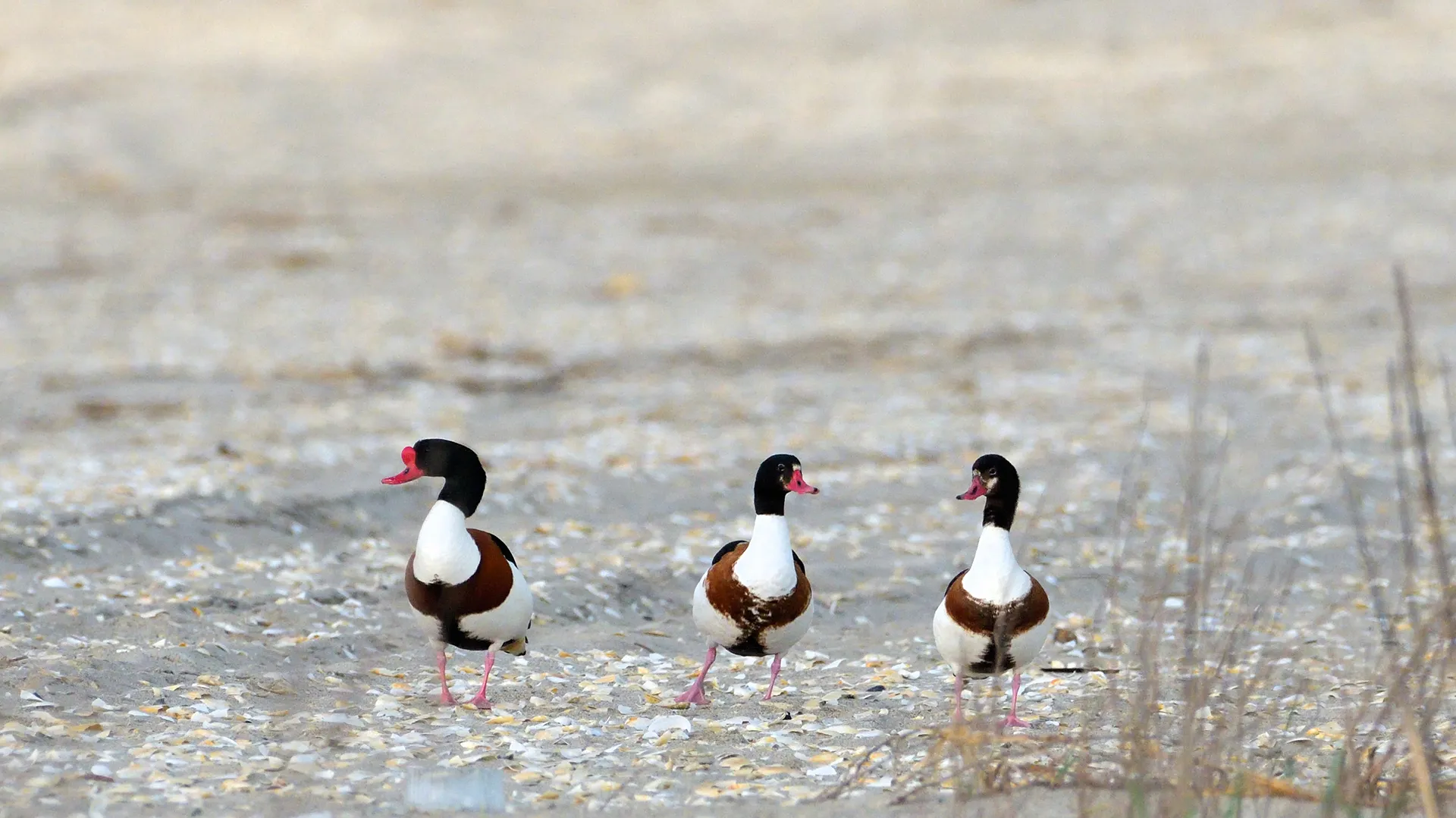
No. 18 on our checklistCommon Shelduck (Tadorna tadorna)
The Common Shelduck, a big black and white duck of the coastal lagoons that nests in fox burrows: identification, diet, crèches and where to see it.
On the muddy shores of the coastal lagoons, a large white and black duck with a bright red bill and a chestnut band across the breast sieves the mud with wide sweeps of its head. This is the Common Shelduck, a bird halfway between ducks and geese, which nests in old fox or rabbit burrows in the dunes.
Quick facts
- Scientific name Tadorna tadorna
- Family Anatidae (ducks, geese and swans)
- Length 58-64 cm
- Wingspan 110 cm
- Weight 1-1.2 kg
- In the Danube Delta and Dobrogea present all year, mainly on the coast and in lagoons
When to see it in the Danube Delta and Dobrogea
- JanModerate
- FebModerate
- MarModerate
- AprModerate
- MayModerate
- JunModerate
- JulModerate
- AugModerate
- SepModerate
- OctModerate
- NovModerate
- DecModerate
- Status here
- All year. Resident, breeding.
- IUCN Red List
- Least Concern
- Our checklist
- No. 18 of 385 · see the full checklist
Identification
It is larger than a Mallard and looks white from a distance, with a black, green glossed head and neck, a broad chestnut band around the breast and shoulders, a belly with a black central stripe and black and white wings with a green speculum. The bill is bright red, and in spring the male has a fleshy red knob at its base. The legs are pink. The female is slightly smaller, without the knob and with a duller pattern. Juveniles are greyish brown and white, without the chestnut band.
Diet
The shelduck feeds in very shallow water and on exposed mud, sweeping its bill from side to side through the mud like a scythe and filtering out small invertebrates. Its main food is small saltwater snails, small crustaceans, insect larvae and worms, which is why you see it mostly in the salt and brackish lagoons on the coast.
Nest and young
It nests in holes: old fox or rabbit burrows, tree holes, hollows under bushes or in banks, sometimes hundreds of metres from water. The female lays eight to ten eggs and incubates them alone for about 30 days, while the male guards the territory. After hatching, the parents walk the chicks to the water. Chicks from several pairs often gather in crèches, led by a few adults.
Where and when to see it
You see it mainly on the coast of the Danube Delta and in the lagoons of Dobrogea: Razim, Sinoie, Sacalin, the Murighiol salt marshes. In spring and summer it breeds in the dunes and on the levees near the sea, and in winter it gathers in flocks on unfrozen water. Inside the Danube Delta, on the freshwater lakes, it is scarcer.
Interesting facts
- A migration to moult. In summer most shelducks of western Europe fly to the Wadden Sea, on the German coast, to moult their flight feathers, and tens of thousands of birds stay there for weeks unable to fly. The young stay behind in crèches, with a few adults.
- Between duck and goose. Shelducks are close relatives of ducks, but resemble geese in size, in males and females looking almost alike, and in their stable pairs.
- An underground nest. Few ducks nest in burrows; the shelduck even uses burrows occupied by foxes, which apparently leave it alone.
Status and threats
The Common Shelduck is widespread on the coasts of Europe and in Central Asia and is listed as Least Concern (LC) by the IUCN. Many shelducks once nested on Popina Island in Lake Razim, until livestock were brought there to graze; today none breed there. Grazing on the coastal levees, disturbance at the nest and the loss of lagoons are the main threats.
See it with us
Our birding guides are biologists and ornithologists who are on the water every day of the year. Small groups, open boats, the best hours of the day.
Keep reading
Keep reading
More from the blog
4 min read
Common Buzzard (Buteo buteo)
The raptor on every roadside pole in winter: the Common Buzzard and its eastern form, the Steppe Buzzard, in the Danube Delta and Dobrogea,...

5 min read
Common Cuckoo (Cuculus canorus)
The Common Cuckoo in the Danube Delta: how to recognize it, how females trick reed warblers into raising their young, migration to Africa and...
5 min read
Mute Swan (Cygnus olor)
Meet the Mute Swan, a truly wild, year-round resident of the Danube Delta: how to recognize it, nesting in the reeds, when to see...