

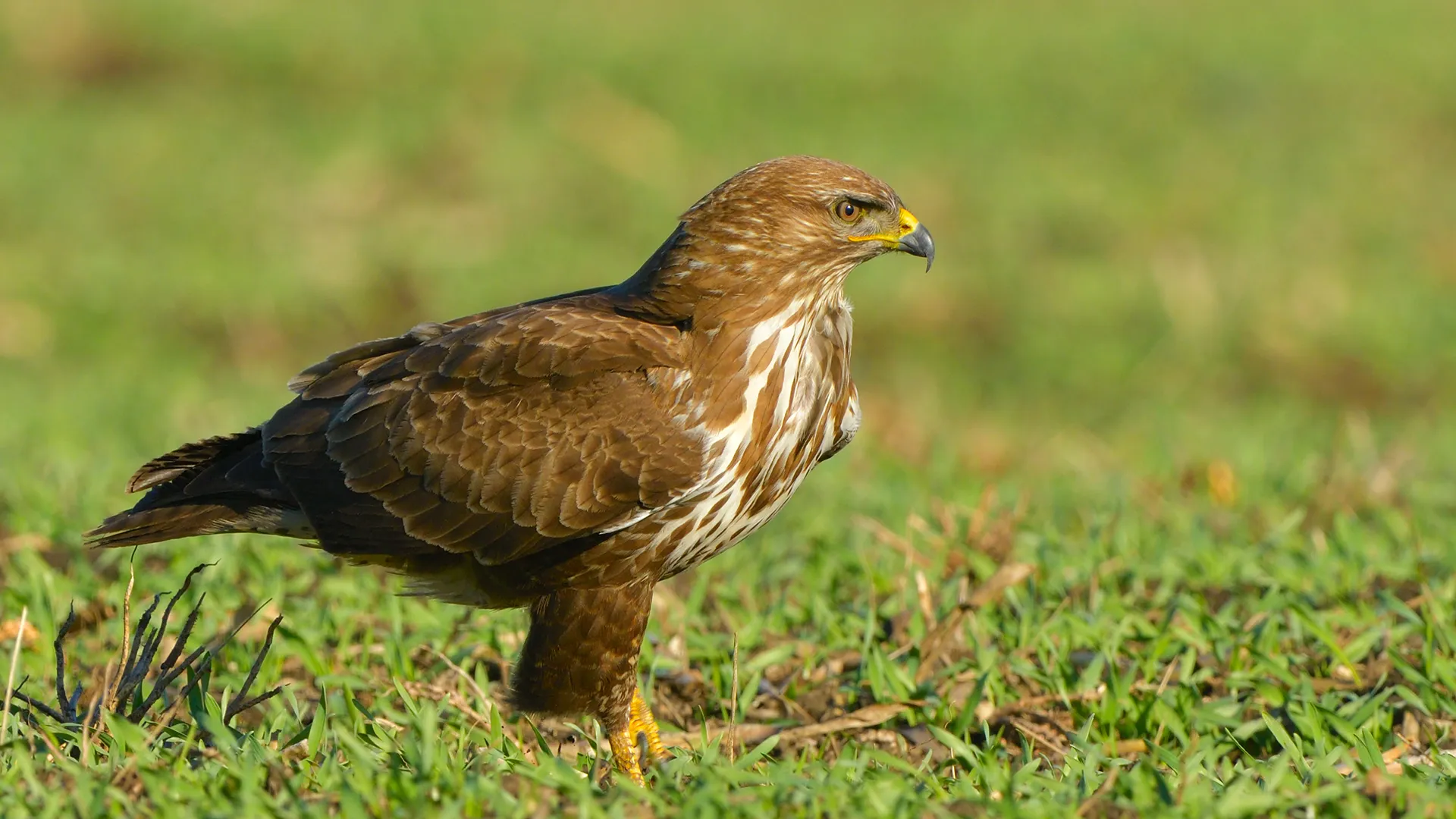
No. 204 on our checklistCommon Buzzard (Buteo buteo)
The raptor on every roadside pole in winter: the Common Buzzard and its eastern form, the Steppe Buzzard, in the Danube Delta and Dobrogea, from mass autumn migration to wintering birds.
The Common Buzzard (Buteo buteo) is one of the most widespread birds of prey of Europe. In the Danube Delta and Dobrogea it breeds only in small numbers, but from autumn to spring it becomes the most common raptor of the open country, perched on poles, trees and haystacks along the roads.
In September and October, Dobrogea also sees a strong migration of buzzards, including the smaller, rufous Steppe Buzzard (Buteo buteo vulpinus) from the east.
Quick facts
Quick facts
- Scientific name Buteo buteo (Linnaeus, 1758); the Steppe Buzzard is the eastern subspecies B. b. vulpinus, sometimes treated as a separate species, Buteo vulpinus
- Common name Common Buzzard, also called Eurasian Buzzard
- Family Accipitridae (hawks, eagles and buzzards)
- Order Accipitriformes
- Weight about 830 g on average (adults), from about 620 g to more than 1.2 kg; females are larger than males
- Diet mainly small mammals, especially voles; rabbits where they are common; the diet varies between areas and years
- Habitat woodland edges and tree belts for nesting; open fields, pastures and meadows for hunting
- Breeding one brood a year; usually 2–3 eggs, incubated for about 34 days; young fly at about 44–52 days
- Conservation status Least Concern (global IUCN Red List); Least Concern on the Romanian Red List (2022)
When to see it in the Danube Delta and Dobrogea
- JanWintering birds
- FebWintering birds
- MarSpring passage
- AprSpring passage
- MayFew breeding pairs
- JunFew breeding pairs
- JulFew breeding pairs
- AugFirst migrants
- SepAutumn passage
- OctAutumn passage peak
- NovWintering birds
- DecWintering birds
- Status here
- Rare breeding bird; very common on migration and in winter, from September to April.
- IUCN Red List
- Least Concern
- Our checklist
- No. 204 of 385 · see the full checklist
How to recognize it
The Common Buzzard is a medium-sized, compact raptor with broad, rounded wings, a short neck and a short, fan-shaped tail. Plumage varies a lot: some birds are almost entirely dark brown, others pale with a dark belly band, and many are in between. In soaring flight it holds its wings in a shallow V. A pale band across the breast and dark wrist patches under the wings are typical. The call is a far-carrying, mewing “pee-yow”.
Two similar birds are common here. The Long-legged Buzzard is larger, with a pale head, rusty unbarred tail and longer wings. The Rough-legged Buzzard, a winter visitor, has a white tail with a dark terminal band and often hovers. Steppe Buzzards are smaller and more rufous than western Common Buzzards and can be hard to separate from young Long-legged Buzzards.
Winter on the plains
The Common Buzzard is a partial migrant in eastern Europe. In winter, birds from the north and east join local ones, and buzzards become a familiar sight over the fields of Dobrogea and the edges of the Danube Delta. A study of wintering buzzards in eastern Romania between 2010 and 2015, using 40 km road transects, found an average density of 0.54 birds per square kilometre, with the highest numbers in December. Buzzards preferred pastures and herbaceous vegetation for hunting, and their numbers increased when cold weather in north-eastern Europe pushed birds south.
A river of buzzards in autumn
Dobrogea lies on the migration route of raptors heading from eastern Europe towards the Bosphorus. In the Măcin Mountains, autumn counts between 2003 and 2007 recorded an average of more than 6,250 buzzards a year, 55.6% of all raptors counted. The median passage date was 4 October. The count includes both Common Buzzards and Steppe Buzzards, which do not always separate easily in the field. On the eastern coast of the Black Sea, at Batumi in Georgia, spring counts averaged about 194,000 Steppe Buzzards a year.
Interesting facts
- Dark, pale or in between. Buzzard plumage is strongly inherited. A long-term study in the Netherlands estimated the heritability of plumage colour at 0.82 and showed that it is controlled by several genes, not by a single gene as long believed.
- A remarkably long life. The oldest ringed Common Buzzard in Britain lived 30 years, 5 months and 21 days.
- Weather forecasters of the plains. In eastern Romania, wintering buzzard numbers rose when temperatures dropped in north-eastern Europe in the two weeks before the counts, as cold weather pushed birds south.
- A comeback story. In Britain the Common Buzzard reached a low point in the middle of the 20th century, after years of persecution. With less persecution, the recovery of rabbits and the end of organochlorine pesticides it has come back strongly, and its population increased by 76% between 1995 and 2024.
Status and conservation
The Common Buzzard is listed as Least Concern on the global IUCN Red List. In Romania it is Least Concern on the Romanian Red List (2022), with an average estimate of about 28,400 breeding pairs and an uncertain trend.
See it on our tours
On our multi-day Danube Delta discovery tours from October to April, buzzards are part of almost every journey across Dobrogea, perched on poles or hovering over the fields. In early October, a raptor watch from the hills can turn into a stream of migrating buzzards.
See it with us
Our birding guides are biologists and ornithologists who are on the water every day of the year. Small groups, open boats, the best hours of the day.
Keep reading
Keep reading
More from the blog
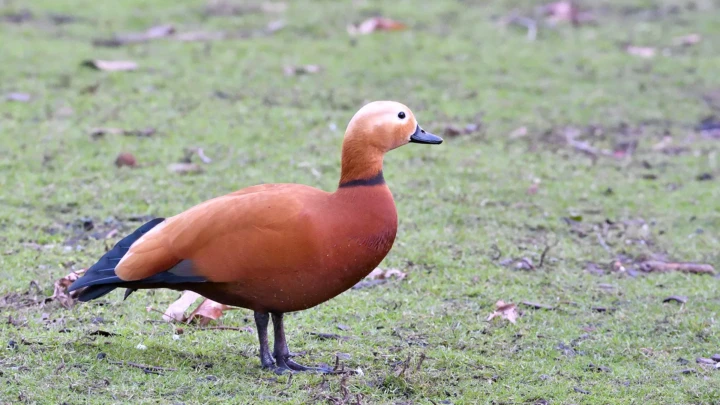
3 min read
Ruddy Shelduck (Tadorna ferruginea)
The Ruddy Shelduck, an orange duck of Asian steppes and salt lakes at the western edge of its range in Dobrogea: identification, nesting and...

5 min read
Great Egret (Ardea alba)
Tall, pure white and elegant: the Great Egret nests in the mixed heron colonies of the Danube Delta and can be seen here all...

5 min read
Caspian Gull (Larus cachinnans)
Long legs, a small pear-shaped head and a laughing call: how to recognize the Caspian Gull in the Danube Delta, its range expansion and...