

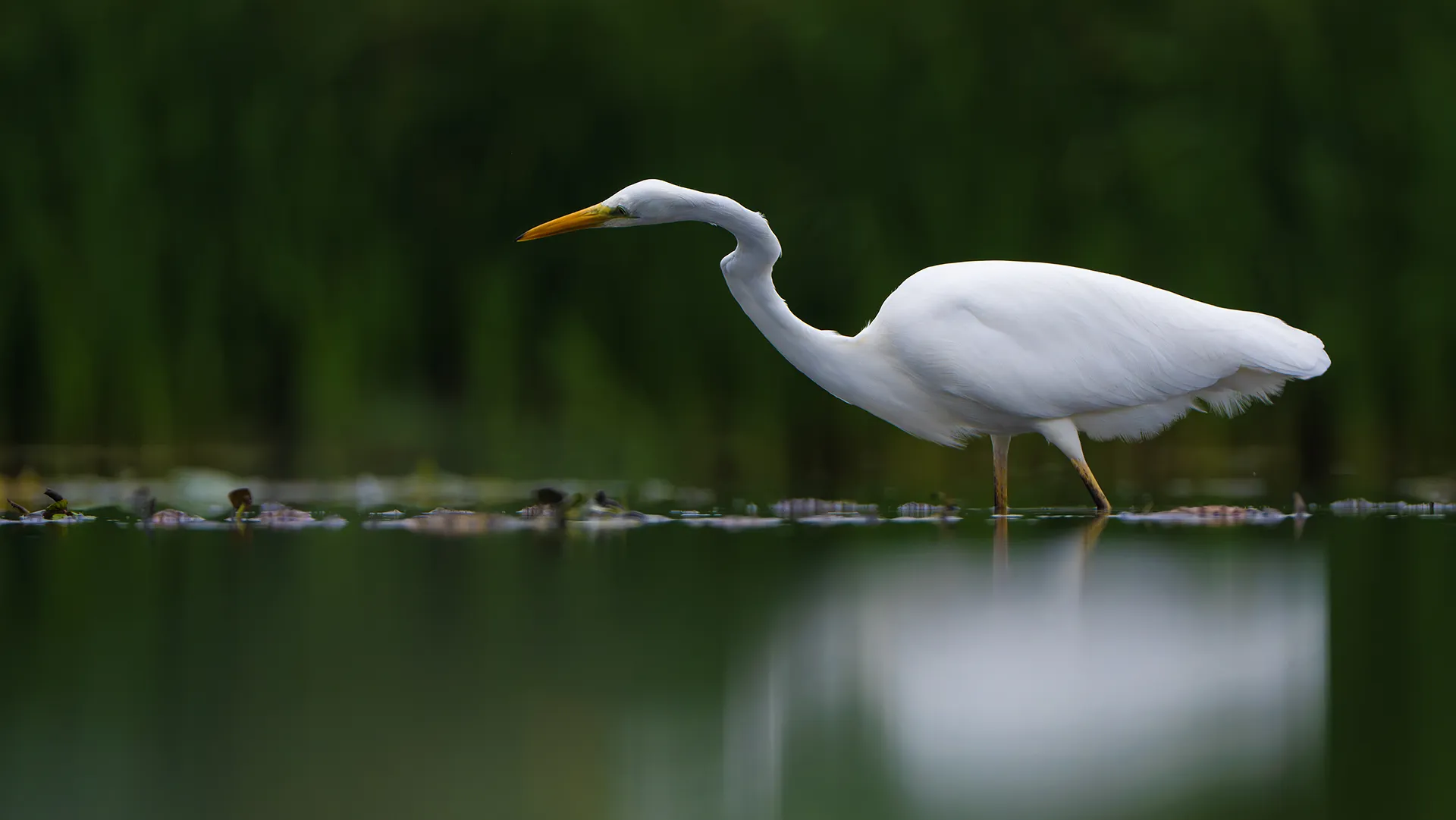
No. 165 on our checklistGreat Egret (Ardea alba)
Tall, pure white and elegant: the Great Egret nests in the mixed heron colonies of the Danube Delta and can be seen here all year, with a peak in late summer.
The Great Egret (Ardea alba) is the largest white heron of Europe. In the Danube Delta it nests in mixed colonies with other herons, cormorants and ibises, and hunts in shallow lakes, channels, fish ponds and flooded meadows.
Unlike most herons here, it does not leave the Danube Delta completely in winter. Some birds stay through the winter, and numbers grow again in late summer, when young birds and migrants gather in the shallows.
Quick facts
Quick facts
- Scientific name Ardea alba Linnaeus, 1758; formerly Egretta alba and Casmerodius albus
- Common name Great Egret, also called Great White Egret
- Family Ardeidae (herons, egrets and bitterns)
- Order Pelecaniformes
- Length about 1 m
- Wingspan about 1.5 m
- Weight about 0.9–1.1 kg; males average larger than females
- Diet mainly fish, also frogs, snakes, crayfish, aquatic insects, grasshoppers and small mammals such as mice
- Habitat shallow lakes, channels, reedbed edges, fish ponds, flooded meadows and wet fields
- Breeding colonial; nests high in trees or reeds; usually 3–4 eggs, incubated by both parents for a little over three weeks; young fly at about 6 weeks
- Conservation status Least Concern (global IUCN Red List); Least Concern on the Romanian Red List (2022)
When to see it in the Danube Delta and Dobrogea
- JanWintering birds
- FebWintering birds
- MarBirds return to colonies
- AprNesting in colonies
- MayChicks in the nest
- JunYoung fledge
- JulPost-breeding gatherings
- AugPost-breeding gatherings
- SepLate-summer peak
- OctMigrants leave
- NovWintering birds
- DecWintering birds
- Status here
- Present all year and partially migrant: breeds in colonies in the Danube Delta, is most numerous in late summer and is seen in smaller numbers in winter.
- IUCN Red List
- Least Concern
- Our checklist
- No. 165 of 385 · see the full checklist
How to recognize it
The Great Egret is a very large, entirely white heron with a long, slender, kinked neck and long dark legs. Its size is the best clue: it stands almost as tall as a Grey Heron. In the breeding season the bill turns mostly black, the bare skin between bill and eye becomes bright green, and long lacy plumes grow from the back. Outside the breeding season the bill is yellow.
The Little Egret is also white but much smaller, with a black bill all year and yellow feet. The Western Cattle Egret is smaller still, stocky and short-necked. In flight, the Great Egret moves with slow, deep wingbeats, the neck folded back and the long legs projecting well beyond the tail.
Life in the heron colonies
In the Danube Delta, Great Egrets breed in mixed colonies together with other herons, Pygmy Cormorants, Glossy Ibises and Eurasian Spoonbills. A study of colonies in the Danube Delta Biosphere Reserve between 2016 and 2023 describes the Great Egret as an early nester that builds its nest high in the canopy, so it is easiest to count in the first half of April, before the trees are in full leaf. The same study found that its breeding numbers fluctuate strongly from year to year.
The nest is a flimsy platform of sticks, twigs and stems. Both parents incubate the eggs and feed the chicks, which begin to fly at about six weeks old. Great Egrets hunt alone or loosely spaced, standing still or walking slowly through shallow water, then striking fish, frogs or insects with a fast thrust of the bill. Studies have also recorded them stealing food from smaller herons.
A comeback across Europe
In the 19th and early 20th centuries the Great Egret was hunted heavily for the plumes used in fashion. Together with shooting and the draining of wetlands, this caused severe declines. In Hungary, numbers fell from more than 230 pairs in 1835 to 25 pairs in 1916. Plume hunting stopped in eastern Europe in the second decade of the 20th century, and the species slowly recovered.
Since 1980 the Great Egret has spread across Europe. A review published in 2014 gives 257 pairs in nine colonies in the Danube Delta in 2001, and 209 pairs in 11 colonies in 2002, while the Romanian population was estimated at 900–1,000 pairs in 2000–2002. The species has since colonised countries far to the west and north. In Britain, where it first bred in 2012, its winter range has expanded by 7,850% between the early 1980s and 2007–2011.
Interesting facts
- Old strongholds on the Danube. Before its recent spread, the main European breeding areas of the Great Egret were along the Danube in Hungary, Bulgaria and Romania, and near the Black Sea in Ukraine.
- First-year birds face the hardest test. Ringed Great Egrets from a colony in central Poland had an estimated annual survival of 85% as adults, but only 48% in their first year.
- Winter movements depend on the population. The Polish birds of the same study flew almost due west in autumn, wintering on average 883 km away, mostly in the Netherlands and Belgium. First-year birds travelled farther than adults.
- Not afraid to steal. Great Egrets often take food from smaller herons, and can be aggressive even when food is not scarce.
Status and conservation
The Great Egret is listed as Least Concern on the global IUCN Red List. In Romania it is Least Concern on the Romanian Red List (2022), with 400–1,000 breeding pairs. A preliminary assessment placed it higher, because the minimum estimate is small, but the final category was lowered because the species is expanding in numbers and range. Its main needs are undisturbed colonies and shallow, food-rich wetlands; reedbed fires, drainage and disturbance near colonies are among the threats recorded in the region.
See it on our tours
On our multi-day photo tours in the Danube Delta and Dobrogea, Great Egrets are among the most rewarding subjects: white birds against green reeds, fishing in the shallows and taking off in slow, wide wingbeats. Late summer, when many gather along the channels and lakes, is especially good.
See it with us
Our birding guides are biologists and ornithologists who are on the water every day of the year. Small groups, open boats, the best hours of the day.
Keep reading
Keep reading
More from the blog

7 min read
Dalmatian Pelican (Pelecanus crispus)
The Dalmatian Pelican, the largest pelican in the world: how to tell it from the Great White Pelican, fishing, breeding, migration and where to...

5 min read
Grey Partridge (Perdix perdix)
A plump farmland bird of the Dobrogea steppe that freezes in the grass and bursts into flight at your feet

5 min read
Wood Sandpiper (Tringa glareola)
A slim, speckled wader from the northern bogs: how to identify the Wood Sandpiper on passage in the Danube Delta and Dobrogea, and when...