

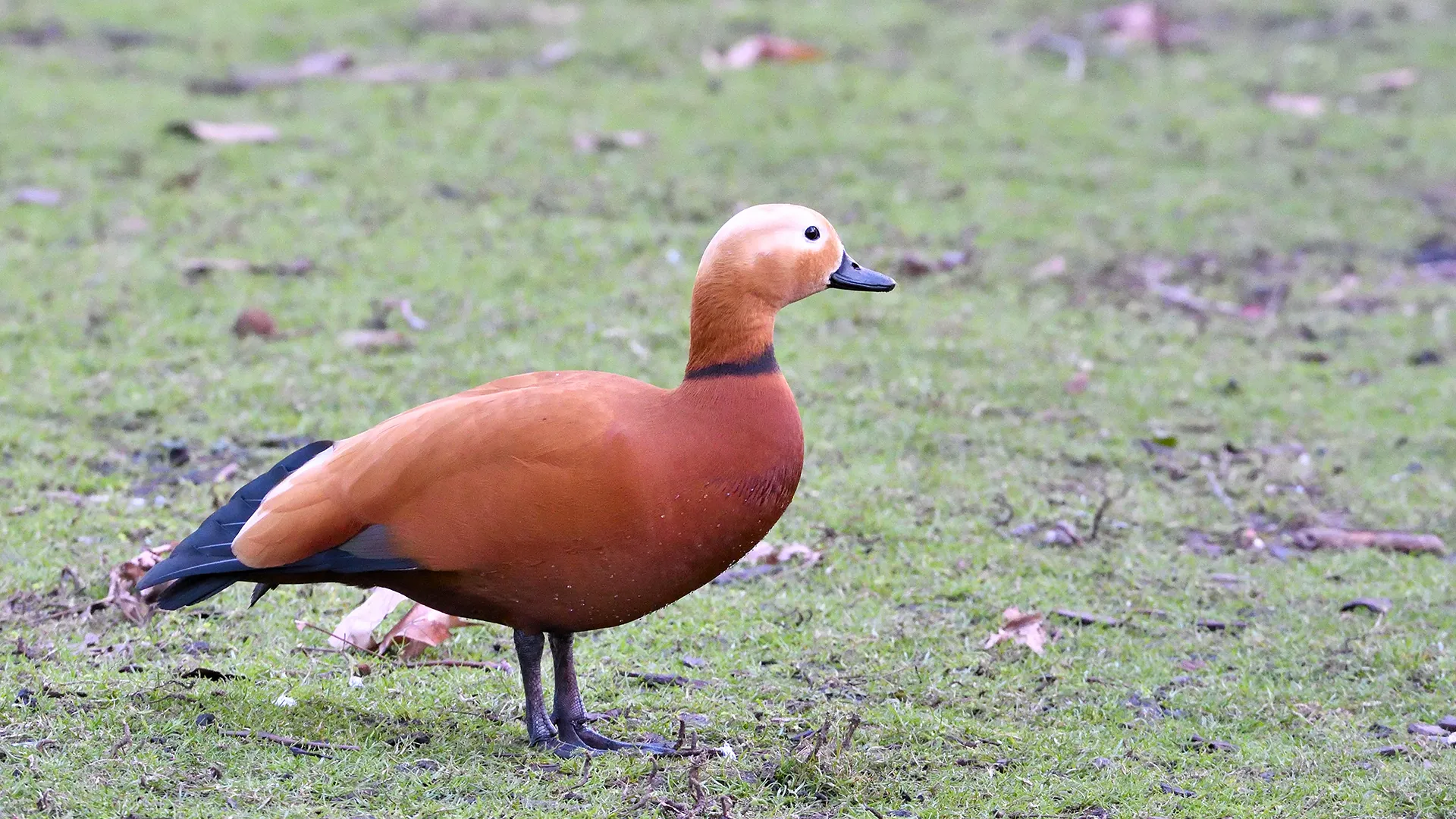
No. 19 on our checklistRuddy Shelduck (Tadorna ferruginea)
The Ruddy Shelduck, an orange duck of Asian steppes and salt lakes at the western edge of its range in Dobrogea: identification, nesting and where to see it.
Rusty orange, with an almost white head and a nasal call that sounds like a toy trumpet: the Ruddy Shelduck is one of the most beautiful ducks in Dobrogea. It is a bird of the steppes and salt lakes of Asia, which reaches us at the western edge of its range.
Quick facts
- Scientific name Tadorna ferruginea
- Family Anatidae (ducks, geese and swans)
- Length 58-70 cm
- Wingspan 110-135 cm
- Weight about 1-1.6 kg
- In Dobrogea and the Danube Delta rare, breeds in small numbers
When to see it in the Danube Delta and Dobrogea
- JanVery rare
- FebVery rare
- MarRare
- AprRare
- MayRare
- JunRare
- JulRare
- AugRare
- SepRare
- OctRare
- NovVery rare
- DecVery rare
- Status here
- All year. Rare breeding.
- IUCN Red List
- Least Concern
- Our checklist
- No. 19 of 385 · see the full checklist
Identification
The body is rusty orange, the head and neck pale buff, almost white in the female. In the breeding season the male has a narrow black collar at the base of the neck. The bill and legs are black. In flight the white wing coverts stand out strongly against the black flight feathers and the green speculum. From a distance it looks like a small goose, especially in flight.
The call is a loud, nasal “aang”, heard from far away, which often announces the bird before you see it.
Diet
The Ruddy Shelduck is omnivorous. It grazes grass and seeds on lake shores and fields and feeds in shallow water on aquatic plants, invertebrates, crustaceans and insects. It often goes out to feed on fields, far from water, especially in the evening and at night.
Nest and young
It nests in holes and cavities, often far from water: in cliff crevices, burrows, tree holes, ruins and sometimes even in the lofts of buildings. The female lays eight to twelve eggs and incubates them alone for about 28 days, guarded by the male. The chicks are then led away on foot, or jump from a high nest to the ground, and the family heads for the water.
Where and when to see it
In Dobrogea you see it rarely, on salt lakes and lagoon shores, on cliffs and the surrounding fields, mostly in spring and summer. The European population is small and concentrated in Türkiye, Bulgaria and along the Black Sea coasts, and only a few pairs breed in Romania.
Interesting facts
- Sacred in Asia. In Tibet and Mongolia the Ruddy Shelduck is considered a holy bird and is protected by Buddhist monks.
- Pairs for life. Male and female stay together for years and defend their territory very noisily.
- African relatives. The Ruddy Shelduck has a very close relative in southern Africa, the South African Shelduck, which looks much like it.
Status and threats
The Ruddy Shelduck ranges from northwest Africa and southeastern Europe to China and is listed as Least Concern (LC) by the IUCN, but in Europe the population is small and has declined, mainly because of wetland loss, hunting and disturbance at the nest.
See it with us
Our birding guides are biologists and ornithologists who are on the water every day of the year. Small groups, open boats, the best hours of the day.
Keep reading
Keep reading
More from the blog

4 min read
White-winged Tern (Chlidonias leucopterus)
Jet black body and white wings in spring: the most striking of the marsh terns over the lakes of the Danube Delta.
5 min read
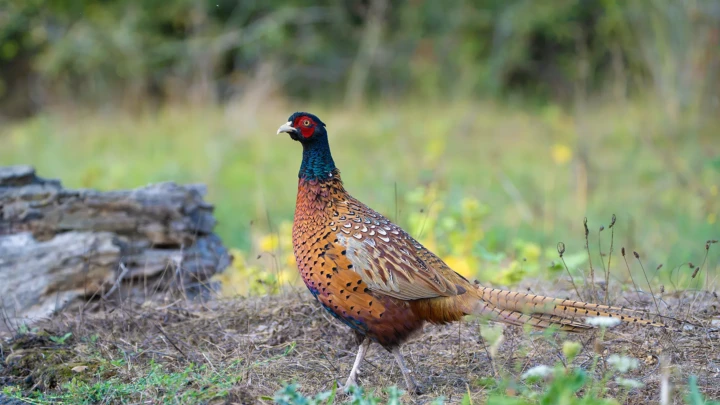
Common Pheasant (Phasianus colchicus)
How an introduced game bird lives in the Danube Delta and Dobrogea: Common Pheasant identification, harems, mate choice by spur length, history and status.
4 min read
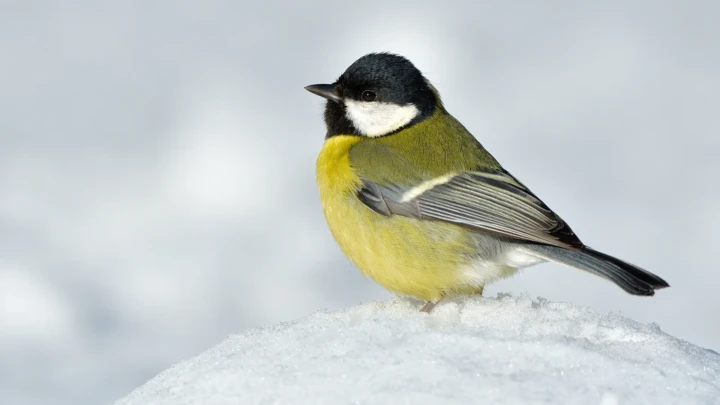
Great Tit (Parus major)
Black cap, white cheeks and a yellow breast with a black stripe: the Great Tit, the most common tit of the Danube Delta and...