

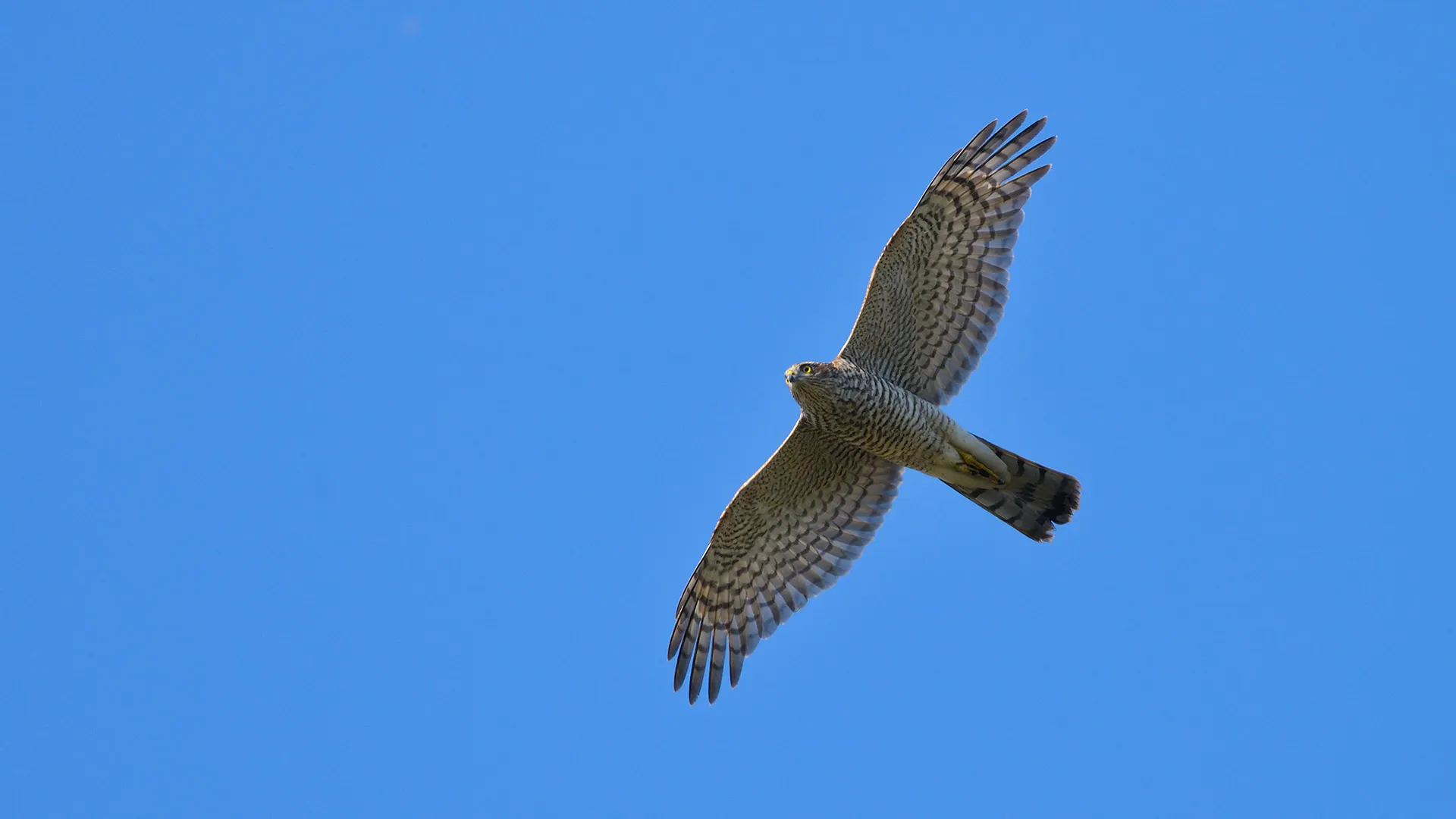
No. 194 on our checklistEurasian Sparrowhawk (Accipiter nisus)
A fast hunter of small birds that turns up in villages, reedbeds and woods: the Eurasian Sparrowhawk is common in the Danube Delta and Dobrogea in winter and on migration.
The Eurasian Sparrowhawk (Accipiter nisus) is a small, agile hawk that specialises in hunting small birds. In the Danube Delta and Dobrogea it is most common from autumn to spring, when birds from the north spend the winter here; only a few pairs stay to breed.
It is often seen as a sudden blur along a hedge, a reed edge or a village garden, scattering sparrows and finches.
Quick facts
Quick facts
- Scientific name Accipiter nisus (Linnaeus, 1758)
- Common name Eurasian Sparrowhawk
- Family Accipitridae (hawks, eagles and kites)
- Order Accipitriformes
- Length males 29–34 cm, females 35–41 cm
- Wingspan males 59–64 cm, females 67–80 cm
- Weight males about 150 g, females about 265 g on average
- Diet mainly small birds, up to 97% of prey; occasionally small mammals
- Habitat woodland edges, tree belts, villages, gardens, reed edges and open farmland in winter
- Breeding one brood a year; usually 4–5 eggs, incubated for about 33 days; young leave the nest at about 26–30 days
- Conservation status Least Concern (global IUCN Red List); Least Concern on the Romanian Red List (2022)
When to see it in the Danube Delta and Dobrogea
- JanWintering birds
- FebWintering birds
- MarWintering birds leave
- AprLast wintering birds
- MayFew breeding pairs
- JunFew breeding pairs
- JulFew breeding pairs
- AugFew breeding pairs
- SepAutumn passage begins
- OctAutumn passage
- NovWintering birds
- DecWintering birds
- Status here
- Winter visitor and passage migrant, common from October to April; rare breeding bird in summer.
- IUCN Red List
- Least Concern
- Our checklist
- No. 194 of 385 · see the full checklist
How to recognize it
The Sparrowhawk is a small hawk with short, rounded wings, a long, square-ended tail and long yellow legs. Males are blue-gray above with orange-barred underparts and orange cheeks. Females are much larger, brownish-gray above and finely barred gray-brown below, with a pale stripe over the eye. The eye is yellow to orange.
Its flight is typical: a few quick wingbeats followed by a short glide. The Eurasian Goshawk is similar in shape but much larger and heavier, while the Levant Sparrowhawk, a summer visitor in Dobrogea, has pointed wingtips that are dark at the tips from below.
A hunter of small birds
Sparrowhawks hunt by surprise. They use hedges, buildings and tree lines as cover, then burst out at low level to grab a bird in flight or on the ground. Small songbirds make up most of the prey, and the size difference between the sexes is reflected in their diet: females can take prey up to about 150 g, such as thrushes or pigeons, while males mostly hunt birds below 40 g, such as tits, sparrows and finches. In winter this makes villages with many sparrows and feeding stations good hunting grounds.
The female lays usually four or five eggs and incubates them for about 33 days. The young leave the nest at about four weeks, and most chick deaths happen in the first three days after hatching.
Migration over Dobrogea
Many Sparrowhawks that breed in northern and eastern Europe move south in autumn. In north Dobrogea, full-season counts in the Măcin Mountains recorded an average of about 530 Sparrowhawks a year between 2003 and 2007, the fourth most numerous raptor at the site. Passage peaked from late September to early October, with a median date of 1 October.
Interesting facts
- A female weighs almost twice as much as a male. British data give an average of about 266 g for females and 151 g for males. This is why females can take much larger prey than males.
- The bird that warned us about pesticides. In the 1950s and 1960s, Sparrowhawks almost disappeared from the most intensively farmed parts of England. Studies showed that DDE, a breakdown product of DDT, thinned the eggshells, and that the insecticides aldrin and dieldrin killed adult birds. After these chemicals were restricted, the species recovered.
- No bird was free of residues. None of 500 Sparrowhawks and 1,500 eggs analysed in Britain between 1963 and the early 1980s was free of organochlorine pesticide residues.
- Long-lived for a small hawk. The oldest ringed Sparrowhawk in Britain lived 17 years and 1 month, although most survive only a few years.
Status and conservation
The Eurasian Sparrowhawk is listed as Least Concern on the global IUCN Red List, and populations are stable or increasing in most of Europe. In Romania it is Least Concern on the Romanian Red List (2022), with an average estimate of about 9,000 breeding pairs and an uncertain trend. In the past the species suffered from persecution and, above all, from organochlorine pesticides. Today rodenticides are a concern: they were found in 39 of 42 dead Sparrowhawks examined in Britain in 2010–2012, although there was no clear evidence that they caused the deaths.
See it on our tours
On our multi-day birdwatching tours in the Danube Delta and Dobrogea between October and April, Sparrowhawks are a regular sight, from birds dashing along the reed edges to females perched quietly in village trees. In autumn, raptor watching from the hills of north Dobrogea can produce dozens in a single day.
See it with us
Our birding guides are biologists and ornithologists who are on the water every day of the year. Small groups, open boats, the best hours of the day.
Keep reading
Keep reading
More from the blog
5 min read
Common Tern (Sterna hirundo)
Black cap, red bill and forked tail: the Common Tern in the Danube Delta, from its colonies and fishing dives to its long migration...

7 min read
Dalmatian Pelican (Pelecanus crispus)
The Dalmatian Pelican, the largest pelican in the world: how to tell it from the Great White Pelican, fishing, breeding, migration and where to...
5 min read
Caspian Gull (Larus cachinnans)
Long legs, a small pear-shaped head and a laughing call: how to recognize the Caspian Gull in the Danube Delta, its range expansion and...