

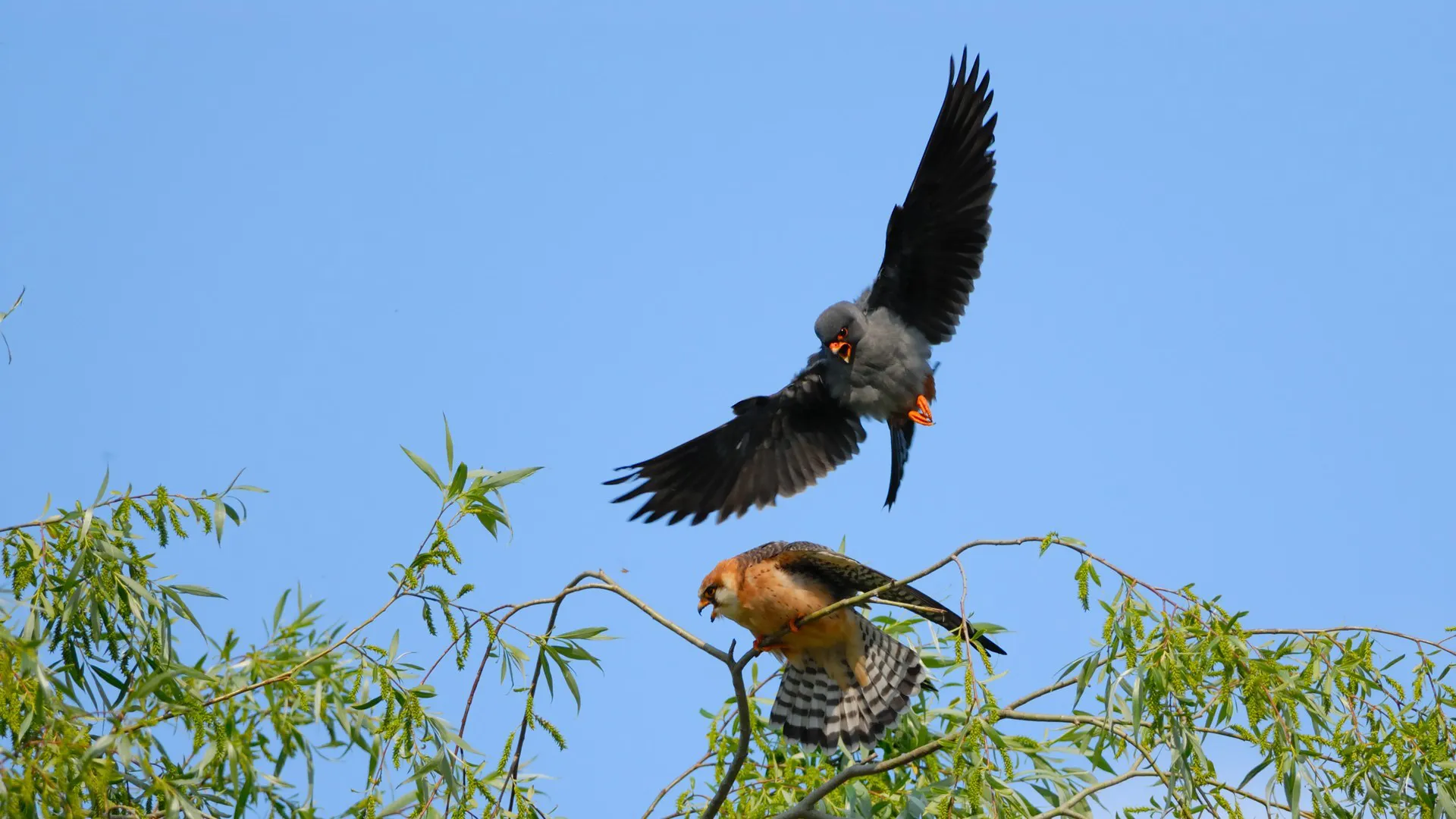
No. 222 on our checklistRed-footed Falcon (Falco vespertinus)
A small, sociable falcon that nests in old rook nests and gathers in big roosts before migrating to southern Africa: the Red-footed Falcon in the Danube Delta and Dobrogea.
The Red-footed Falcon (Falco vespertinus) is a small falcon of open steppe and farmland. Unlike the other birds of prey of Romania, it breeds in colonies. It does not build its own nest: in Romania it uses mainly old nests of rooks.
It arrives in April and leaves in September, after gathering at communal roosts. In the Danube Delta and Dobrogea it is a summer breeder and a common migrant, often seen hunting insects over meadows and farmland.
Quick facts
Quick facts
- Scientific name Falco vespertinus Linnaeus, 1766
- Common name Red-footed Falcon
- Family Falconidae (falcons)
- Order Falconiformes
- Length about 27–33 cm
- Wingspan about 65–77 cm
- Weight about 130–200 g
- Diet mainly large insects such as grasshoppers, crickets, beetles and dragonflies; also small rodents, lizards and small birds
- Habitat steppe, grassland, farmland with tree belts and rookeries, floodplain meadows
- Breeding in colonies, in old nests of rooks and other birds or in nest boxes; usually 3–4 eggs, incubated by both parents; young fledge at about one month
- Conservation status Vulnerable (global IUCN Red List); Vulnerable on the Romanian Red List (2022)
When to see it in the Danube Delta and Dobrogea
- JanIn Africa
- FebIn Africa
- MarIn Africa
- AprSpring arrival
- MayPairs settle in colonies
- JunIncubation
- JulChicks in the nest
- AugYoung fledge
- SepRoosts, autumn departure
- OctLast migrants
- NovIn Africa
- DecIn Africa
- Status here
- Summer breeder and passage migrant, from late April to September; winters in southern Africa.
- IUCN Red List
- Vulnerable
- Our checklist
- No. 222 of 385 · see the full checklist
How to recognize it
The Red-footed Falcon is a little smaller than a Common Kestrel. Adult males are dark slate-gray, with silvery flight feathers, rusty-red “trousers” and under-tail, and red legs, eye-ring and base of the bill. Females are very different: orange-buff crown and underparts, a small dark mask, and gray, barred upperparts. Young birds are brownish and streaked below.
It often hovers like a kestrel and catches insects in flight like a hobby. The Common Kestrel has a reddish back and a longer tail, while the Eurasian Hobby is larger and longer-winged, with heavily streaked underparts.
Living with rooks
The fate of the Red-footed Falcon in Romania is tied to the Rook. Rooks breed early in spring, and by the time the falcons return the young rooks are ready to leave, so the falcons take over the empty nests. In the 1990s, rook numbers in eastern Hungary and western Romania fell by 90% because of agricultural intensification, poisoning and tree removal, and the falcons declined with them, to fewer than 1,000 pairs in the two countries by the early 2000s. An international LIFE project installed 3,400 nest boxes in suitable areas, and in Romania the Milvus Group has also campaigned to stop the hunting of rooks during the breeding season.
Colonies can be large, with many pairs nesting close together, and Eurasian Hobbies and Common Kestrels sometimes nest in the same rookeries. The falcons hunt mostly large insects, and they are most active at dawn and dusk.
Roosts and a long journey
Before migration, Red-footed Falcons gather in the evenings in groves and lines of trees, from a few birds to more than a thousand, and return to the same roosts each year. Many falcons migrating through eastern Romania cross Dobrogea and rest at roosts there. Satellite-tracked birds have shown how long the journey is: a male tagged at a roost in north Dobrogea flew about 33,000 km, crossed the Mediterranean and the Sahara twice, wintered in Namibia and Botswana and returned to breed in Ukraine, north of the Black Sea.
Interesting facts
- Wintering on termites. In southern Africa, Red-footed Falcons wander after rain, feeding on winged termites that emerge after thunderstorms, as well as locusts, crickets and beetles. Thousands may descend on a single area after a storm.
- A falcon that lives in groups. Unlike other raptors of Romania, it is gregarious all year: it breeds in colonies, roosts in flocks and migrates in groups.
- Tagged in Dobrogea, nesting in Ukraine. The tracking studies show that birds passing through Dobrogea come from a wide area, including breeding colonies north of the Black Sea and even, in one case, a bird tagged in Kazakhstan that reached Romania in September.
- Up to 12 years old. The oldest known Red-footed Falcon was 12 years old.
Status and conservation
The Red-footed Falcon is listed as Vulnerable on the global IUCN Red List, after being classified as Near Threatened, because of fast declines in parts of its range. In Romania it is Vulnerable on the Romanian Red List (2022), with 1,500–2,500 breeding pairs and a decline of about 32%, although this trend was calculated from only two assessments. The main threats are habitat loss on the breeding grounds, the loss of nest trees and rookeries, pesticides and hunting along the migration route.
See it on our tours
On our multi-day photo tours in the Danube Delta and Dobrogea in May and June, Red-footed Falcons hunting over the meadows give great chances for flight shots, and the colourful males perched on wires are a classic image of the Danube Delta summer.
See it with us
Our birding guides are biologists and ornithologists who are on the water every day of the year. Small groups, open boats, the best hours of the day.
Keep reading
Keep reading
More from the blog
5 min read
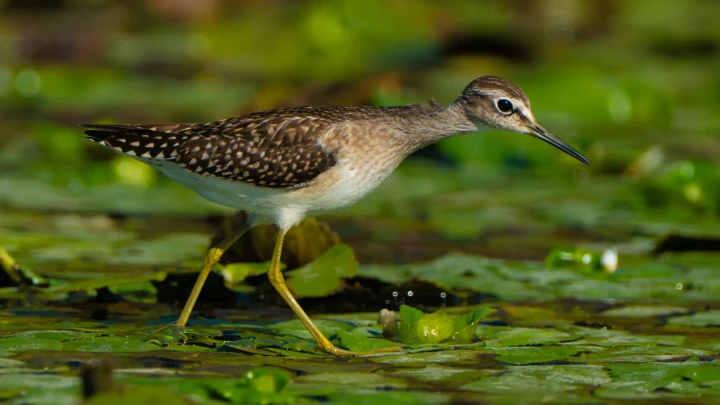
Wood Sandpiper (Tringa glareola)
A slim, speckled wader from the northern bogs: how to identify the Wood Sandpiper on passage in the Danube Delta and Dobrogea, and when...
3 min read
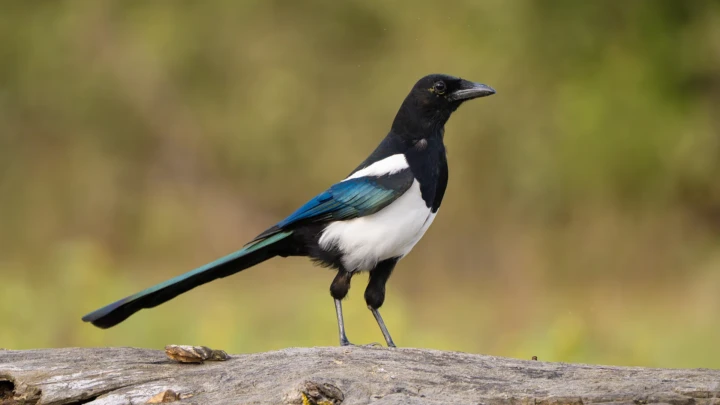
Eurasian Magpie (Pica pica)
Black and white with a long, glossy tail and one of the brightest minds among birds: the Eurasian Magpie, a familiar resident of the...
4 min read
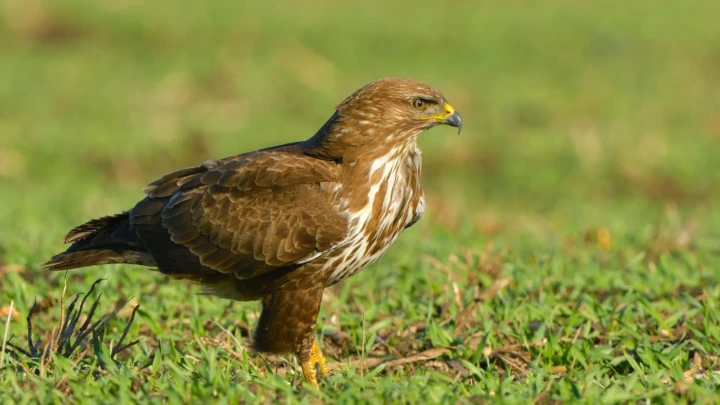
Common Buzzard (Buteo buteo)
The raptor on every roadside pole in winter: the Common Buzzard and its eastern form, the Steppe Buzzard, in the Danube Delta and Dobrogea,...