

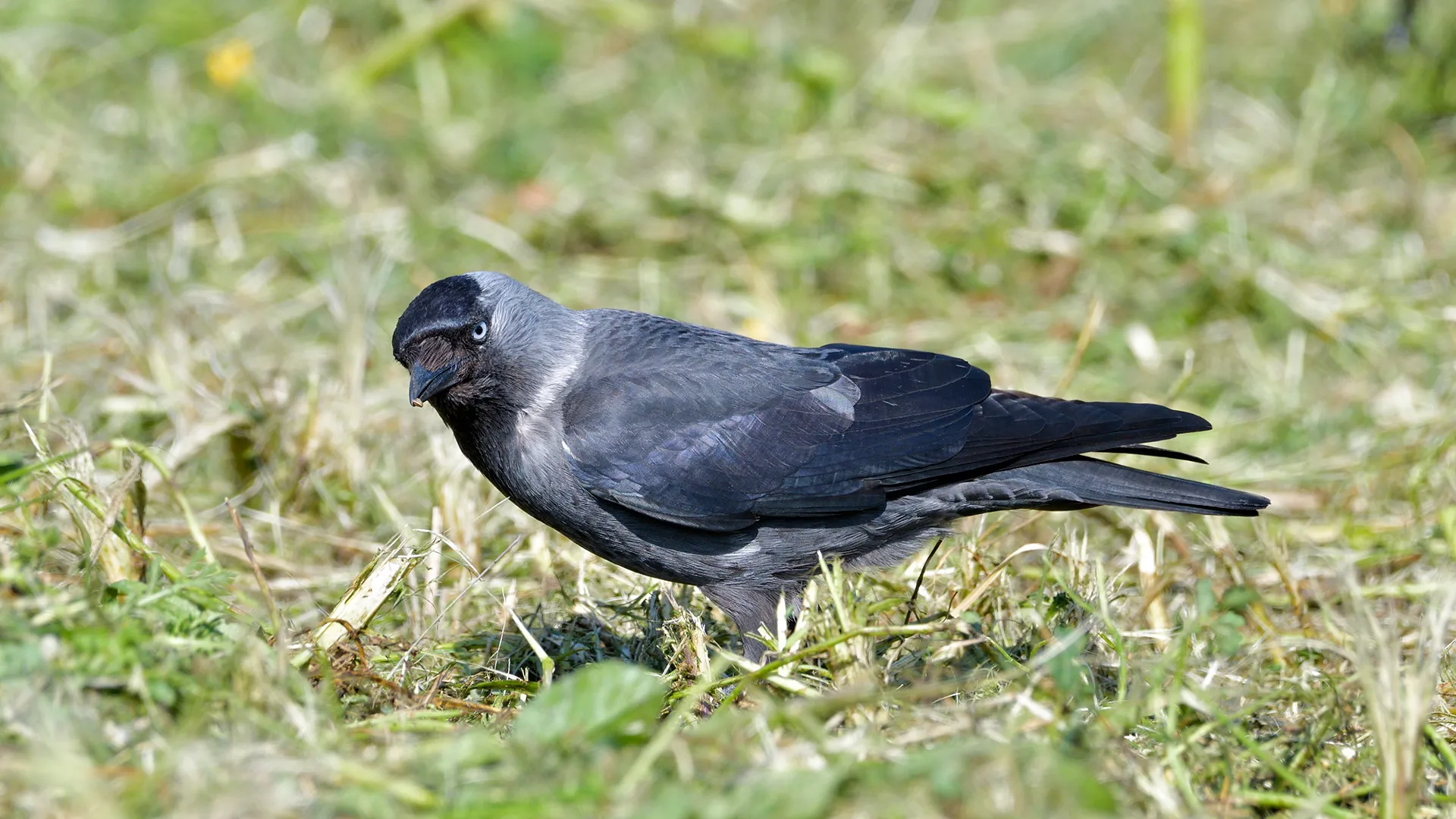
No. 239 on our checklistWestern Jackdaw (Coloeus monedula)
The smallest crow of the Danube Delta, with a grey nape and pale silver eyes: the Western Jackdaw, a sociable bird of villages, old buildings and farmland that keeps the same partner for years.
The Western Jackdaw (Coloeus monedula), long known as Corvus monedula, is the smallest crow of the Danube Delta and Dobrogea. It lives all year in villages and towns, around old buildings and farmland, and is almost always seen in pairs or noisy flocks.
Up close, its pale eyes give it a look unlike any other crow, and the birds use those eyes to talk to each other.
Quick facts
Quick facts
- Scientific name Coloeus monedula (Linnaeus, 1758); formerly Corvus monedula
- Common name Western Jackdaw, also Eurasian Jackdaw
- Family Corvidae (crows, jays and magpies)
- Order Passeriformes
- Wing length about 23 cm (adults, British ringing data)
- Weight about 230 g (adults; males slightly heavier)
- Diet omnivorous: insects and other invertebrates, seeds and grain, fruit, scraps, and occasionally eggs
- Habitat villages and towns, old buildings, farmland, open woodland and cliffs
- Breeding in holes, in colonies; usually 4–5 eggs, incubated by the female for about 20 days; young leave the nest at about 32 days
- Conservation status Least Concern (global IUCN Red List); Least Concern on the Romanian Red List (2022)
When to see it in the Danube Delta and Dobrogea
- JanPairs together, flocks
- FebPairs together, flocks
- MarPairs claim nest holes
- AprEgg-laying, incubation
- MayChicks in the nest
- JunYoung fledge
- JulFamily groups
- AugFlocks on fields
- SepPresent all year
- OctFlocks, communal roosts
- NovFlocks, communal roosts
- DecFlocks, communal roosts
- Status here
- Resident, present all year in villages, towns and farmland.
- IUCN Red List
- Least Concern
- Our checklist
- No. 239 of 385 · see the full checklist
How to recognize it
The jackdaw is clearly smaller than the Hooded Crow and the Rook, with a short bill and a rounded head. It is black with a grey nape and sides of the head. The eye of the adult is silvery white, while young birds have blue eyes. Its call is a short, bright chack, easy to pick out from the deeper calls of other crows.
Birds from eastern and south-eastern Europe belong to the subspecies soemmerringii, one of four subspecies recognized by Birds of the World.
A life in pairs
Jackdaws form long-term, strictly monogamous pairs. They nest in holes: chimneys, roofs and attics of old buildings, church towers, tree holes and cracks in cliffs. Several pairs often nest close together, forming small colonies. In neighbouring Bulgaria, the national breeding bird atlas found jackdaws breeding mainly in towns, villages and industrial zones, and less often in cliffs, caves and steep sea shores.
Outside the breeding season jackdaws feed in flocks on fields and pastures, often together with Rooks, and gather in communal roosts on winter evenings.
Eyes that send a message
A 2013 field experiment near Cambridge, UK, placed pictures inside 80 nest boxes. Jackdaws touched the boxes less often only when the picture showed a jackdaw face with bright eyes. A face with dark eyes had no such effect. The study suggests that the pale iris works as a warning to rivals approaching a nest. The authors described it as the first evidence, outside primates, that eye colour can be used to communicate with members of the same species. In another study, jackdaws responded to where a human was looking when deciding to take food, which shows that they also pay attention to human eyes.
Interesting facts
- Silver eyes, blue eyes. Young jackdaws have blue eyes, which turn silvery white in adults.
- A gaze that guards the nest. In the 2013 experiment, only a jackdaw face with bright eyes kept other jackdaws away from nest boxes. A face with dark eyes did not.
- Choosy about partners. In a 2019 experiment in Cornwall, UK, 139 wild jackdaws with electronic tags learned to feed with partners that brought them better rewards, while keeping their long-term bonds with mates and relatives.
- Up to 18 years. The oldest ringed jackdaw in Britain lived 18 years.
Status and conservation
The Western Jackdaw is listed as Least Concern on the global IUCN Red List. In Romania it is Least Concern on the Romanian Red List (2022), with 319,514–547,141 breeding pairs and an uncertain trend.
See it on our tours
On our multi-day Danube Delta discovery tours you will meet jackdaws in the villages along the way, often perched on roofs and chimneys. Look at them closely: the pale eyes are the best way to tell them from other crows.
See it with us
Our birding guides are biologists and ornithologists who are on the water every day of the year. Small groups, open boats, the best hours of the day.
Keep reading
Keep reading
More from the blog
3 min read
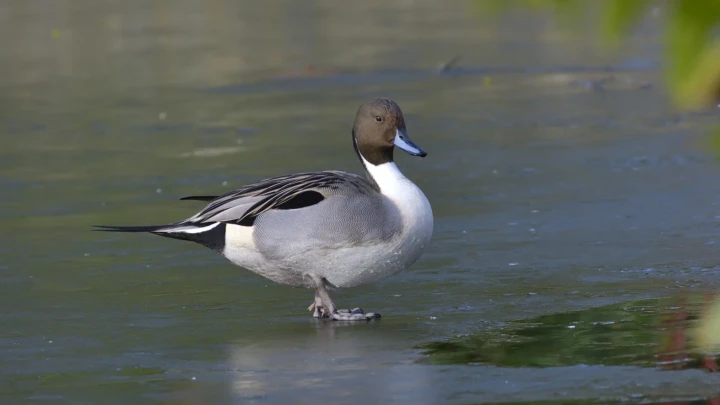
Northern Pintail (Anas acuta)
The Northern Pintail, perhaps the most elegant duck in Europe: identification, diet, breeding and when to see it on passage in the Danube Delta.

4 min read
Red-necked Grebe (Podiceps grisegena)
A brick red neck, pale grey cheeks and a dagger bill with a yellow base: a shy breeding grebe of the quiet lakes of...
2 min read
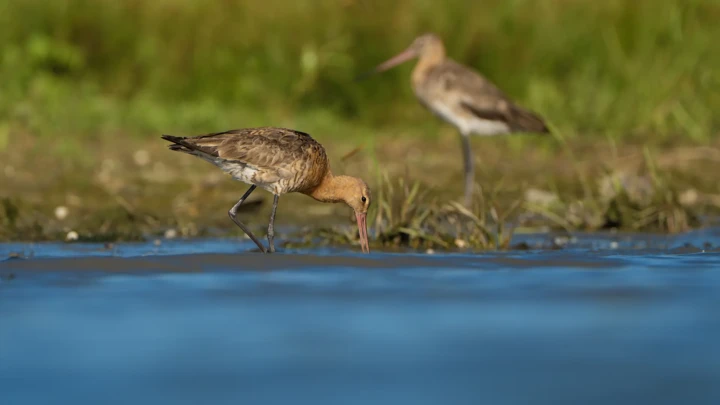
Black-tailed Godwit (Limosa limosa)
A long-billed wader with a bold wing stripe. Black-tailed Godwit occurs on passage and is a very rare breeder in the Danube Delta region.