

No. 26 on our checklistAesculapian Snake (Zamenis longissimus)
The snake of the god of medicine, one of Europe's longest serpents, living in the forests of Dobrogea. Discover the harmless Aesculapian snake and where to see it.
The Aesculapian Snake (Zamenis longissimus) is the snake of the god of medicine: the same harmless, slender serpent that wound around the staff of Asclepius in ancient Greece and still forms the symbol of the medical profession today. It is one of the longest snakes in Europe, a gentle constrictor of the forest edges, and in our region it lives in the deciduous woods of Dobrogea.
Older books know it as Elaphe longissima, the name it carried for most of the twentieth century, and it is the largest and most graceful snake of the Danube Delta and Dobrogea region, though it belongs to the hills and forests rather than the wetlands themselves.
Quick facts
Quick facts
- Scientific name Zamenis longissimus (Laurenti, 1768), formerly Elaphe longissima
- Common name Aesculapian Snake
- Family Colubridae (typical snakes)
- Order Squamata (scaled reptiles)
- Length usually 110 to 160 cm, occasionally up to 2 m
- Diet small mammals, birds and lizards, subdued by constriction
- Habitat deciduous forest edges, clearings and warm slopes
- Activity diurnal
- Breeding eggs laid in June and July; hatchlings emerge in late summer
- Conservation status Least Concern (IUCN); strictly protected under Annex IV of the EU Habitats Directive and Appendix II of the Bern Convention
When to see it in the Danube Delta and Dobrogea
- JanVery rare
- FebVery rare
- MarRare
- AprModerate
- MayAbundant
- JunAbundant
- JulAbundant
- AugAbundant
- SepModerate
- OctRare
- NovVery rare
- DecVery rare
- Status here
- Active from March to October; hibernates in winter.
- IUCN Red List
- Least Concern
- Our checklist
- No. 26 of 30 · see the full checklist
Description and identification
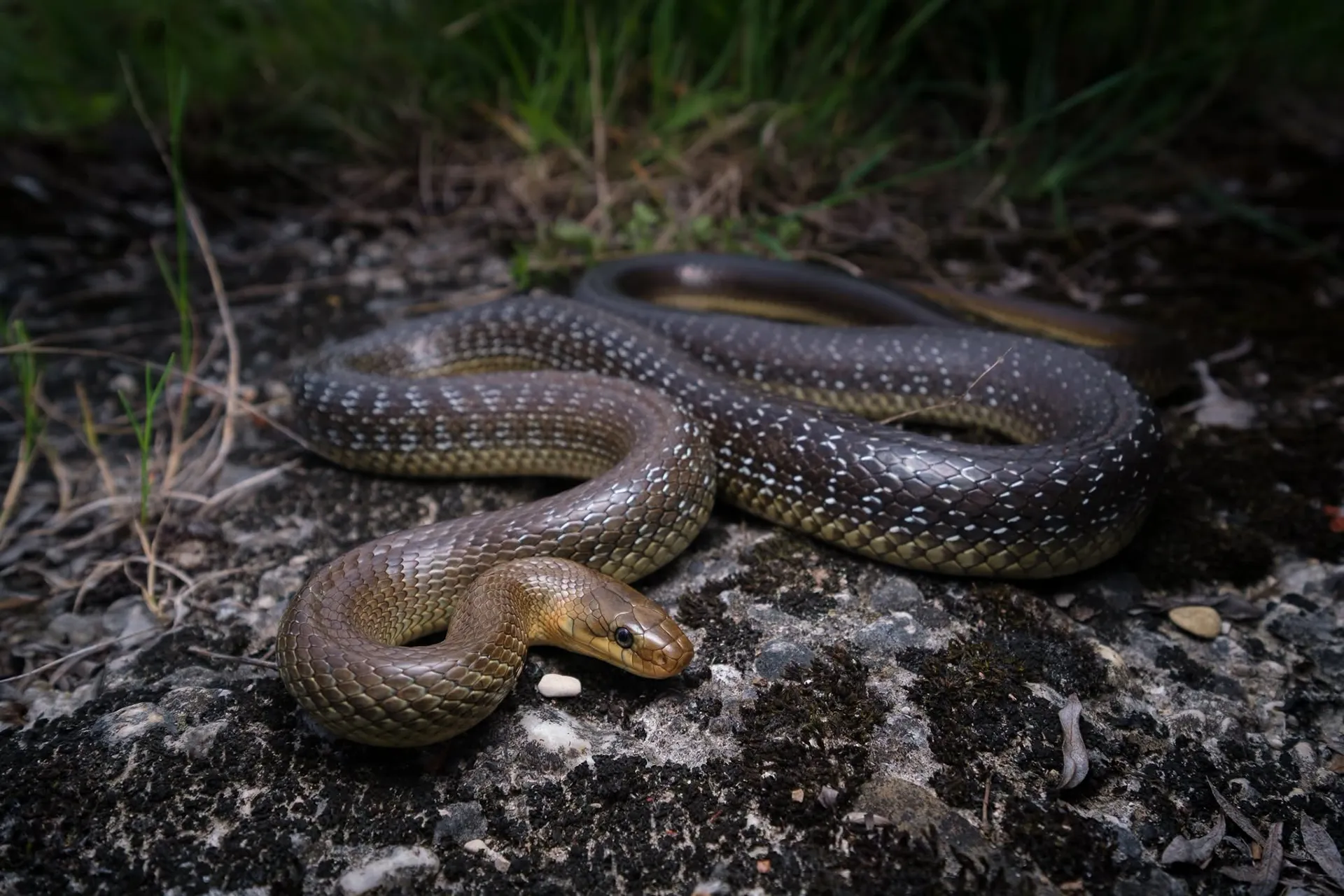
The Aesculapian snake is a large but slender animal: adults usually measure 110 to 160 cm, and exceptional individuals reach two metres, which makes it one of the longest snakes in Europe. The body is uniform — grey brown, olive or dark brown, with smooth, unusually shiny scales that catch the light as if the snake were polished; the belly is pale yellow. There is no pattern to speak of in adults, which surprises visitors expecting a “dangerous looking” animal: this snake is entirely harmless, without venom, and rarely bites even when handled.
Juveniles are very different: small, brown with dark spots and a pale collar, they can recall a grass snake or a young viper, but the round pupils, the smooth scales and the slender, rounded head give them away. Males grow larger than females, and both sexes are quick, agile snakes of the forest floor.
The snake of the god of medicine
The species takes its name from Aesculapius, the Roman god of medicine, whose Greek counterpart Asclepius carried a staff wound with a sacred serpent. In the temples of the god, non-venomous snakes — this species, in the Mediterranean world — were kept and honoured, and the rod with the snake remains the emblem of medicine to this day, on pharmacies, ambulances and medical associations across the world.
The association is fitting: the Aesculapian snake is calm, deliberate and completely harmless to people. It hunts by constriction, coiling its body around prey, and swallows it head first.
Habitat
This is a snake of warm, wooded country: deciduous forest edges, clearings, bushy slopes, old orchards and overgrown ruins, always with plenty of sunshine and cover. It avoids both the open steppe and deep shade, and in our region it is characteristic of the Dobrogea hills: the forests of Babadag, the slopes of the Măcin Mountains and the wooded valleys that cut the plateau between the Danube and the Black Sea. Within the Danube Delta’s wetlands it is absent; to meet it, our tours climb out of the reed beds and into the dry hills.
An excellent climber
Thanks to the angled edges of its belly scales, the Aesculapian snake climbs extraordinarily well: it ascends vertical, branchless trunks, hunts in bushes and trees, and has been recorded foraging four to twenty metres above the ground. Part of its diet is taken straight from bird nests — eggs, nestlings and occasionally adult birds — alongside the small mammals that form its staple food: mice, voles, young rats, shrews and moles. Lizards are also taken, especially by younger snakes.
The snake is active by day, especially in the morning and late afternoon, when it can be seen basking in a sunlit clearing or gliding through the leaf litter with surprising speed. When approached it usually disappears quietly rather than defends itself.
Reproduction
Mating takes place in late spring, typically from mid-May to mid-June, sometimes in conspicuous tangles of several males around a single female. In late June and July the female lays 5 to 20 large, pear-shaped eggs in a warm, humid place where decay generates heat: rotting tree stumps, piles of leaves and brushwood, compost heaps, cavities under roots. The eggs incubate for six to ten weeks, and the hatchlings, 20 to 28 cm long, emerge in late summer and early autumn, fully independent from the first day.
Males mature at about 100 cm and females at about 85 cm, and a large female can live for well over fifteen years in the wild.
Conservation and threats
The Aesculapian snake is listed as Least Concern by the IUCN across its wide range from France to Iran. It is strictly protected at European level, in Appendix II of the Bern Convention and Annex IV of the EU Habitats Directive, and by national legislation in Romania. The main threats are local: the loss of old, structurally rich forest edges, road mortality on the warm slopes where snakes bask, and killing by people who mistake the large brown animal for a viper.
In Dobrogea the species remains well established in the larger forests and their edges, and it is one of the reptile highlights of the region for visitors who leave the water for a day.
Where and when to see the Aesculapian Snake in Dobrogea
Look for it in and around the deciduous forests of the region: the Babadag forest, the wooded slopes of the Măcin Mountains and the valleys between the hills. On warm mornings from May to July, an adult Aesculapian snake basking on a forest path or at the edge of a clearing is a realistic reward for a slow, quiet walk; watch the sunlit ground ahead and the lower branches of bushes, and scan fallen trunks. Most sightings last only seconds, until the animal flows off the path and into the undergrowth.
Our multi-day nature tours that combine the Danube Delta with the hills of Dobrogea include exactly this kind of forest-edge habitat, and the Aesculapian snake is among the species our guides show guests most proudly — a two-metre ambassador of the god of medicine, seen and forgotten by no one.
See it with us
Slow open boats, small groups and a guide who knows the places and the wildlife. From a few hours on the water to a week in the Danube Delta and Dobrogea.
Keep reading
Keep reading
More from the blog
5 min read
Grass Snake (Natrix natrix)
The harmless snake with the yellow collar, the delta's most often seen serpent and a famous actor that plays dead. Discover the grass snake...
5 min read
Agile Frog (Rana dalmatina)
Meet the Agile Frog of Dobrogea: long-legged woodland life, early spring breeding and responsible observation during a wider Danube Delta journey.
5 min read
Balkan Green Lizard (Lacerta trilineata) in Dobrogea
Meet the Balkan Green Lizard, the largest lizard in Romania, found only in Dobrogea near the Danube Delta: identification, where it lives, behavior, taxonomy...