


Argamum (Orgame), the Ancient City on Lake Razim
Founded by Greek settlers in the 7th century BC on a cliff above Lake Razim, Orgame is the first town in Romania named in a written source.
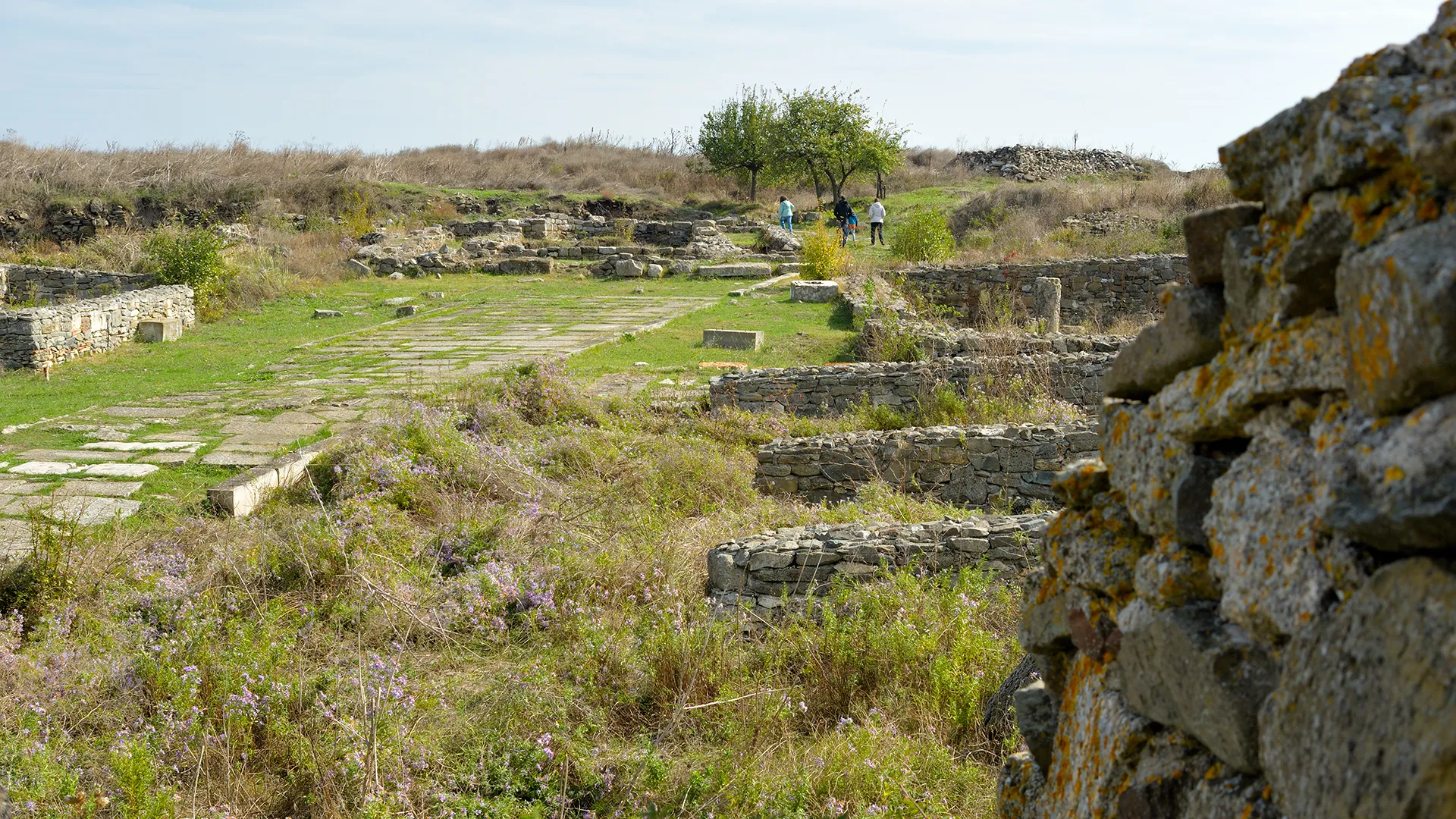
Seven kilometres from the village of Jurilovca, on a limestone cape called Dolojman, stand the ruins of Argamum. Greek settlers founded the city in the 7th century BC under the name Orgame, and in Roman times it became Argamum. Together with the fort on Bisericuta Island, just offshore, it guarded the entrance to a gulf of the Black Sea, the sea the Greeks then called the Scythian Pontus.
Quick facts
- Where Cape Dolojman, 7 km from Jurilovca, Tulcea County
- Founded Middle of the 7th century BC, by Greek settlers from Asia Minor
- Names Orgame (Greek), Argamum (Roman)
- Today Partly excavated ruins on a cliff above Lake Razim

The first town in Romania named in writing
Orgame is the first settlement on the territory of today’s Romania mentioned in a written source: Hecataeus of Miletus names it, about a century and a half after its founding, as a city close to the Danube. For a long time Histria was thought to be the oldest town in the country. The excavations at Cape Dolojman have shown that the Greeks settled here about a generation earlier.
The key find is a remarkable tomb in the Greek cemetery, dated to the middle of the 7th century BC. It belonged without doubt to a leading figure of the first settlers, and offerings were brought to it for several generations, an honour reserved for heroes. The researchers believe it was the tomb of the founder of the city.
What the excavations have found
The cape had been lived on long before the Greeks, in the Late Bronze Age and in the early Iron Age, but it was empty when the settlers arrived. They came from the western coast of Asia Minor, and for a long time their city traded mostly with that world: its pottery came from the workshops of Miletus, Samos, Clazomenae and Chios, and its wine and olive oil from the same regions. Local kilns show that the settlers soon made their own pottery too.
Among the most debated finds are the so called arrowhead coins: small bronze pieces shaped like arrowheads, never used as weapons but as money, before real coins were struck. Hoards of them were found in the villages around Jurilovca, Visina and Enisala, within a few kilometres of Orgame.
In Roman times the city appears as Argamum. A boundary inscription from AD 100, which marks the territory of Histria, names the land of the Argamenses as its northern neighbour. In late Roman times Argamum became a strong fortress on the sea frontier of the Eastern Roman Empire, in the province of Scythia Minor. Within its walls the archaeologists have uncovered four early Christian basilicas. One of them, outside the walls, has an underground chamber that is unique among the early Christian monuments of Dobrogea.
The last coins found here were struck under Emperor Heraclius, in 613 and 614. City life faded in the following decades, during the Avar and Slav raids. The cape was used again only briefly, in the 11th century, and then abandoned for good.
A legend
Local legend says that the Argonauts sailed past here, and even stopped, on their way home with the Golden Fleece of King Aeetes. The only problem is that the legend is much older than the city.
Visiting Argamum today
The site is an open, partly excavated ruin, and only a small part of the ancient city has been explored so far. There is little on site to explain what you see, so it is worth coming with a guide. Cape Dolojman is also a strictly protected nature reserve: high limestone cliffs, wide views over Lake Razim and Lake Golovita, the sand bar beyond them and, in the distance, the Black Sea. The steppe vegetation and the birdlife of the cliffs make it a beautiful place at any time of year.
In summer the cape is hot and dry, with no shade, so bring water and a hat. Argamum is one of the three ancient and medieval sites on our 3 Fortresses day trip from Tulcea, together with Enisala and Histria.
The archaeology in this article follows the research report of Mihaela Manucu Adamesteanu, scientific director of the Orgame and Argamum excavations. Original text in Romanian by Iliuta Goean.
See it with us
Slow open boats, small groups and a guide who knows the places and the wildlife. From a few hours on the water to a week in the Danube Delta and Dobrogea.
Keep reading
Keep reading
More from the blog

3 min read
Macin Mountains National Park, the Old Mountains of Dobrogea
Among the oldest mountains in Romania, worn down to rocky ridges above the steppe: rare plants, birds of prey and quiet trails, close to...
2 min read
Capidava, the Roman Fortress at the Bend of the Danube
A Roman fort on a rocky bluff above the Danube, between Harsova and Cernavoda: walls, towers and a wide view over the river.

3 min read
Tulcea City Break: Museums, History and the Aquarium
A day in Tulcea, the gateway to the Danube Delta: the Monument Hill, the museums of history, folk art and fine art, and the...