

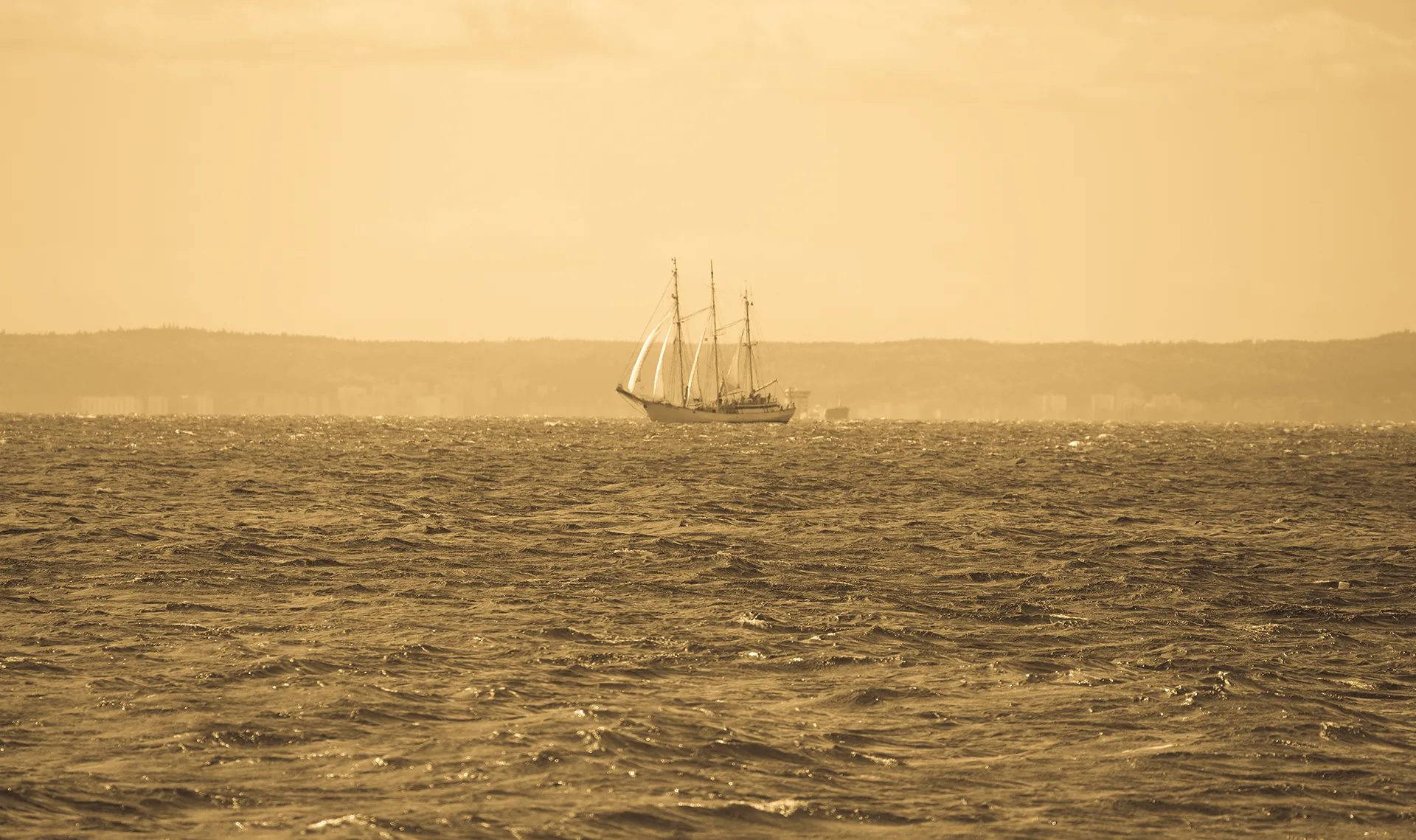
How Mila 23 Was Born: a Greek Inn, Pirates and the Mile That Named a Village
A Greek innkeeper from Kefalonia, the pirates of Sulina, Lipovan fishermen and a river mile marker: how the village of Mila 23 began in the heart of the Danube Delta.
Every village in the Danube Delta has a story, but few have one like Mila 23. Before the Sulina Canal was cut straight, this bend of the river was a halfway stop for merchants, sailors and men who lived from what the ships carried. A young Greek from Kefalonia built an inn here, fish was salted and sold, news travelled from mouth to mouth, and a mile marker gave the place its name. This is how a few fishermen’s houses in the reeds became the village we call home today.
Quick facts
- Where on the Old Danube, in Crișan commune, about halfway between Tulcea and the Black Sea
- Name from mile 23 of the old Sulina arm, counted upstream from the sea at Sulina
- The old river route about 84 km of meanders from the Sulina mouth to the Tulcea arm, before the bends were cut
- First inhabitants a few Lipovan fishing families
- The founding figure Herakles Antoniadis, a Greek innkeeper from Kefalonia, in the second half of the 19th century
- Access today by water only
A River of Bends and Oars
Picture the Sulina arm in the 1860s. There was no straight canal, only a river that wound through the reeds for about 84 km between the Tulcea arm and the sea. Sailing up the river was slow and difficult, so most people travelled in rowing boats. There were no roads, no newspapers and no radio. Everything that reached the heart of the Danube Delta, goods and news alike, came by water and at the speed of the oars.
Halfway along this route, on a bend of the river, the boats stopped for the night. A day of rowing from Tulcea brought you exactly here. Only three or four houses of Lipovan fishermen stood on the high ground, but the place had something more valuable than size: everybody travelling between the mainland and the sea passed by it.
Sulina, a Port of Sailors, Greeks and Pirates
At the end of the river lay Sulina. After the Crimean War, the European Commission of the Danube was created in 1856 to keep the mouth of the river open for shipping, and from 1858 its engineers worked to clear the sand bar at the Sulina mouth. In 1870 Sulina was declared a free port, a porto franco, and the little town grew at an astonishing speed. Ships from all over Europe anchored there, and the Greeks became its largest community: merchants, ship owners, captains and river pilots.
Where there are rich ships, there are men who live from them. The shallow waters at the mouth and the endless reeds behind it were a perfect hiding place. Some of these men offered to guide ships through the shallows and then took part of the cargo, hiding it on small channels deep in the reeds and selling it to whoever passed by. One of them is still remembered in Sulina: Ghiorghios Kontoguris, born in Kefalonia in 1838, who plundered ships stranded near the shore. He was shot dead on a street in Sulina in 1871, and his gravestone still stands in the town’s cemetery. In those years, a respected sea captain having friends among such men was nothing unusual. It was simply how things worked at the edge of the world.
Herakles, from Kefalonia to the Reeds
Around 1870, the harbour master of Sulina was a Greek from Kefalonia. With him came one of his nephews, a young man of about twenty named Herakles Antoniadis, who had left behind on the island a wife expecting their first child. Herakles was hot blooded. Soon after he arrived, a quarrel over a woman in a Sulina tavern ended in a knife fight, and a young local man was killed.
Afraid of the police and of the dead man’s family, Herakles fled upriver and hid with men his uncle knew: the pirates who had made their base around the bend where Mila 23 stands today. There they kept the goods taken from the ships and sold them to the merchants who stopped for the night.
The story of Herakles is written on paper in two places. In the local archives here, in documents that have never been digitised, and on Kefalonia, where we met the Antoniadis family. They still keep documents about the harbour master and about Herakles, and his great great grandchildren live on the island to this day. Both tell the same story, and as far as we know, this article is the first time it is told online.
The Inn at the Halfway Stop
Herakles was a fugitive, but he was also clever and bold, and he understood very quickly what kind of place he had landed in. Imagine it: merchants with money in their pockets, on their way to the free port of Sulina, spending the night on the riverbank and eager to buy goods they could sell on the mainland. Pirates offering what they had taken from the ships. Sailors and fishermen bringing news from both ends of the river. Everything was bought, sold and talked about right here.
So Herakles built an inn. In the meantime, his uncle settled the matter with the family of the young man who had died, and the police stopped looking for him. His wife, who had given birth on Kefalonia, came to Sulina, and Herakles brought her to the inn. But she found a different man from the one she had married: hard, rough and living far from the law. After three years, and accusing him of affairs with other women, she returned to Kefalonia with their two children.
Salted Fish and a Growing Village
As more and more ships reached Sulina, more and more people travelled up and down the river, and they all needed to buy or sell something. Herakles was the man who arranged it all. Soon he began salting and drying fish, the most important food on the ships leaving for the open sea. Travellers stopped and bought fish from him because it was cheaper than in Sulina, and Herakles also had news, contraband and stolen goods to offer.
Little by little he became the biggest buyer of fish from the local fishermen, and the fishermen started to build their houses close to his inn. A safe buyer for your catch is the best reason to settle somewhere, and this is how the scattered houses on the bend slowly turned into a village. Herakles, it is said, later had two more wives and children with both of them.
The Mile That Gave the Village Its Name
The engineers of the European Commission of the Danube, led by Charles Hartley, measured the whole Sulina arm in nautical miles, starting from the sea at Sulina (mile 0) and going upstream toward Tulcea. The inn of Herakles stood exactly at mile 23. Twenty three nautical miles are about 42.6 km, half of the old river route, which is why this was the natural place for the boats to stop for the night.
The name stuck. You may read that Mila 23 is 23 miles from Tulcea; it is not. The miles were counted from the sea, and the shipping channel of Sulina still uses the same system today, with mile numbers from the mouth upstream. The original markers of the Commission are gone, replaced during the communist period with much plainer ones.
When the River Moved Away
Once the mouth was secured, the Commission began its greatest project: cutting the bends of the Sulina arm to make a straight canal for the ships. The work was finished in 1902, and the route shrank from about 84 km to the canal we know today. The big bend of Mila 23 was left aside, on what is now called the Old Danube. The ships no longer passed by the inn, and the halfway stop slowly lost its role as a crossroads. The village, however, kept its fishermen, and the fishermen kept the village alive.
The Lipovan Fishermen of Mila 23
The first people of Mila 23 were Lipovan fishermen. The elders of the village say their ancestors came from Vâlcov and Chilia Nouă, across the Chilia arm, drawn by the rich fishing grounds. They were already here when Herakles arrived, and they are the ones who stayed through every change that followed.
For a long time the village was a string of hamlets along the river and the canals. The biggest one lay downstream from the mouth of the Eracle canal. After the great floods of the 1970s, a raised platform was built, and when the drainage of the Pardina and Stipoc area took away their fishing grounds, the fishermen from Stipoc also moved to Mila 23 and built their homes on the platform. This is a late chapter of the story, but it gave the village the shape and the blue painted houses you see today. You can read more about them in our article on Lipovan Blue.
The Disappearance of Herakles
Herakles remained a prominent figure of the area until the beginning of the Second World War, when life turned upside down here too. Then he simply disappeared. Some said he went back to Kefalonia, which his relatives on the island have never confirmed. Others said he was killed by pirates in a quarrel. Nobody knows for sure.
His name, however, is still on the map. The canal that leads from Mila 23 toward Lake Matița is the Eracle canal, written on maps as Eracle or Heracle. Every time our boats turn into it, we pass the man who, in a way, started it all.
What the Kitchen Remembers
History is written in documents, but also in recipes. Look at the traditional dishes of Mila 23 and of the whole Danube Delta. Plachia is the Greek plaki, fish slowly cooked with onions and tomatoes. Scordolea is the Greek skordalia, the garlic and bread sauce. Saramura, grilled fish in a hot garlicky brine, has its twin in the Greek psari ladolemono. And mujdei, the garlic sauce served with almost every fish, is the same as toum, the oldest form of this sauce we found, which spread all around the Mediterranean.
These recipes most likely came with the Greeks. They were the first newcomers here and the friendliest with the local people. Herakles and his inn at mile 23, the large Greek community of Sulina and the early Greek settlers of Dobrogea all left their mark on the food we eat today. Taste them in the village and you taste a piece of this story.
Mila 23 is where we live and where our boat trips start. Come and see the bend of the Old Danube where the inn once stood, and read more about the village today in Mila 23: the Lipovan Village in the Heart of the Danube Delta.
Iliuta GOEAN
See it with us
Slow open boats, small groups and a guide who knows the places and the wildlife. From a few hours on the water to a week in the Danube Delta and Dobrogea.
Keep reading
Keep reading
More from the blog

3 min read
The Trip to Sfantu Gheorghe and the Sacalin Lagoon
A long boat day across the south of the Danube Delta, to the Sacalin lagoon, the mouth of the Danube and the fishing village...
3 min read
Autumn in the Danube Delta: Mist, Migration and Golden Reeds
Gathering flocks, young pelicans learning to fish, misty sunrises and golden reeds: what you see in the Danube Delta in autumn, month by month.
5 min read
Our Boats for Danube Delta Trips
No roof, no windshield, nothing between you and the Danube Delta: the open boats we built for slow, quiet trips with a clear view...