

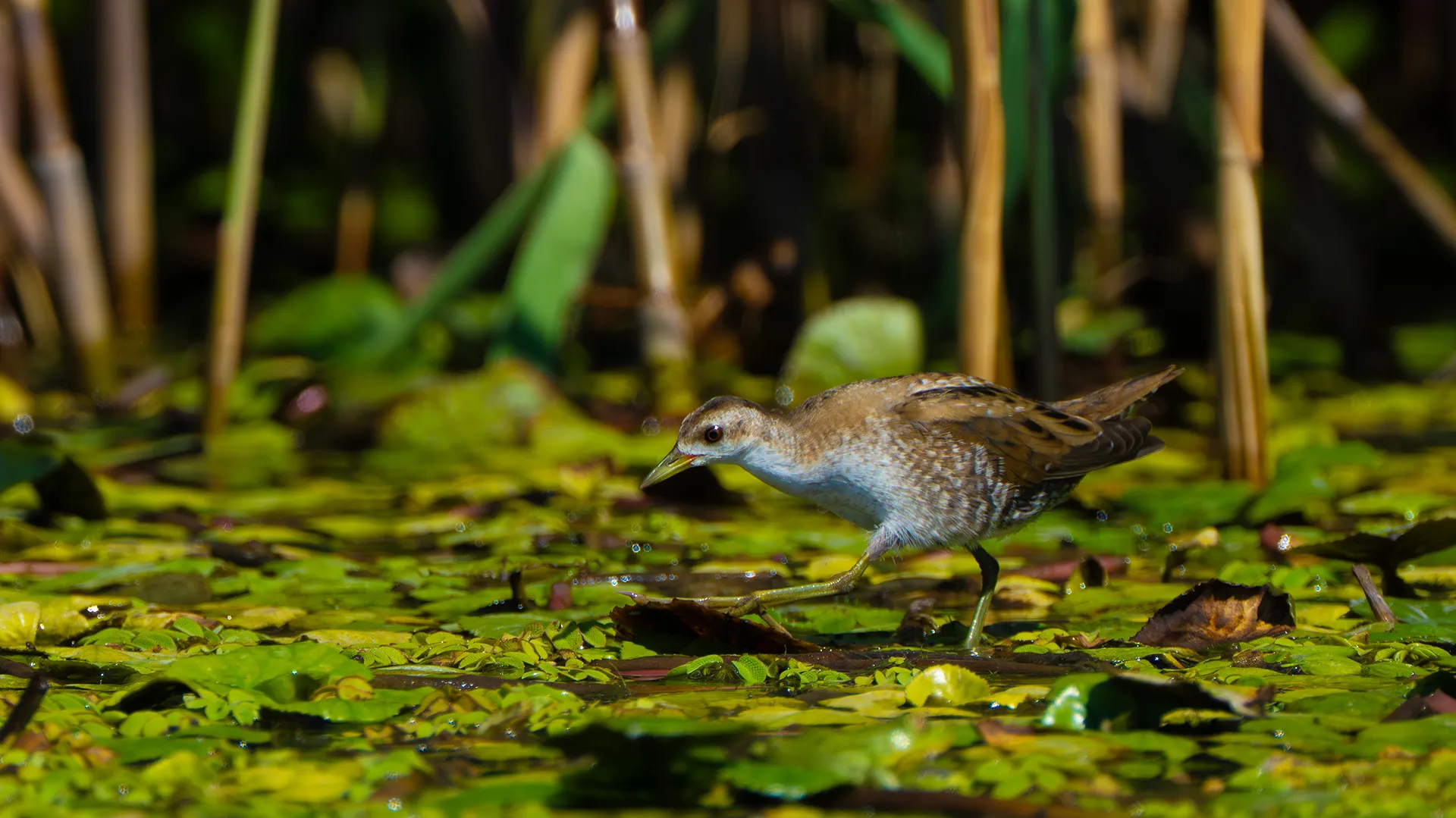
No. 67 on our checklistLittle Crake (Zapornia parva)
A tiny rail that spends much of its time hidden in marsh vegetation. Little Crake breeds in the Danube Delta and is recorded from April to October.
The Little Crake (Zapornia parva) is a tiny rail of marshes with dense vegetation. It is a summer breeder in the Danube Delta and Dobrogea, and the local checklist records it from April to October.
Scopoli originally described it as Rallus parvus in 1769.

Quick facts
Quick facts
- Scientific name Zapornia parva (Scopoli, 1769)
- Common name Little Crake
- Family Rallidae
- Order Gruiformes
- Weight about 50 g
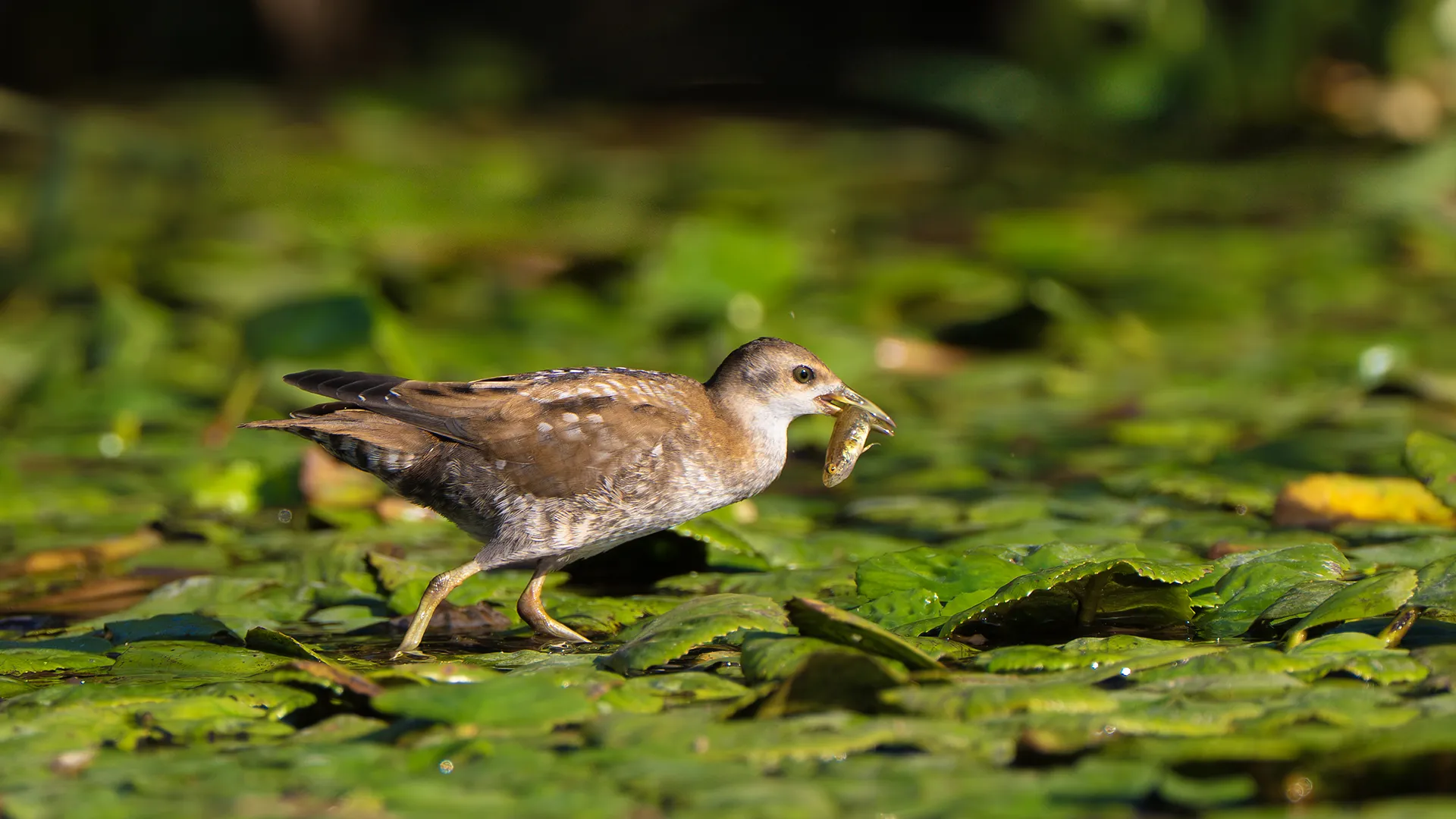
- Diet chiefly insects; also other small invertebrates and seeds and shoots of aquatic plants
- Habitat marshes and reedbeds with dense vegetation at the water’s edge
- Breeding a shallow cup of plant material in dense vegetation on or close to water
- Conservation status Least Concern globally; Least Concern as a breeding bird in Romania (2022)
When to see it in the Danube Delta and Dobrogea
- JanNo checklist code
- FebNo checklist code
- MarNo checklist code
- AprPresent
- MayPresent
- JunPresent
- JulPresent
- AugPresent
- SepPresent
- OctScarce
- NovNo checklist code
- DecNo checklist code
- Status here
- Summer breeder; recorded April–October, less often in October.
- IUCN Red List
- Least Concern
- Our checklist
- No. 67 of 385 · see the full checklist
How to recognize it
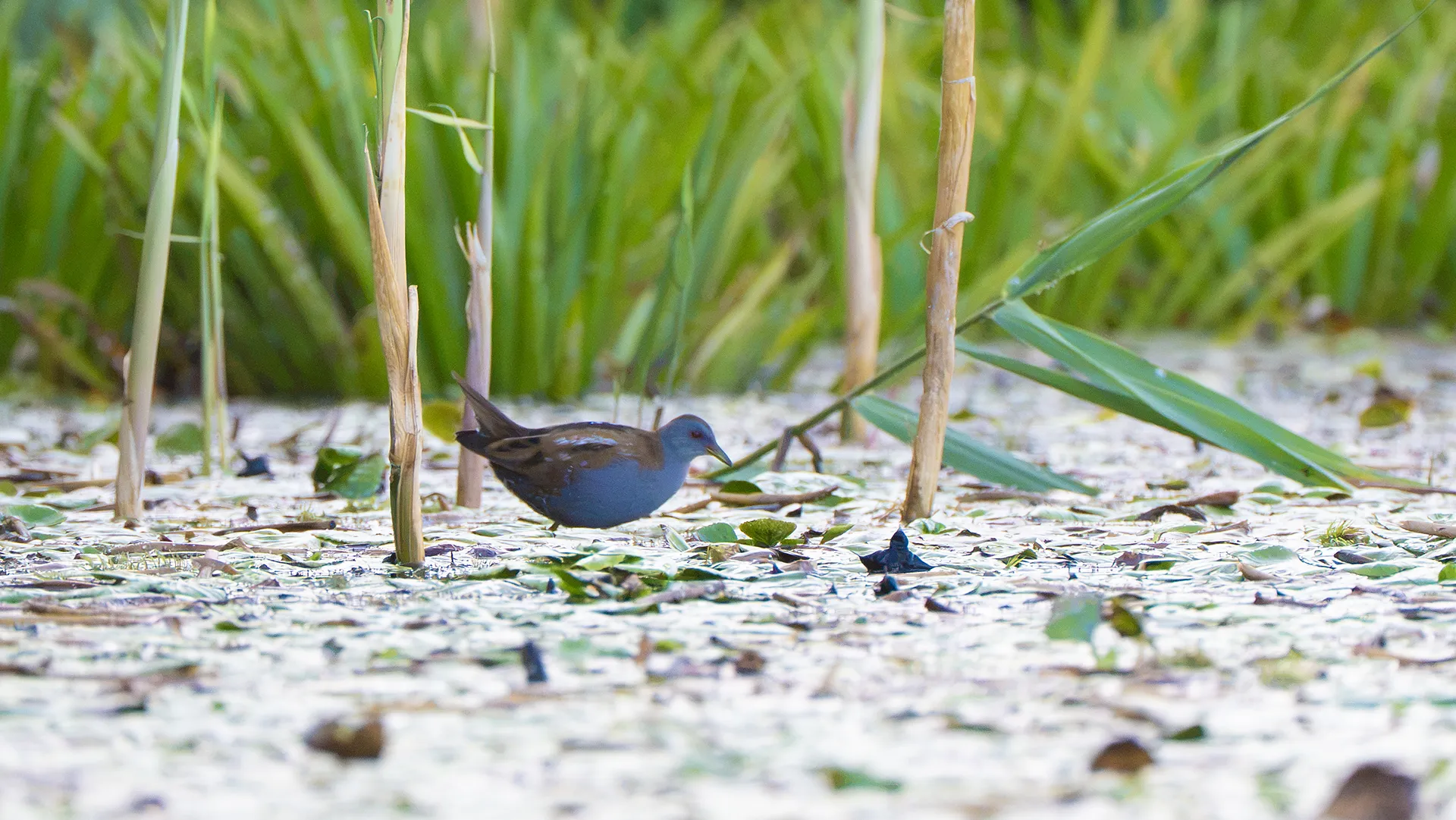
The adult male has a blue-grey face and underparts, with olive-brown upperparts. The female has a pale throat and warmer underparts. On adults seen well, look for red at the base of the greenish bill. That mark is useful, but may be hard to pick out in poor light.
A rail of dense marsh vegetation
The Little Crake makes its nest among thick plants close to the water. It feeds mainly on insects, including water beetles, and also takes other small invertebrates and plant material. The Bulgarian breeding atlas notes that secrecy and a short calling season can make occupied sites difficult to find. When watching from a boat, give a quiet opening in the reeds time rather than moving closer to the vegetation.
Interesting facts
- The adult sexes look different. The male is blue-grey below, whereas the female has a pale throat and warmer underparts.
- An adult can show red at the bill base. It is a small mark that takes a good view to see.
- The nest can be right beside water. The shallow cup is concealed in dense plants.
- Its original name was Rallus parvus. Older references may also use Porzana parva.
Status and conservation
The Little Crake is Least Concern globally and as a breeding bird in Romania’s 2022 Red List. The national estimate is 3,600–36,000 breeding pairs, with an unknown short-term trend. The broad interval should not be read as a local estimate for the Danube Delta.
See it on our tours
On our multi-day birdwatching tours in the Danube Delta and Dobrogea, watch small openings at the reed edge during the April–October season. A brief view of a crake slipping across a gap may be all you get.
See it with us
Our birding guides are biologists and ornithologists who are on the water every day of the year. Small groups, open boats, the best hours of the day.
Keep reading
Keep reading
More from the blog
4 min read
Gadwall (Mareca strepera)
Meet the Gadwall, a plant-eating dabbling duck that steals food from coots: identification, breeding in the Danube Delta, autumn migration and status.
5 min read
Common Wood Pigeon (Columba palumbus)
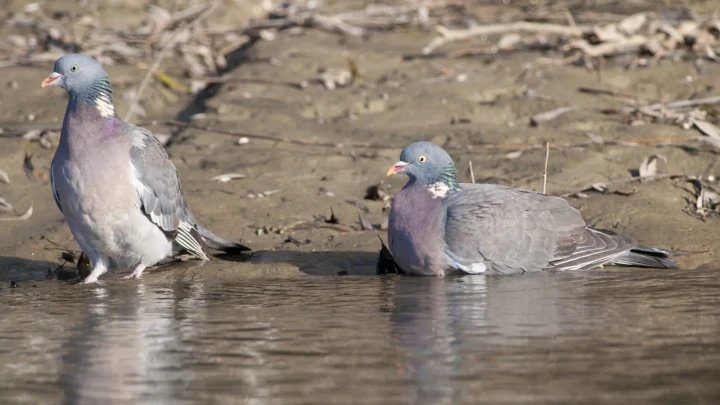
The Common Wood Pigeon, Europe's largest pigeon, in the forests and fields of the Danube Delta and Dobrogea: identification, breeding, migration and status.

4 min read
Isabelline Wheatear (Oenanthe isabellina)
A pale sandy wheatear that sings from the top of a mound and often nests in an old ground squirrel burrow.