

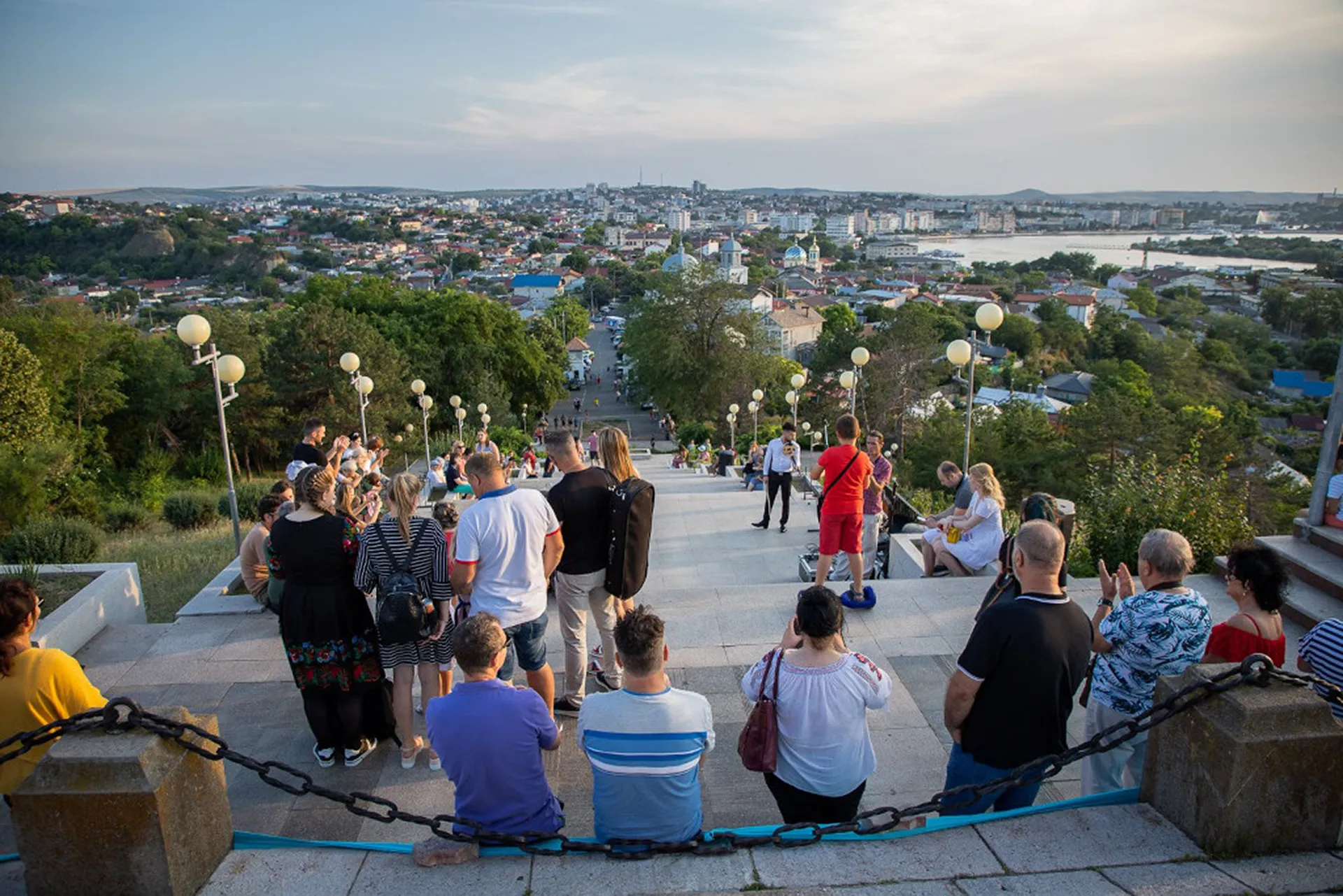
Tulcea: the History of the Town at the Entrance to the Danube Delta
From Aegyssus, the fortress mentioned by Ovid, to the Azizie Mosque and the Independence Monument: the story of Tulcea, where the Danube Delta begins.
Tulcea is the town on the right bank of the Danube, set on the hills of northern Dobrogea, exactly where the Danube Delta begins. Most travellers see it only as the starting point for the channels and lakes, yet it deserves a full day: it has an ancient fortress mentioned by Ovid, a mosque built in the reign of Sultan Abdulaziz, churches raised by communities that lived here side by side, and a few museums that many larger towns would envy.
Quick facts
- Where on the Tulcea branch of the Danube, in northern Dobrogea; the seat of Tulcea County
- Ancient name Aegyssus, the fortress on Colnicul Hora, today Monument Hill
- Ottoman period the present town grows from around 1420; in the 19th century it becomes the capital of the Sanjak of Tulcea
- Romania after the War of Independence of 1877-1878
- With us our day trips into the Danube Delta start from Tulcea
Aegyssus, the fortress on Colnicul Hora
The oldest part of the town lies on the rocky hill in the north-east of Tulcea, known in the past as Colnicul Hora. A Getic settlement stood here first, then the fortress of Aegyssus. The poet Ovid, exiled to Tomis, mentions it in his letters from exile in the year 12 AD and records a local tradition that tied the name of the fortress to a legendary founder, Caspios Aegyssos.
In Roman times, Aegyssus was one of the fortifications on the Lower Danube frontier. Excavations have uncovered its walls and towers, with building phases from the 3rd, 4th and 6th centuries, when the fortress also appears in the writings of Procopius. The ruins can still be seen today in Monument Park, next to the Museum of History and Archaeology.
The Ottoman town
Present-day Tulcea grew under Ottoman rule, from around 1420. The Russo-Turkish wars swept over the town several times, and in 1829 it was almost destroyed. In the 19th century, after the Tanzimat reforms, Tulcea became the capital of the Sanjak of Tulcea, within the Danube Vilayet.
The places of worship of the communities that lived together in the town remain from this period. The Greeks built the Church of the Annunciation (Buna Vestire) between 1848 and 1854, replacing a church made of planks. St Nicholas Cathedral was built between 1862 and 1865, on the site of a wooden church raised by Romanians who had taken refuge from the village of Beștepe. The Muslim community received the Azizie Mosque in 1863, and the Bulgarians have St George’s Church, also known as the Bulgarian Church. They all stand a few streets from one another, and a walk through the old centre is, in fact, a lesson in how people of different faiths have lived together in Dobrogea.
Tulcea becomes Romanian
After the War of Independence of 1877-1878, Northern Dobrogea returned to Romania, and Tulcea with it. King Carol I visited the town on 17-18 October 1879 and laid the foundation stone of a monument dedicated to the war and to the union of Dobrogea with Romania, right on Colnicul Hora, above the ruins of the ancient fortress.
The monument was made between 1897 and 1899 by the artists Giorgio Vasilescu and Constantin Bălăcescu: an obelisk with the statue of a Romanian infantryman (dorobanț) and an eagle with spread wings at its base. It was inaugurated on 2 May 1904, in the presence of the royal family, together with the park around it. Rebuilt in 1976-1977, the monument became the symbol of the town and also appears on the county’s coat of arms.
In the 20th century, especially after the Second World War, Tulcea grew quickly and became an industrial town and an important river port. Among the people born here is the mathematician Grigore Moisil (1906-1973), one of the founders of Romanian computer science.
What to see in Tulcea
Monument Hill, the museums and the aquarium can all be seen on foot in a single day. You will find them all, with practical tips, in our article Tulcea City Break: Museums, History and the Aquarium.
Visiting Tulcea with us
Our day trips into the Danube Delta start from Tulcea in the morning. If you arrive a day earlier, you have time to climb Monument Hill, stop by the aquarium and walk along the Danube promenade at sunset. The next day, your guide waits for you at the boat, and the town is left behind at the edge of the first reed-lined channels.
See it with us
Slow open boats, small groups and a guide who knows the places and the wildlife. From a few hours on the water to a week in the Danube Delta and Dobrogea.
Keep reading
Start from Tulcea with us
Related tours
Destinations: Danube Delta
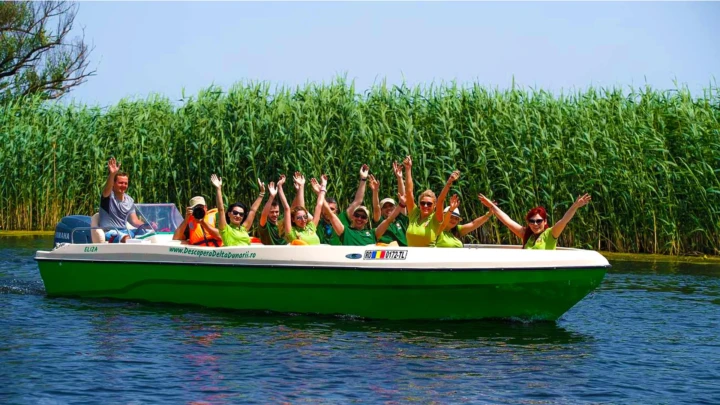
Discover the wild Danube Delta between Tulcea and Mila 23 with a naturalist guide, and taste fresh fish cooked the local way in a fishing village reached only by water.

Destinations: Danube Delta
A day by boat from Tulcea to Letea, with a coffee stop in Mila 23, a safari car to Letea Forest and an optional lunch in a local household.

Destinations: Danube Delta
Six hours with a boat and a guide only for you, through hidden channels and quiet lakes to the fishing village of Mila 23, with an optional lunch at a local guesthouse.
From €450 per boat
See the tour: PRIVATE Guided Day Trip in Danube Delta, Tulcea to Mila 23
Destinations: Danube Delta
Cross the Danube Delta from west to east with your own boat and guide, through Mila 23 and along the Old Danube to Sulina and the Black Sea.
From €550 per boat
See the tour: PRIVATE Guided Day Trip in Danube Delta, Tulcea to SulinaKeep reading
More from the blog

3 min read
Macin Mountains National Park, the Old Mountains of Dobrogea
Among the oldest mountains in Romania, worn down to rocky ridges above the steppe: rare plants, birds of prey and quiet trails, close to...

3 min read
Histria, the Greek City on the Shore of Lake Sinoe
Founded by settlers from Miletus in the 7th century BC, Histria lived for thirteen centuries on the shore of a Black Sea gulf that...

5 min read
Tulcea City Break: Museums, History and the Aquarium
A day in Tulcea, the gateway to the Danube Delta: the Monument Hill, the museums of history, folk art and fine art, and the...