

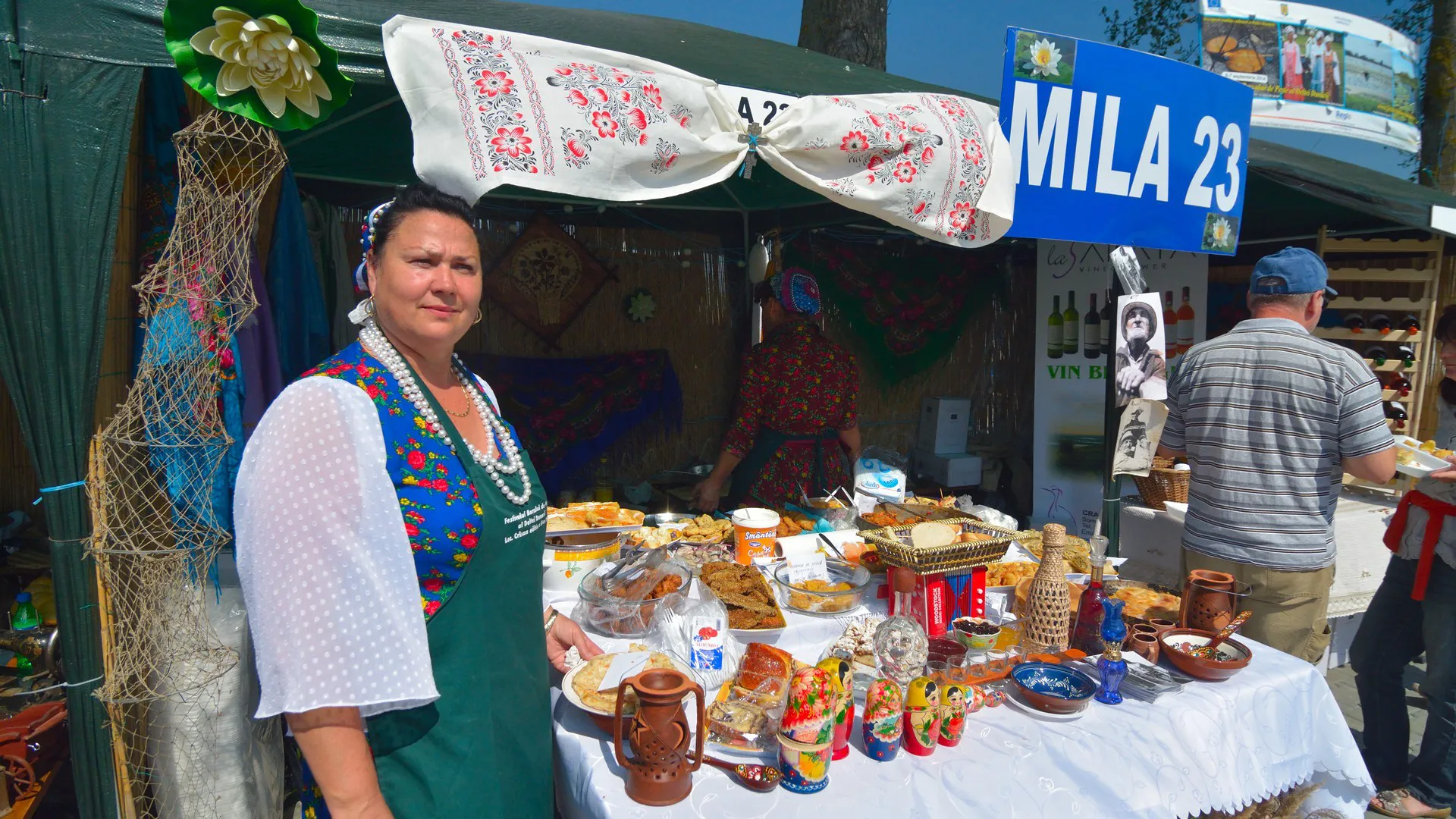
Mila 23: the Lipovan Village in the Heart of the Danube Delta
A village reached only by boat, on the Old Danube: 6,000 years of history, Lipovan Blue houses and the canoe champions who made Mila 23 famous.
Mila 23 is a village you can reach only by water. It stands on the bank of the Old Danube, right in the middle of the Danube Delta, with houses painted white and Lipovan Blue, quiet lanes without cars and the water a few steps from every gate. It is also our home in the Danube Delta and the starting point of most of our tours.
Quick facts
- Where On the Old Danube, in the middle of the Danube Delta, Crisan commune, Tulcea County
- Population About 450 people
- Access Only by boat
- People Mostly Lipovans, Russian Old Believers
- Known for Its canoe and kayak champions, among them Ivan Patzaichin
- Ivan Patzaichin Museum Usually open Wednesday to Sunday, 11:00 to 18:00

Where the name comes from
The name is a waterway mark. Distances on the Sulina branch are counted in nautical miles, from mile 0 at Sulina, on the Black Sea coast. The village grew at mile 23 of the old Sulina branch, the winding course that ships followed before the branch was straightened for navigation at the end of the 19th century. When its great bends were cut off, this stretch became the Old Danube, a quiet branch that large ships no longer use.
Before the straightening, Mila 23 was an important stop on the way between Tulcea and Sulina. In the days of boats moved by oars, it lay about halfway between the two towns, a full day of rowing, so most boats going up or down the river stopped here for the night. Read more about how Mila 23 was born, from a Greek inn to the first fishermen’s houses.
Six thousand years of life on the water
People lived here long before the village. About 4.5 km southwest of Mila 23, at a place called Taraschina, archaeologists have been studying since 2009 a settlement mound from the second half of the 5th millennium BC, belonging to the Gumelnita culture of the Copper Age. Today the site lies partly under water. The artefacts date from about 4,400 to 4,300 BC and show people who lived from farming and raising animals. The excavations, run by a joint Romanian and French team (the research institute of the Tulcea museums, the National History Museum of Romania and French research laboratories), also found later layers: Greek, Roman and medieval.
In 2013 a second Copper Age site was recorded on the bank of the Sontea channel, after a man from Mila 23, Haralambie Buhaev, showed it to the researchers. It is now known as Dambul lui Haralambie, Haralambie’s Mound.
From scattered households to the platform
For a long time Mila 23 was not one compact village but a string of hamlets scattered along the Sulina branch, the Old Danube and the nearby channels. The place on the bank opposite today’s village was called Fantana Dulce, Sweet Fountain, and the largest settlement, with the most houses, lay downstream of the junction with the Eracle channel, on both banks. After the great floods of 1970 and 1974, the houses moved onto a platform: a stretch of land raised artificially on the right bank of the Old Danube. The community church, dedicated to Saint John Chrysostom, was built on the platform in 1983, in the place of an older church. Thanks to the platform, the village stays dry when the spring high water comes.
After 1980 the village grew again. From the 1960s, large areas around Pardina were drained for agriculture, and in the 1980s fish farms were built on the Stipoc ridge, so the fishermen who lived there lost their fishing grounds. Many of them took refuge in Mila 23 and built their houses on the platform, next to those of the flood victims and the old families of the village. The old hamlets were slowly forgotten, and the village found its new place on the Old Danube.
A Lipovan village
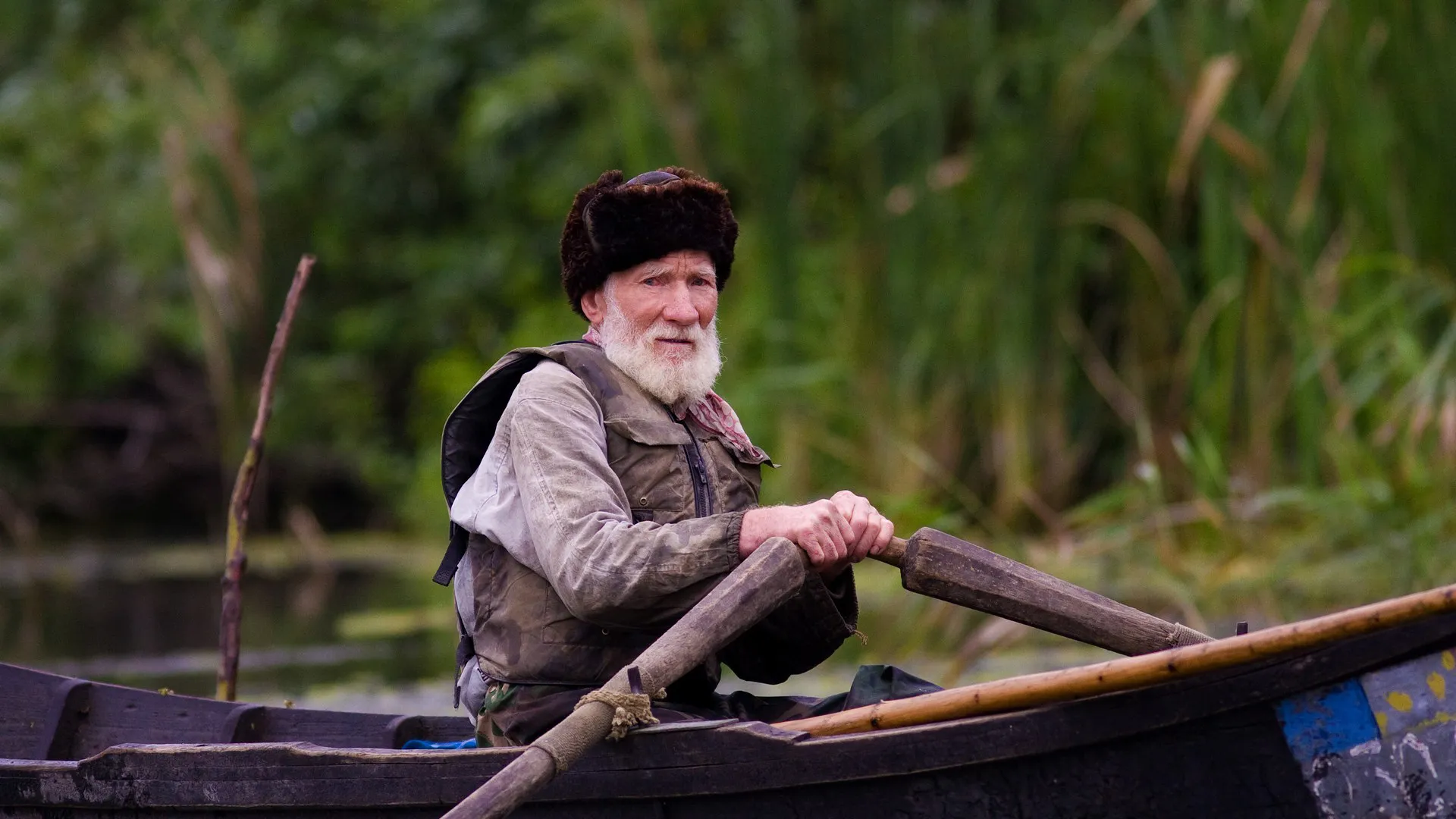
Most people in Mila 23 are Lipovans, Russian Old Believers whose ancestors refused the church reforms of Patriarch Nikon in 1654 and, persecuted at home, found refuge in the Danube Delta and Dobrogea. They kept their faith, their language and their way of building, with natural materials such as reed, wood and clay. The old houses are white, with window frames, gates and fences in the intense light blue known as Lipovan Blue. Russian is still spoken in the lanes, and the village has two Lipovan choirs, Sinicika and Rusalka, which often take part in contests and festivals. Its team of cooks won first place two years in a row at the D’ale Gurii Dunarii cooking contest.
The village of champions
Generations in Mila 23 grew up on the water, and the paddle was part of everyday life. In the 1960s, canoe and kayak coaches came looking for these young fishermen, and the village became a nursery of champions. Serghei Covaliov, born here in 1944, was world champion in canoe doubles in 1966 and won Olympic gold in Mexico City in 1968, together with another boy from Mila 23, Ivan Patzaichin.
Patzaichin, born here in 1949, went on to win four Olympic gold medals (1968, 1972, 1980 and 1984) and was named athlete of the 20th century by the International Canoe Federation. Agafia Buhaev, also born in Mila 23, won Olympic gold in the women’s kayak four in Los Angeles in 1984, and Culina Popov also came from the village’s kayak tradition. Their close relatives still live in Mila 23 and tell visitors stories from the childhood of these great champions. Inspired by them, around twenty young people from the village became Olympic, world or European champions. The Ivan Patzaichin Museum in the village tells his story; it is usually open Wednesday to Sunday, 11:00 to 18:00.
Mila 23 today
Many families of fishermen have turned to tourism, and the village has guesthouses rated from 2 to 4 stars. Thanks to tourism, the village also built a running water network that reaches every house. Life still follows the water: boats are the cars of Mila 23, everything arrives by boat and the day starts early. In spring and summer pelicans fly over the houses, and Pallas’s gulls rest almost every day on the water in front of the village. The calm is deepest at sunrise and in the evening, outside the hours of the speed boats, now the greatest threat to nature in the Danube Delta.
Around the village
Mila 23 sits at a crossroads of the Danube Delta. In one day by boat you reach the lakes Trei Iezere, Fortuna and Radacinos, the Sontea channel, the great lakes of the north around Matita and Merhei, or the oak forest of Letea. This is why we chose it as the base of our tours: from here, every day can follow a different route. Read our 10 reasons for Mila 23.
Discover Mila 23 with us
You can see Mila 23 on our shared day trip from Tulcea, with a stop to taste the local cuisine, or stay in the village on our nature tour of 4 days, the Summer Nature Escape or a private tour in Mila 23. Our birdwatching and photo tours are based here too. See also where you stay.
See it with us
Slow open boats, small groups and a guide who knows the places and the wildlife. From a few hours on the water to a week in the Danube Delta and Dobrogea.
Keep reading
Keep reading
More from the blog

3 min read
Why Mila 23? 10 Reasons We Chose It as Our Home in the Danube Delta
Only by boat, on a quiet branch, with pelicans overhead and a different route every day: why we made Mila 23 our home in...

For photographers4 min read
The Danube Delta: a Complete Guide for Photographers and Nature Lovers
When to come, where to go, what you can see and how to photograph it: a complete guide to the Danube Delta for photographers...
9 min read
How Mila 23 Was Born: a Greek Inn, Pirates and the Mile That Named a Village
A Greek innkeeper from Kefalonia, the pirates of Sulina, Lipovan fishermen and a river mile marker: how the village of Mila 23 began in...