

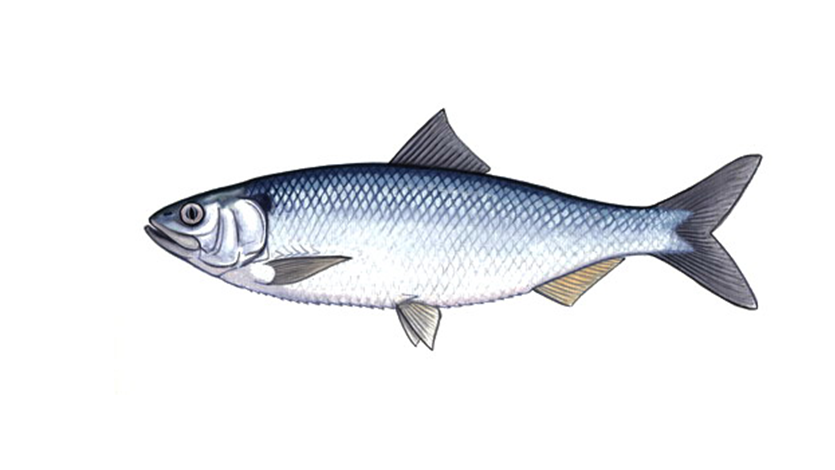
Pontic Shad (Alosa immaculata): the Great Migrant of the Danube
Every spring the Pontic shad swims from the Black Sea up the Danube to spawn: its migration, size, status and interesting facts.
Every spring, huge shoals of a silvery fish leave the Black Sea and swim up the Danube to spawn. The Pontic shad, also called the Danube shad, is one of the great migrants of the river, a key link between the sea and the Danube Delta and one of the most valued fish on local tables.
Quick facts
- Scientific name Alosa immaculata (formerly Alosa pontica)
- Family Herrings and shads (Clupeidae)
- Size Usually 25 to 35 cm, up to about 41 cm and 700 g
- Lifespan Up to 7 years
- Migration From the Black Sea up the Danube, mainly March to June
- IUCN Red List Vulnerable in 2008, Least Concern in the 2022 assessment
Description
The Pontic shad has a slender, streamlined body, silver on the sides with a blue green back, a deeply forked tail and large scales that come off easily. Its scientific name, immaculata, means spotless: unlike some related shads, it usually has no row of dark spots along the flank.
Where it lives
The species lives in the Black Sea and the Sea of Azov and migrates to spawn in the large rivers that flow into them: the Danube, the Dniester, the Dnieper, the Don and the Kuban. In Romania it is found in the Black Sea along the coast, in the Danube Delta and along the Danube, on its way upstream.
The spring migration
The migration starts in early spring, when the water of the Danube reaches about 3 to 7°C, peaks in April and May at 9 to 17°C, and ends in June. The shad enter the Danube through its branches in the Danube Delta and swim upstream for hundreds of kilometres; one of the key spawning areas in Romania lies near Braila. Spawning takes place in the river, in late spring and early summer. The eggs drift with the current, and the young fish are carried down toward the sea, where they grow.
Studies on the Romanian Danube show shoals made mostly of fish 3 to 5 years old, measuring on average about 30 to 33 cm and weighing around 300 g, with females slightly larger than males.
Food
At sea, the Pontic shad hunts small fish and crustaceans. During the spawning migration it feeds very little, living on the fat reserves gathered in the sea.
Status and threats
The Pontic shad was listed as Vulnerable on the IUCN Red List in 2008; the latest global assessment, from 2022, lists it as Least Concern. Its main threats are overfishing during the migration and the loss of spawning grounds. The great dams on the Danube block its way upstream, and the species is now considered extinct in Hungary, where it once arrived every spring.
Interesting facts
- Its meat is very rich: studies on the Lower Danube found about 17 to 18% fat, rich in polyunsaturated fatty acids, which explains its fame in the kitchen.
- In Romania, annual catches of Pontic shad averaged 200 to 500 tonnes between 2008 and 2017, making it one of the most important commercial fish of the Danube.
- Males usually arrive first at the start of the migration; toward the end, females dominate the shoals.
- The shad that arrive at the mouths of the Danube carry the most fat; it is used up gradually on the long swim upstream.
In the Danube Delta
For the fishermen of the Danube Delta, the shad run has always been one of the signs of spring, and grilled or smoked shad is part of the local cuisine. Discover more fish of the region in our list of the fishes of the Danube Delta and the Black Sea.
See it with us
Slow open boats, small groups and a guide who knows the places and the wildlife. From a few hours on the water to a week in the Danube Delta and Dobrogea.
Keep reading
Keep reading
More from the blog

Birds3 min read
Green-winged Teal (Anas crecca)
A small dabbling duck with a flash of green in the wing. Green-winged Teal, also called Eurasian Teal, occurs locally from September to April.

Birds3 min read
Northern Shoveler (Spatula clypeata)
The Northern Shoveler feeds with its broad bill in the water, filtering tiny crustaceans and seeds. It is present year-round in the Danube Delta.

Birds5 min read
Purple Heron (Ardea purpurea)
The heron of the reed beds: once the most common heron of the Danube Delta, now second to the Grey Heron, and the reason...