

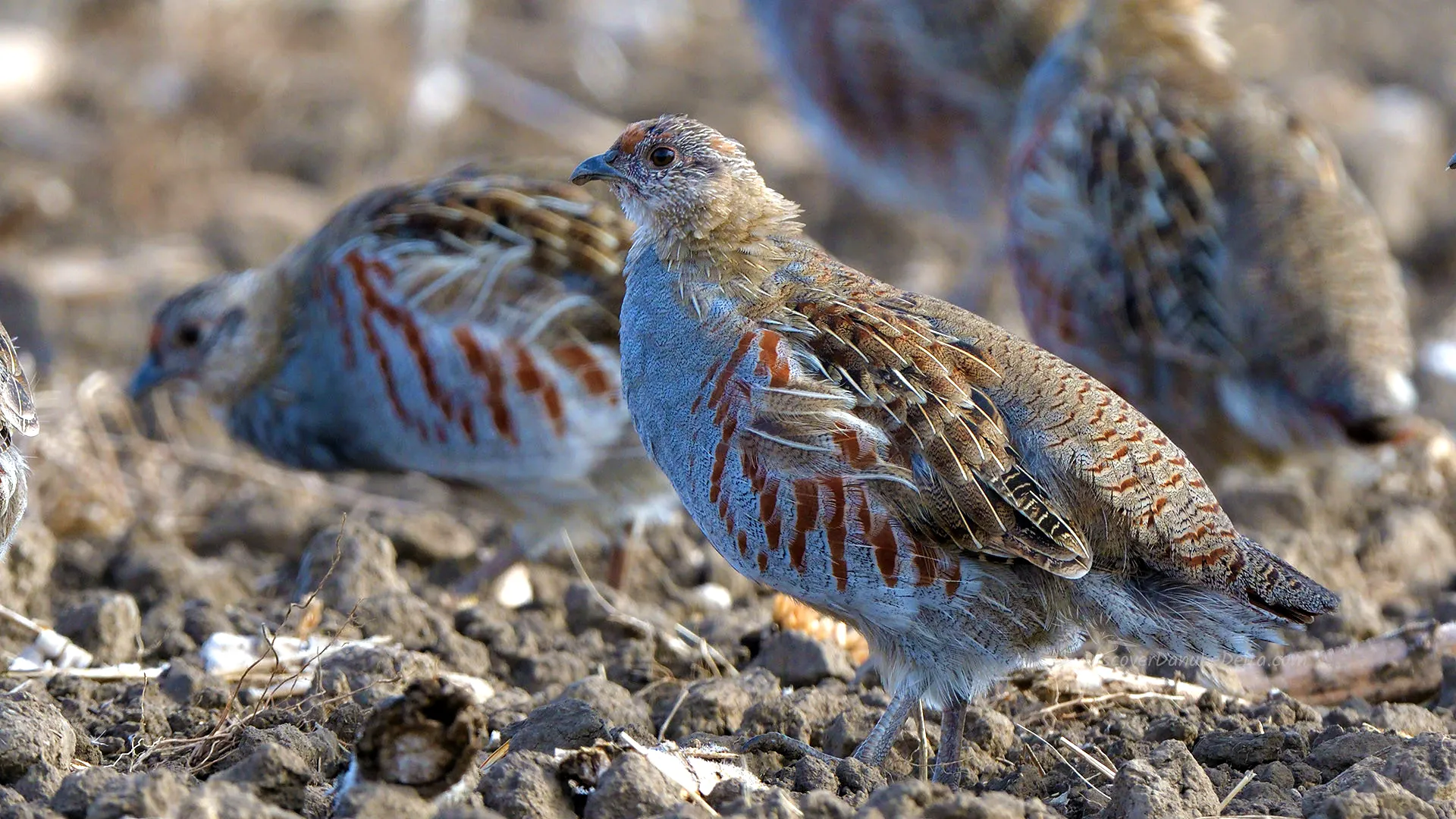
No. 40 on our checklistGrey Partridge (Perdix perdix)
A plump farmland bird of the Dobrogea steppe that freezes in the grass and bursts into flight at your feet
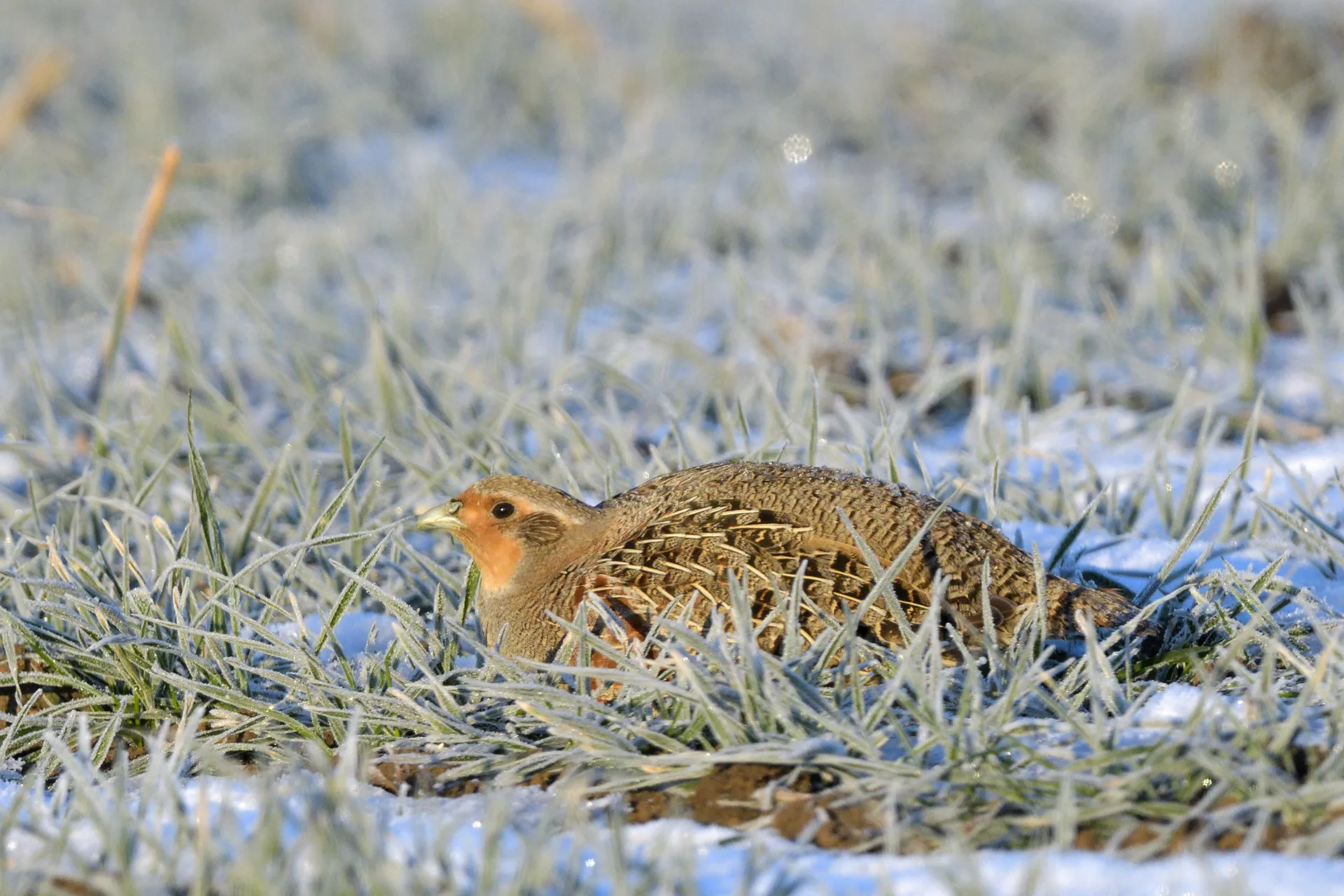
The Grey Partridge is a round, short tailed bird of open farmland and steppe. It lives all year in the fields of continental Dobrogea, walking along the edges of crops and grassy ditches, and it is far easier to hear than to see. Most visitors meet it the same way: a few birds that have been crouching motionless in the grass suddenly explode into the air a few metres away, whirr low over the field and drop out of sight again.
Quick facts
- Scientific name Perdix perdix
- Length 29 to 32 cm
- Wingspan 46 cm
- Weight 390 g
- Clutch usually 13 to 16 eggs
When to see it in the Danube Delta and Dobrogea
- JanModerate
- FebModerate
- MarModerate
- AprModerate
- MayModerate
- JunModerate
- JulModerate
- AugModerate
- SepModerate
- OctModerate
- NovModerate
- DecModerate
- Status here
- All year. Resident.
- IUCN Red List
- Least Concern
- Our checklist
- No. 40 of 385 · see the full checklist
How to recognise it
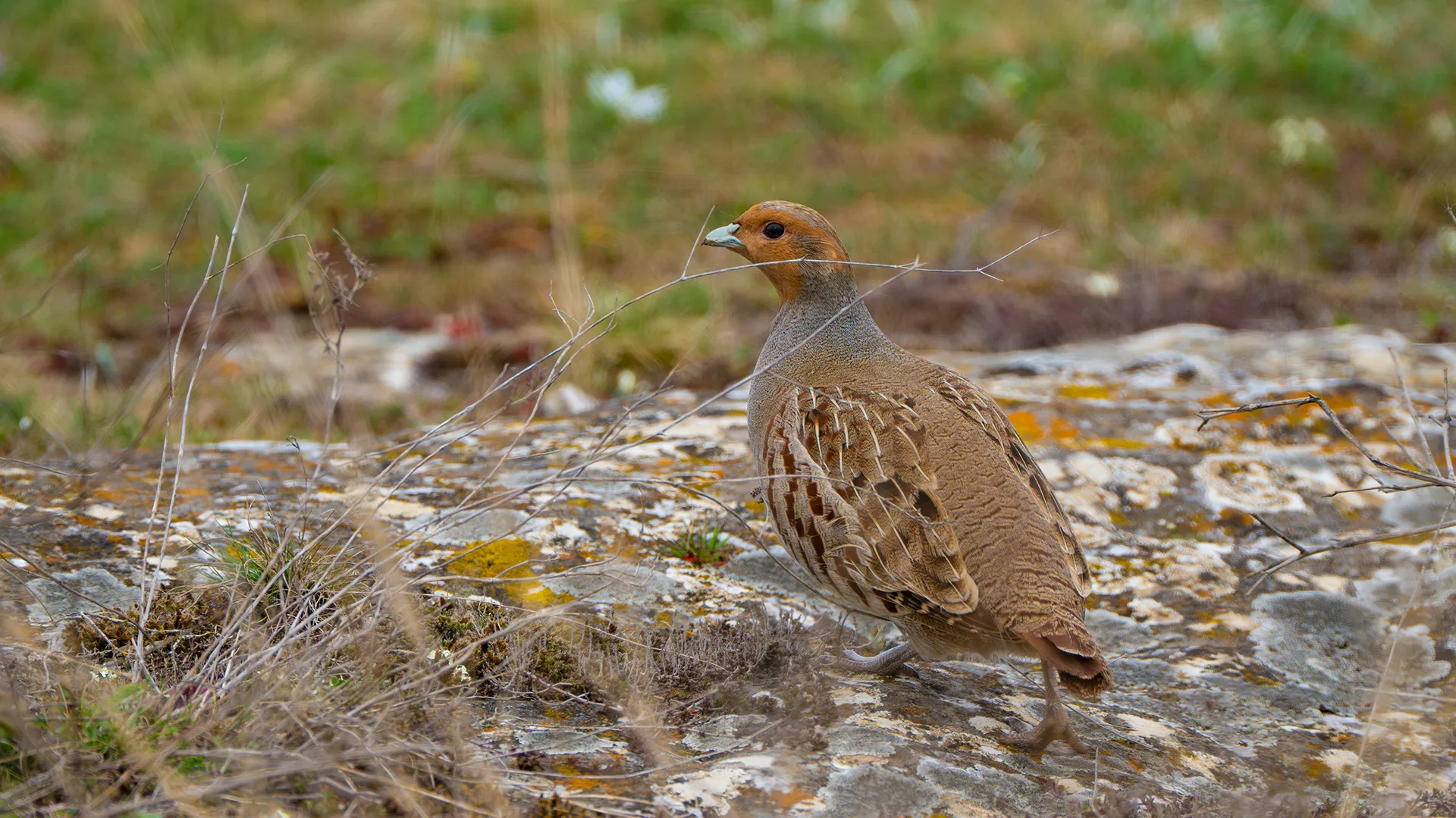
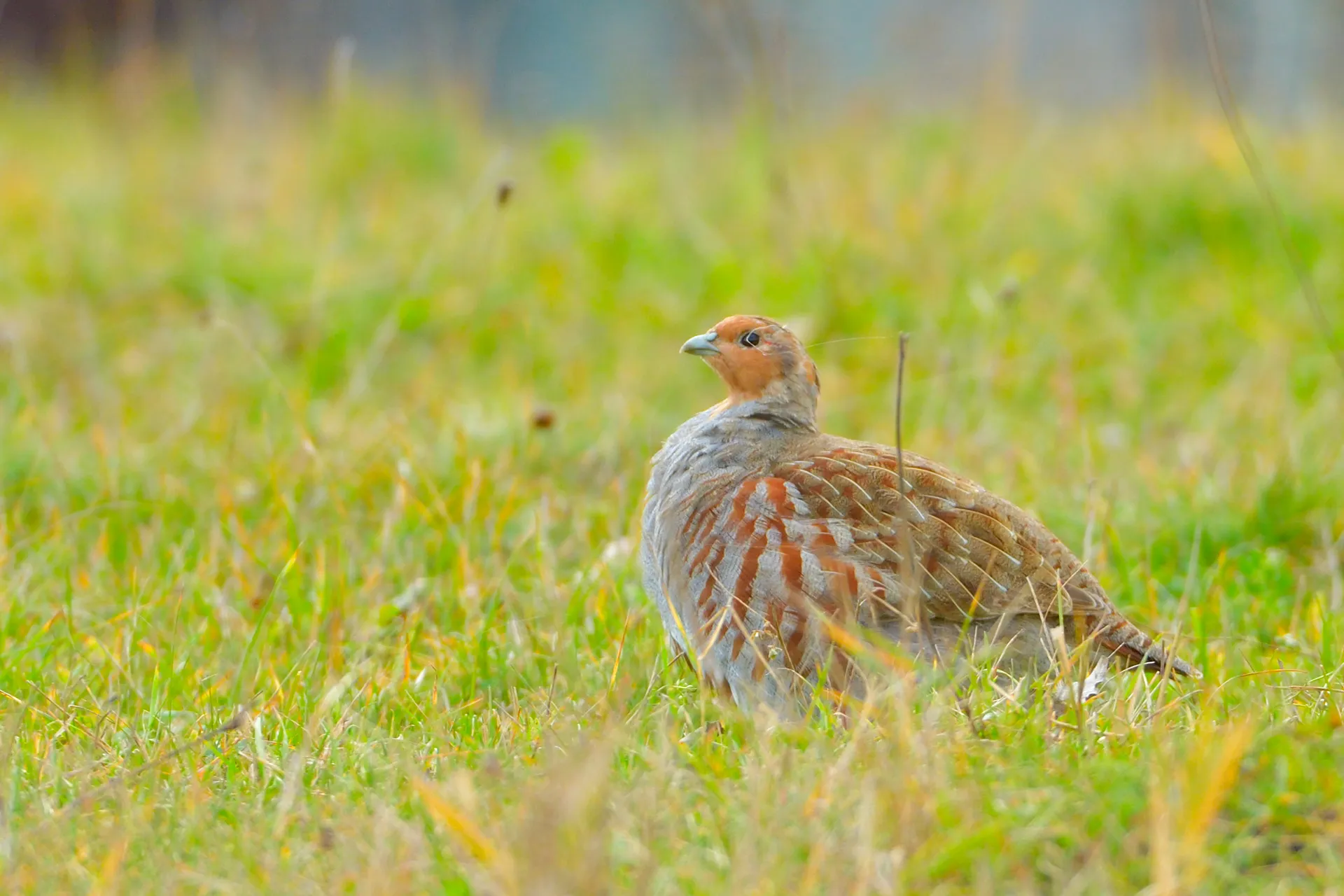
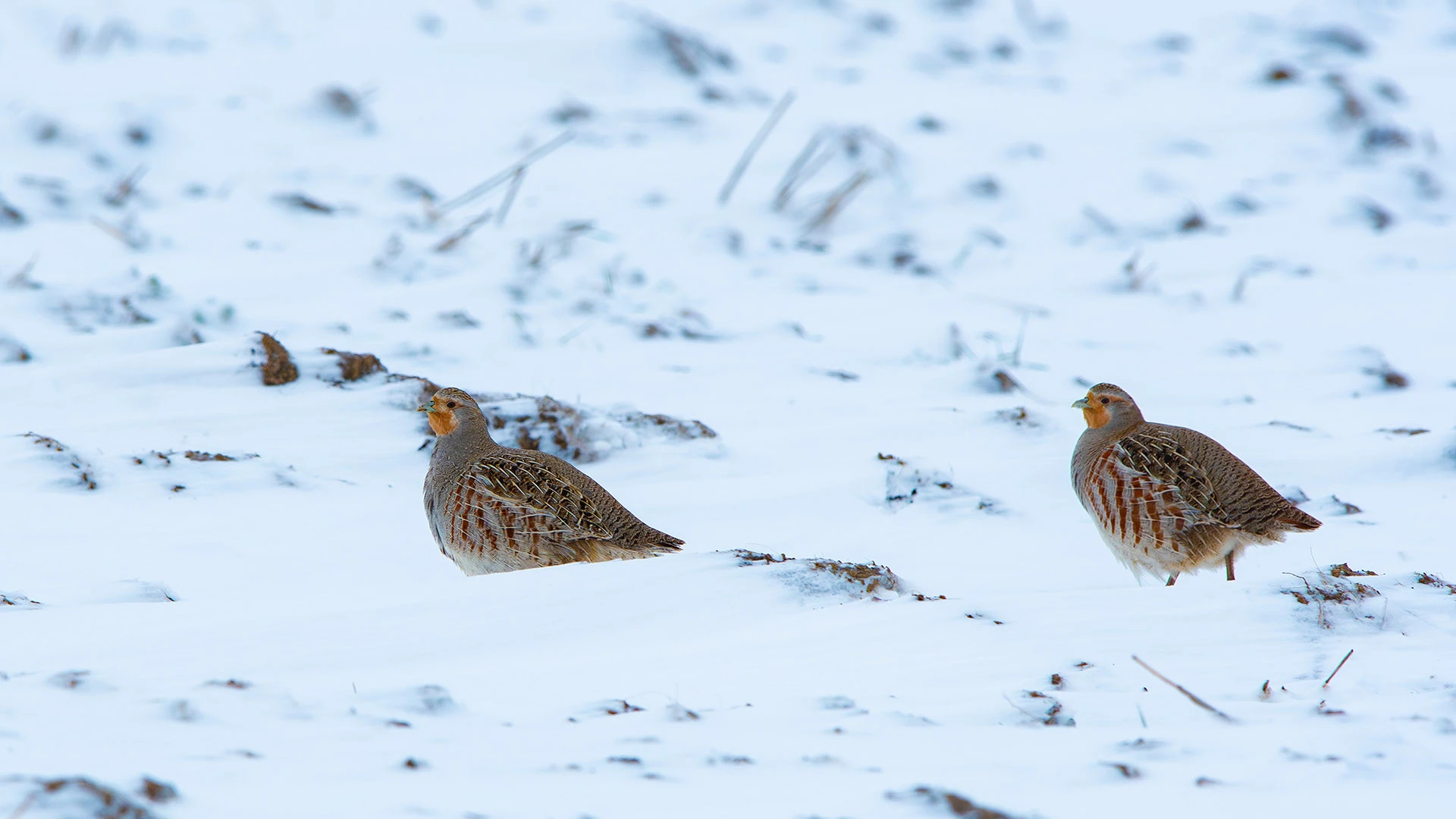
Seen well, it is a beautiful bird. The face and throat are a warm orange, the neck and breast fine grey, and the flanks are barred with broad chestnut stripes. On the belly the male carries a dark chestnut patch shaped like a horseshoe; in the female it is usually smaller, sometimes missing. The back is brown with pale streaks, which is all you see when the bird crouches in a furrow.
In flight, look for the rusty orange outer tail feathers, the rapid whirring wingbeats and the long glides on bowed wings, low over the crop. In spring and at dusk the male gives a harsh, creaking call, often the first sign that partridges are in the field.
Life in the fields
Grey Partridges pair up at the end of winter and nest on the ground, in the tall grass of a field margin, a ditch or a hedge bottom. The clutch is one of the largest of any bird: usually 13 to 16 eggs, incubated by the female for 23 to 25 days. The chicks leave the nest a few hours after hatching and, for their first weeks, live almost entirely on insects.
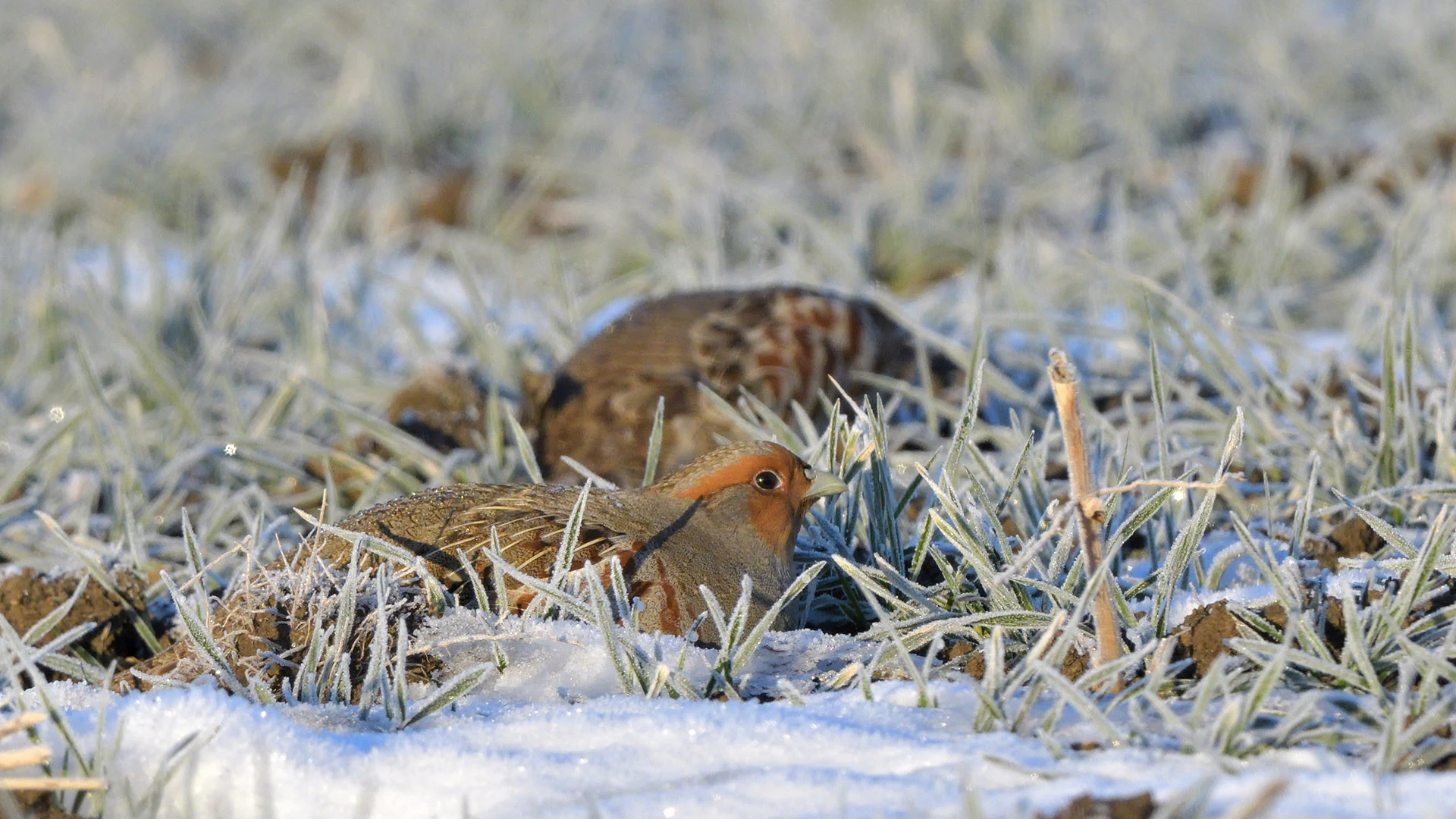
After the breeding season the families stay together as coveys, and in autumn and winter you meet groups of ten or more birds feeding on seeds, shoots and fallen grain. When danger comes, their first answer is to freeze, trusting their colours. Only when that fails does the whole covey burst up at once.
Where to see it in Dobrogea
The Grey Partridge is resident in Dobrogea and can be found in every month of the year. It needs open land with some cover: small fields, steppe grassland, field edges with weeds and ditches with tall grass. You will not find it in the reed beds and on the water of the Danube Delta; its place is in the dry farmland and steppe of continental Dobrogea, inland from the wetlands.
The best chances are early in the morning and late in the afternoon, when the birds come out to feed along the edges of the fields and the tracks between them. Driving slowly on farm tracks and scanning the margins works better than walking, because a partridge that hears footsteps simply sinks into the grass. Winter, with the crops low or gone, is the easiest season to see whole coveys.
We look for it on our continental Dobrogea birding day trip from Tulcea, and in winter on the winter birding day trip, where the same fields hold the Red-breasted Geese.
Interesting facts
- A bird from a Greek myth. Perdix is the Greek word for partridge. In the myth told by Ovid, the inventor Daedalus threw his nephew Perdix from the Acropolis out of jealousy, and the goddess Athena turned the boy into a partridge in mid air. Remembering his fall, the story says, the partridge never flies high and nests on the ground.
- “Hungarian Partridge” in America. The species was brought to North America in the early 20th century, many birds coming from Hungary, and hunters there still call it the “Hun”.
- A family that sleeps in a circle. On winter nights a covey roosts on the ground packed tightly together, the birds facing outwards, so that they keep warm and can explode in every direction at once if a fox comes close.
Why it is declining
Worldwide the Grey Partridge is listed as Least Concern by the IUCN, but across much of Europe its numbers have fallen sharply since the 1960s; in the United Kingdom, where it is best studied, the breeding population dropped by more than 90%. The main cause is modern farming. Herbicides and insecticides remove the insects the chicks depend on, so the broods starve in their first weeks. Large fields with no margins leave no place to nest, and early mowing destroys clutches.
Switzerland shows where this road ends. In the middle of the 20th century about 10,000 Grey Partridges lived on Swiss farmland. By 2018 only two breeding pairs were left, near Geneva, and after no birds were found in 2019 the species was declared extinct in the country. Years of habitat work and the release of hundreds of birds could not bring it back.
In Romania the Grey Partridge is still a game species, hunted every autumn, while the same pesticides and the same large fields that emptied Western Europe spread across our plains. We think this is a mistake. Hunting a farmland bird that is disappearing from half of Europe, instead of protecting the margins and fallow strips it needs, repeats exactly what other countries have already paid for. Where small fields and weedy edges remain, as in parts of Dobrogea, partridges still hold on. Seeing a covey here is a privilege that much of Europe has already lost.
See it with us
Our birding guides are biologists and ornithologists who are on the water every day of the year. Small groups, open boats, the best hours of the day.
Keep reading
Keep reading
More from the blog
3 min read
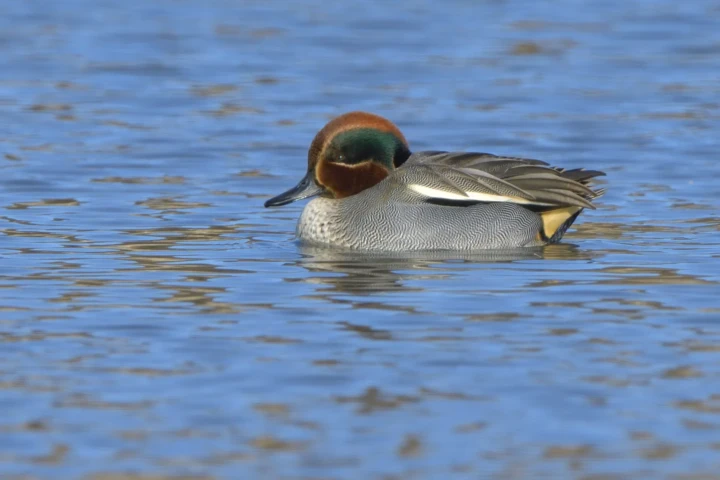
Green-winged Teal (Anas crecca)
A small dabbling duck with a flash of green in the wing. Green-winged Teal, also called Eurasian Teal, occurs locally from September to April.
2 min read
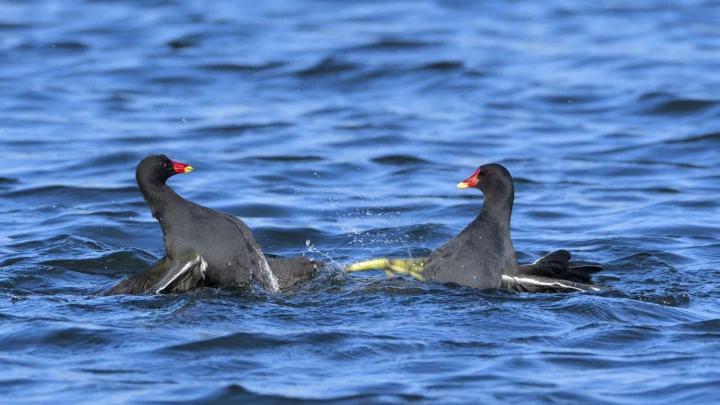
Common Moorhen (Gallinula chloropus)
A red bill with a yellow tip and a flick of white under the tail mark the Common Moorhen, a summer breeder in the...
4 min read
Western Marsh Harrier (Circus aeruginosus)
Gliding low over the reeds with wings raised in a shallow V: the Western Marsh Harrier is the most typical bird of prey of...