

No. 16 on our checklistSteppe Runner (Eremias arguta)
Meet the Steppe Runner, a fast steppe lizard that in the EU lives only in Romania, on the sand dunes of the Danube Delta: identification, habitat, breeding and conservation.
The Steppe Runner (Eremias arguta) is a lizard of the Central Asian steppes that reaches its western limit on the sand dunes of the Danube Delta. Within the European Union it lives only in Romania, and almost all Romanian records come from the sandy levees and beaches of the Danube Delta.
It is fast, well camouflaged against the sand and easy to miss until it dashes from one tuft of grass to the next.
Quick facts
Quick facts
- Scientific name Eremias arguta (Pallas, 1773); Romanian populations belong to Eremias arguta deserti (Gmelin, 1789)
- Common name Steppe Runner, also written Steppe-runner
- Family Lacertidae (wall lizards and relatives)
- Order Squamata (lizards and snakes)
- Length males about 15 cm including the tail; females 1–2 cm smaller
- Diet small invertebrates, mainly insects such as beetles and ants, and spiders
- Habitat sand dunes with sparse vegetation on the marine levees and the Black Sea beaches of the Danube Delta
- Activity by day, in warm weather; runs quickly between plants and can bury itself in sand
- Breeding lays eggs; mating in May and June, eggs laid at the beginning of July
- Conservation status Least Concern in Europe and Vulnerable in the EU27 (European Red List, 2025); Endangered in the Romanian Red Data Book of Vertebrates (2005)
When to see it in the Danube Delta and Dobrogea
- JanWinter rest
- FebWinter rest
- MarWinter rest
- AprWeather-led
- MayMating season
- JunMating season
- JulEgg-laying
- AugActive
- SepActive
- OctWeather-led
- NovWinter rest
- DecWinter rest
- Status here
- Indicative seasonal pattern; activity depends on sunshine and sand temperature. No abundance estimate.
- IUCN Red List
- Least Concern in Europe and Vulnerable in the EU27 (European Red List, 2025)
- Our checklist
- No. 16 of 30 · see the full checklist
Description and identification
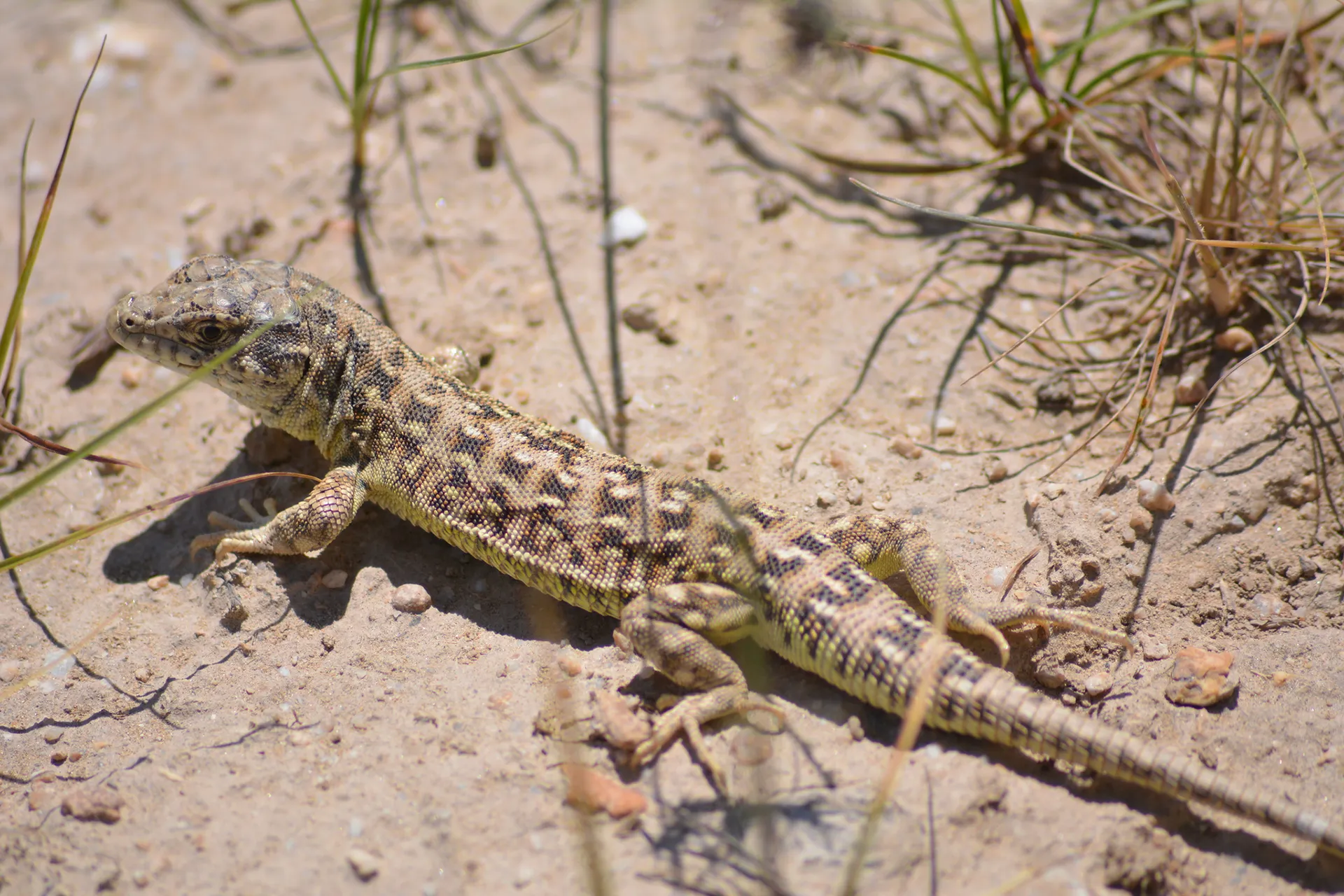
The Steppe Runner is a small, sturdy lizard with a deep head and a relatively short tail. The back is grayish brown, marked with rows of ocelli: small whitish spots ringed by dark scales, running along the length of the body. In young lizards the ocelli can merge into pale lines parallel to the spine. The belly is whitish and unmarked.
Older males can have rough, tubercle-like scales on the head and neck, which give them a slightly dragon-like look. Both pairs of legs carry well-developed scales that the lizard uses for digging, so it can disappear into loose sand in a moment.
Only two other small lizards share its range in Europe: the Sand Lizard and the Balkan Wall Lizard. Female Sand Lizards can look similar at first glance, but they have a noticeably thicker tail. The combination of open sand, rows of pale eye-spots and very fast, low dashes is typical of the Steppe Runner.
A lizard of the Danube Delta’s dunes
The first Romanian record came from near Lake Sinoe at the very beginning of the 20th century, and in 1911 Grigore Antipa confirmed the species on the sand dunes of the Danube Delta. Since then it has been recorded on the marine levees of Letea and Caraorman, at Sărăturile and Sfântu Gheorghe, and in the southern Danube Delta at Periteașca, Grindul Perișor, Grindul Lupilor, Gura Portiței, Grindul Chituc, Histria and Vadu. Old records also exist from Enisala and Jurilovca.
It lives on dunes with sparse vegetation, both on the sandy levees in the western part of the marine Danube Delta and along the coast, and on the levees of the Razim-Sinoie lagoon complex. At Sfântu Gheorghe it was found only on small vegetated dunes on the beach. Outside Dobrogea, the species was confirmed again in 2007 in the Hanu Conachi sand dune reserve in southern Moldavia, where much of its habitat has been lost to Black Locust plantations.
On Grindul Chituc, Zsolt Török followed the first row of high, vegetated dunes behind the beach on a single August day in 2007. Along a narrow strip about 3.2 km long and only a few meters wide, he recorded 371 Steppe Runners, almost all of them adults. The lizards were found from that row of dunes inland only as far as the edge of the denser, rush-dominated vegetation. This was a count on one day in one very narrow habitat, not an estimate for the whole Danube Delta.
Running, digging and breeding
The Steppe Runner is very fast. In open sand it usually moves in short, rapid dashes between plants, such as tufts of grass or small bushes, which serve as shelter. When disturbed it can run a long way before stopping, but a slow, careful approach often allows a good view.
Its ability to bury itself quickly in sand, together with colors that match the ground, lets it live in open, sparsely vegetated places where other lizards would be more exposed to predators. On Chituc the lizards sheltered under clumps of lyme grass, wormwood, saltwort and Sea Holly.
According to Fuhn and Vancea, the Romanian population mates in May and June, and a clutch of usually four eggs is laid at the beginning of July. The diet consists of small invertebrates, especially insects such as beetles and ants, and spiders.
Conservation and responsible observation
Globally the Steppe Runner is assessed as Least Concern, because it has a very large range in Asia. In the European Red List published in 2025 it is Least Concern in Europe as a whole but Vulnerable in the EU27, where it occurs only in Romania. The first European assessment, in 2009, rated it Near Threatened in Europe and Vulnerable in the EU27, and named coastal development for tourism and military purposes as major threats.
In Romania it is listed as Endangered in the Romanian Red Data Book of Vertebrates (2005) and as Vulnerable in the Red List of the Danube Delta Biosphere Reserve. It is not included in the EU Habitats Directive, but it is strictly protected in Romania as a species of national interest under Annex 4B of Government Emergency Ordinance 57/2007, and it is listed in Appendix III of the Bern Convention.
The vegetated dunes it depends on are fragile. Stay on existing paths and tracks, do not drive or camp on the dunes, and do not try to catch the lizards or dig them out. The calendar above shows seasonal activity, not how many lizards are present.
Seeing it on a nature tour
On our multi-day nature tours in the Danube Delta, the sandy levees of Letea and Caraorman and the wild beaches of the coast offer a chance to see this steppe lizard at the western edge of its range. Watch the open sand between tufts of grass on a warm, sunny day, and be ready for a very brief view.
See it with us
Slow open boats, small groups and a guide who knows the places and the wildlife. From a few hours on the water to a week in the Danube Delta and Dobrogea.
Keep reading
Keep reading
More from the blog
5 min read
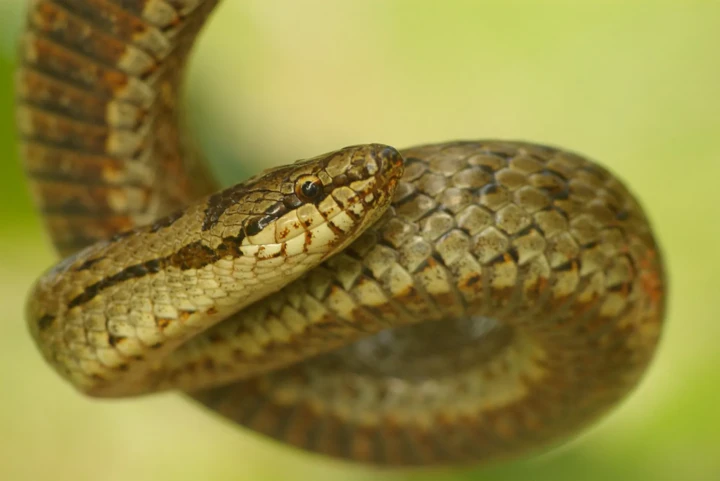
Smooth Snake (Coronella austriaca)
Discover the Smooth Snake in the Danube Delta and Dobrogea: identification, live-bearing reproduction, dry refuges and responsible wildlife watching.
5 min read
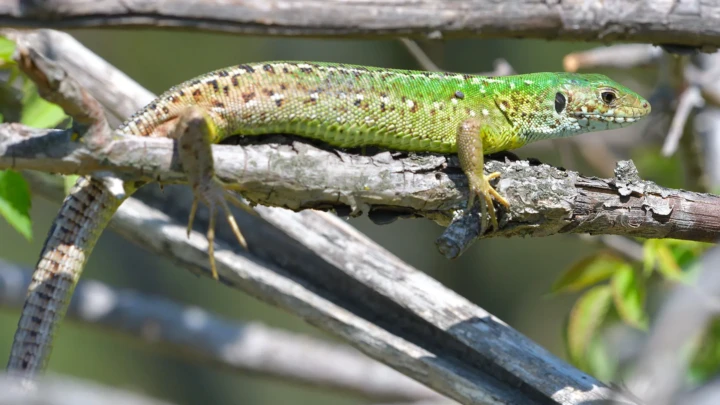
European Green Lizard (Lacerta viridis)
A bright green lizard up to 40 cm long, basking on the bushes of Dobrogea's hills. Discover the European green lizard and where to...
5 min read
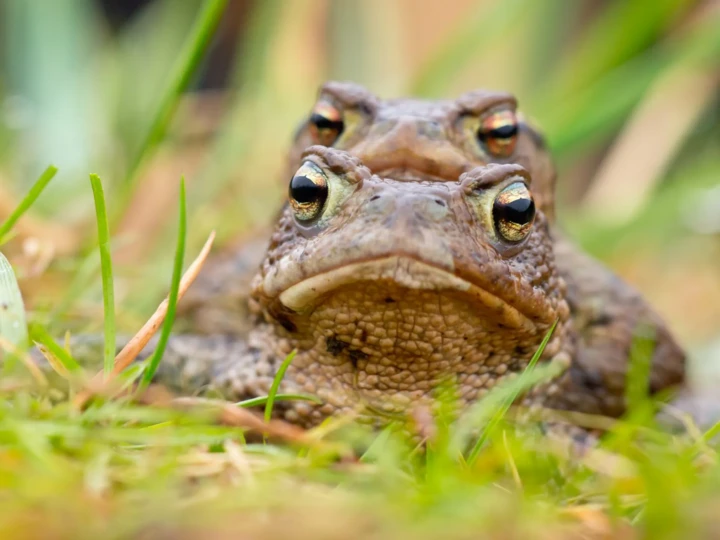
Common Toad (Bufo bufo)
Meet the Common Toad in the Danube Delta and Dobrogea: golden eyes, spring breeding journeys and a mostly hidden life on land.