

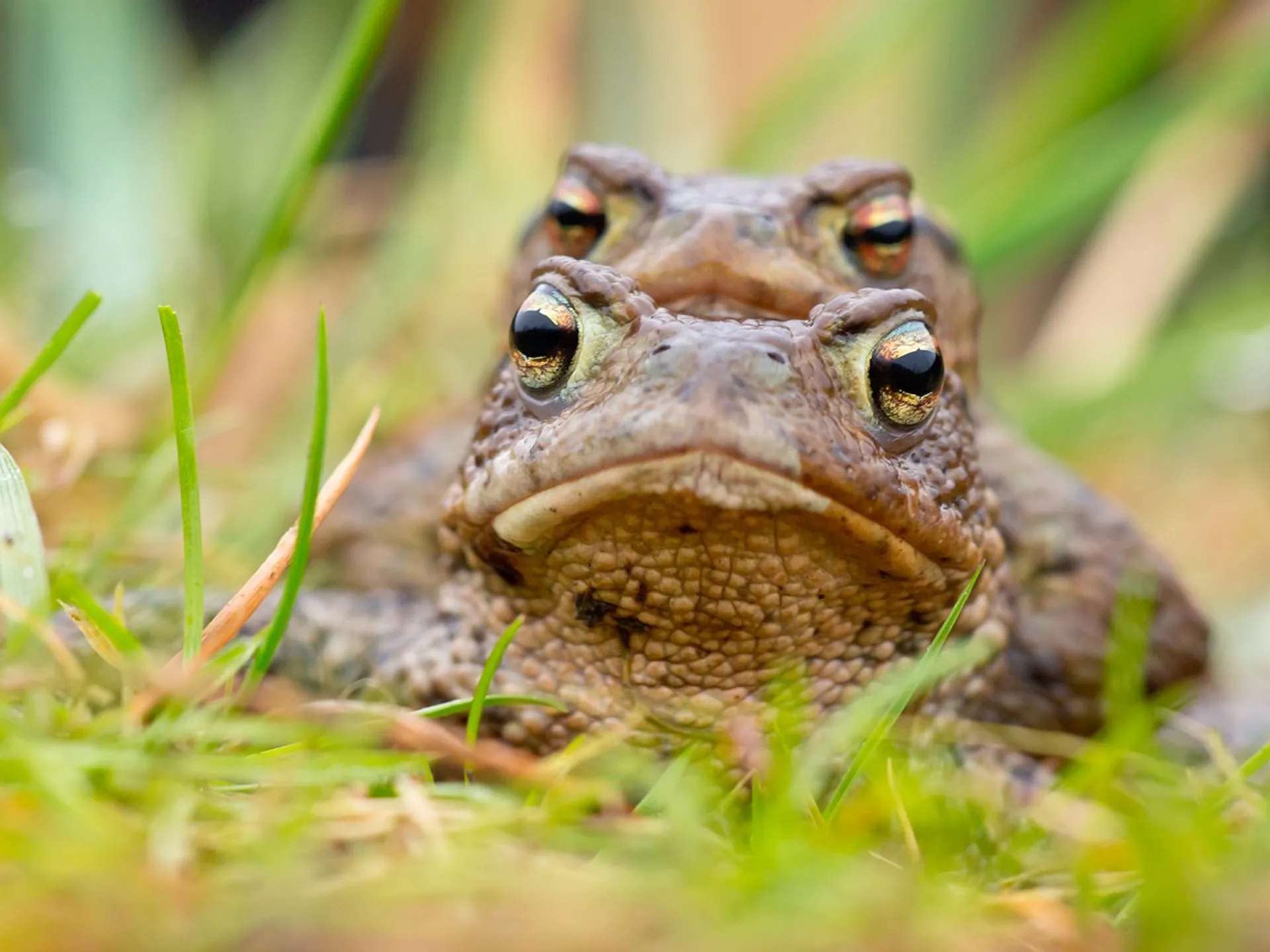
No. 6 on our checklistCommon Toad (Bufo bufo)
Meet the Common Toad in the Danube Delta and Dobrogea: golden eyes, spring breeding journeys and a mostly hidden life on land.
The Common Toad (Bufo bufo) is an amphibian that spends much of its life away from water. Its warty brown skin, copper-gold eyes and deliberate walk suit a life among leaves and roots, rather than the conspicuous daytime activity of frogs along a channel.
In the Danube Delta and Dobrogea, the word “common” needs some care. It describes a widespread European species, not a promise of an easy local sighting: Romanian research documents a more restricted regional distribution than that of several other amphibians on our checklist.
Quick facts
Quick facts
- Scientific name Bufo bufo (Linnaeus, 1758)
- Common name Common Toad
- Family Bufonidae (true toads)
- Order Anura (frogs and toads)
- Length males up to about 8 cm; females larger, reaching about 13 cm
- Diet invertebrates, including insects, spiders and slugs
- Habitat woodland, scrub and sheltered terrestrial habitats near suitable breeding water
- Activity mainly at dusk and at night
- Breeding spring; eggs laid in paired gelatinous strings
- Conservation status Least Concern globally (IUCN)
When to see it in the Danube Delta and Dobrogea
- JanWinter rest
- FebWinter rest
- MarActive
- AprActive
- MayActive
- JunActive
- JulActive
- AugActive
- SepActive
- OctActive
- NovWinter rest
- DecWinter rest
- Status here
- Indicative spring-to-autumn activity; weather affects the season. Not an abundance estimate.
- IUCN Red List
- Least Concern (global)
- Our checklist
- No. 6 of 30 · see the full checklist
Description and identification
Look first at the build: a broad body, short legs and a blunt, rounded head. The back is usually brown or olive-brown, sometimes quite dark, while the pale underside may carry darker speckling. Females are noticeably larger than males, especially when carrying eggs before breeding.
The eyes are particularly useful in a close photograph. The iris is golden to copper-colored and the pupil is horizontal. Behind each eye lies an elongated swelling called a parotoid gland, part of the animal’s chemical defense. Together with the rough skin and generally brown appearance, these features distinguish it from the green-spotted European Green Toad.
Movement gives another clue. A Common Toad generally walks or makes short hops, rather than the long, sudden leaps associated with many frogs. Its unhurried gait should not be mistaken for an invitation to pick it up: an undisturbed animal is both a better observation and a better photograph.
Where it belongs in our region
A regional synthesis published in 2009 assembled literature records, museum specimens and field observations of amphibians in Dobrogea. For the Common Toad, it reported records concentrated in northern Dobrogea and the Danube Delta, including the Măcin area, Luncavița, Niculițel, Maliuc and Crișan. These are documented records, not a map of guaranteed present-day encounters.
This matters when choosing where to look. Sheltered woodland, scrub and other places with ground cover are more relevant than a broad view over open reed beds. A breeding pond is only part of the habitat: the surrounding land must also offer feeding areas and places to retreat from heat, dryness and winter cold.
Night hunting and chemical defense
Outside the breeding season, adults spend most of their time on land. By day they shelter beneath vegetation, roots, dead wood or other cover; at dusk they emerge to feed. Damp evenings are particularly suitable for activity, although toads can use drier terrestrial conditions than many frogs.
The menu includes insects, spiders and slugs. These small predators connect the invertebrate life of the ground with the larger food web, even though visitors may walk past their shelter without noticing them. Watching the path at your feet after rain can be more productive than scanning the water.
The parotoid glands and other skin glands produce defensive secretions that discourage predators. This is a chemical defense, not a venomous bite. Avoid handling toads, keep pets from mouthing them and never bring your fingers to your eyes or mouth after contact with an amphibian.
Breeding and the journey to water
In spring, adults move toward breeding water, often returning to established ponds along familiar routes. This seasonal journey explains why an animal normally encountered alone on land can suddenly appear alongside many others. Temperature and rainfall influence the timing, so a fixed calendar date is less useful than the arrival of mild, damp weather.
A male clasps a female behind her forelegs in a breeding embrace called amplexus. As she deposits the eggs, he fertilizes them externally. The spawn forms long gelatinous strings with paired rows of dark eggs, usually arranged around submerged vegetation rather than floating in the rounded clumps familiar from some frogs.
The dark tadpoles may gather in groups. Development depends on water temperature and local conditions, so figures from another country should not be treated as a timetable for a Dobrogea pond. After metamorphosis, tiny toadlets leave the water and begin terrestrial life, requiring shelter around the breeding site as well as water within it.
Conservation and threats
The Common Toad is assessed as Least Concern globally. That category does not mean every population is secure: the loss of breeding ponds and the interruption of migration routes can still remove local populations from otherwise suitable landscapes.
Roads are especially dangerous where they separate terrestrial habitat from breeding water. Conserving a pond without the surrounding cover and safe routes to it protects only part of the life cycle. For visitors, the practical response is straightforward: leave shelters undisturbed, do not move animals or spawn between ponds, and watch carefully where you step around breeding sites.
When to look during a wildlife tour
Spring breeding activity and damp evenings during the warmer months offer sensible opportunities to look. Winter is generally a period of shelter and greatly reduced activity, although unusually mild weather can interrupt that pattern. The monthly calendar above is an indicative activity guide, not a measurement of local abundance or a guarantee of sightings.
During multi-day birdwatching programs that include the Danube Delta and Dobrogea, birds remain the main focus, but we also pay attention to other wildlife when suitable habitats and conditions coincide. A Common Toad seen on a woodland path is worth pausing for: it reveals a quieter part of the region’s biodiversity than the birds overhead.
See it with us
Slow open boats, small groups and a guide who knows the places and the wildlife. From a few hours on the water to a week in the Danube Delta and Dobrogea.
Keep reading
Keep reading
More from the blog
5 min read
European Green Toad (Bufotes viridis)
The green-spotted toad of Dobrogea's dry steppe, singing its trilling chorus in warm spring evenings. Discover the European green toad and where to find...
4 min read
Loggerhead Sea Turtle (Caretta caretta) in the Black Sea
The Loggerhead Sea Turtle reaches the Black Sea only by chance. How to identify it, the only two records from Romania, both on Danube...
5 min read
Balkan Green Lizard (Lacerta trilineata) in Dobrogea
Meet the Balkan Green Lizard, the largest lizard in Romania, found only in Dobrogea near the Danube Delta: identification, where it lives, behavior, taxonomy...