

No. 18 on our checklistSand Lizard (Lacerta agilis) in the Danube Delta
Meet the Sand Lizard, a common and photogenic lizard of the Danube Delta levees and Dobrogea: identification, where to see it, the euxinica subspecies, breeding and conservation.
The Sand Lizard (Lacerta agilis) is one of the most widespread lizards in Romania and one of the easiest to see on the sandy levees of the Danube Delta. A distinct form, described as Lacerta agilis euxinica, was named from the Danube Delta and the neighboring Black Sea coast.
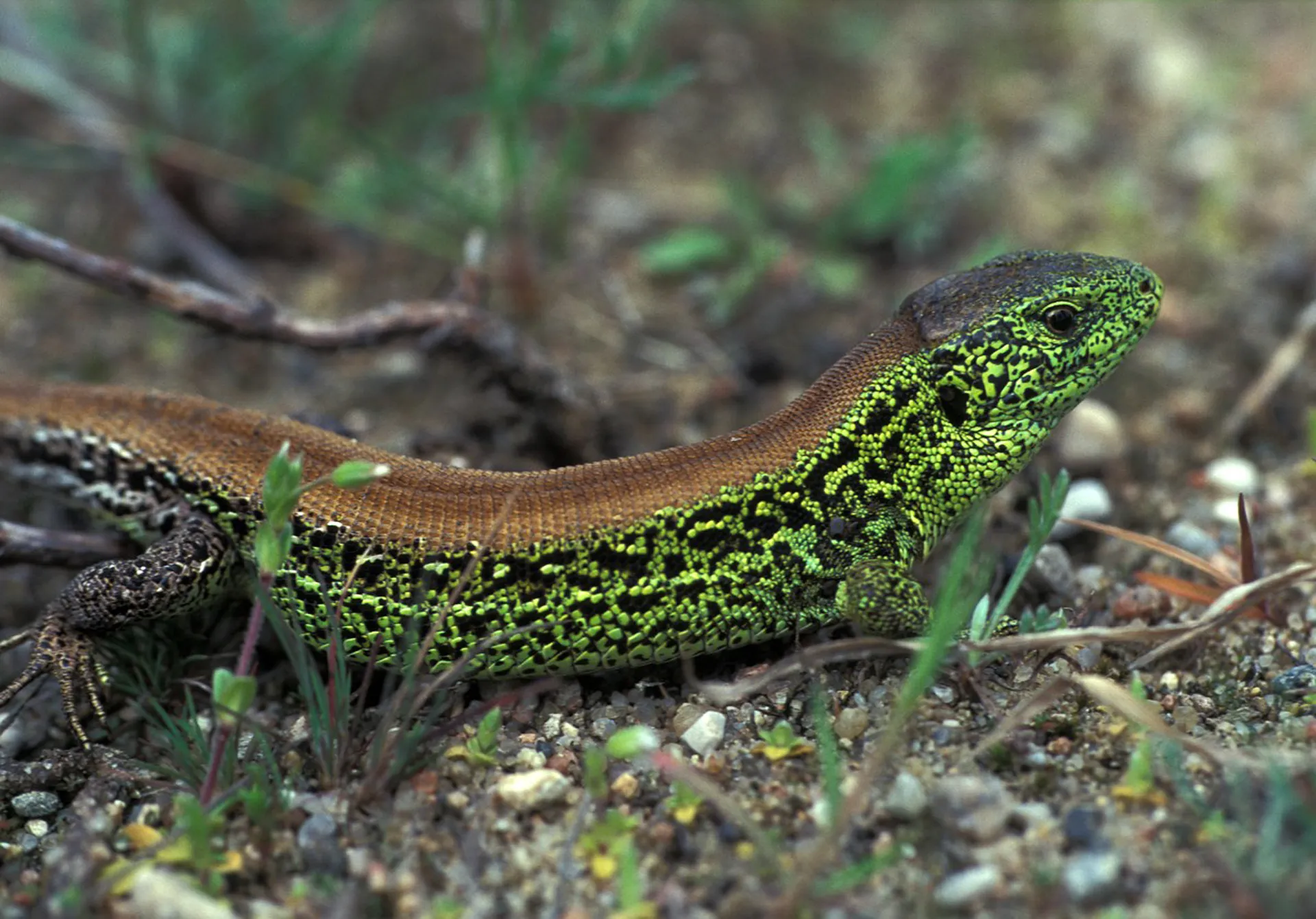
In spring the males show bright green flanks, which makes them one of the most photogenic reptiles of the Danube Delta and Dobrogea.
Quick facts
Quick facts
- Scientific name Lacerta agilis Linnaeus, 1758; populations of the Danube Delta and nearby coast were described as Lacerta agilis euxinica Fuhn & Vancea, 1964, a subspecies whose validity is still debated
- Common name Sand Lizard
- Family Lacertidae (wall lizards and relatives)
- Order Squamata (lizards and snakes)
- Length usually just over 20 cm including the tail; females slightly larger than males
- Diet insects, spiders and other small invertebrates
- Habitat sunny open places with some vegetation: sandy levees, grassy dunes, meadows, embankments, forest edges and river valleys
- Activity by day, from spring to autumn; basks in the open and shelters in dense vegetation or burrows
- Breeding lays eggs, usually in early summer, in sunny, loose soil or sand; young appear in late summer
- Conservation status Least Concern (global IUCN Red List); EU Habitats Directive Annex IV
When to see it in the Danube Delta and Dobrogea
- JanWinter rest
- FebWinter rest
- MarEmerging
- AprMating colors
- MayMating season
- JunEgg-laying
- JulActive
- AugHatchlings
- SepActive
- OctLast activity
- NovWinter rest
- DecWinter rest
- Status here
- Widespread on the sandy levees of the Danube Delta and in suitable habitats across Dobrogea. Indicative seasonal pattern only.
- IUCN Red List
- Least Concern
- Our checklist
- No. 18 of 30 · see the full checklist
Description and identification
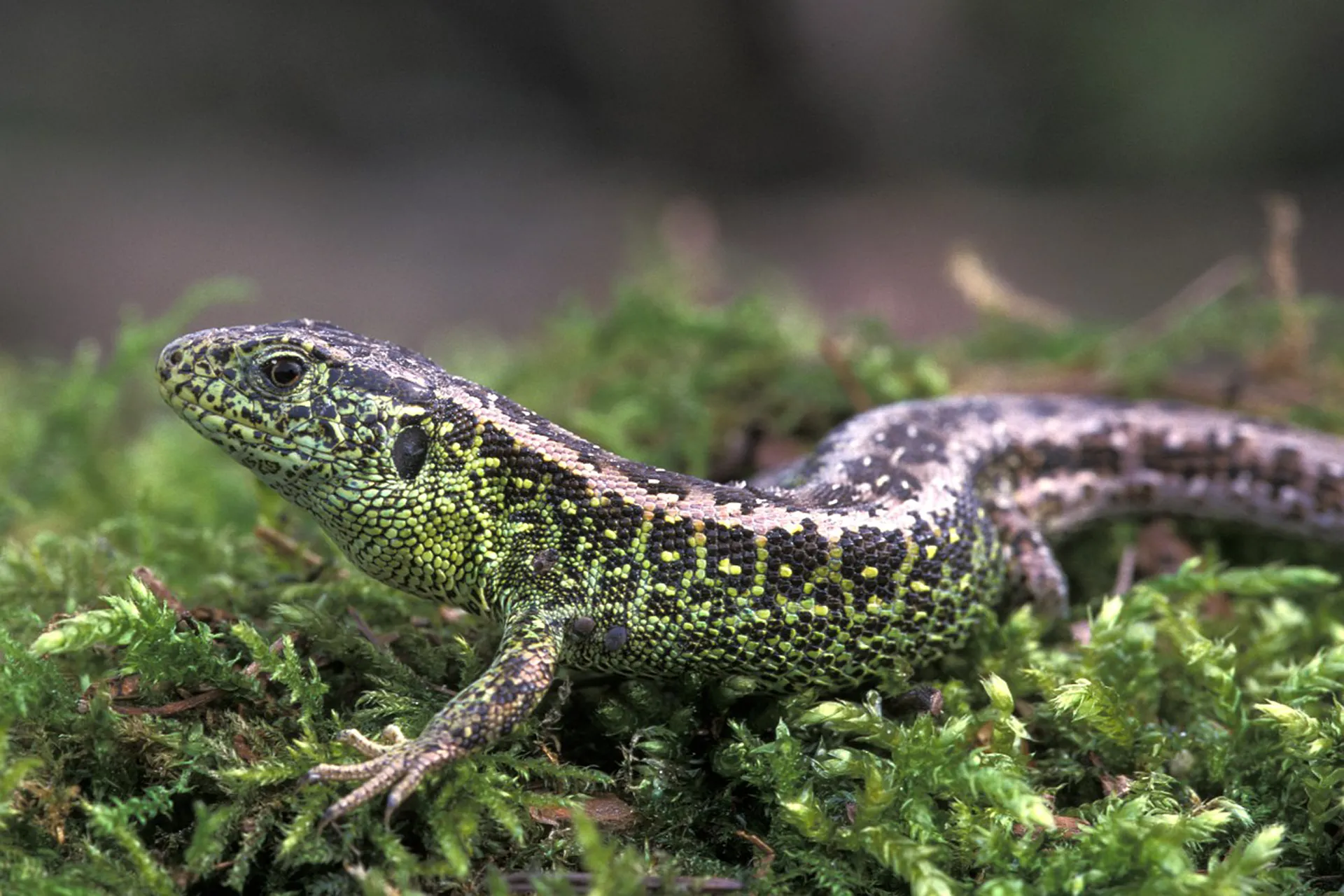
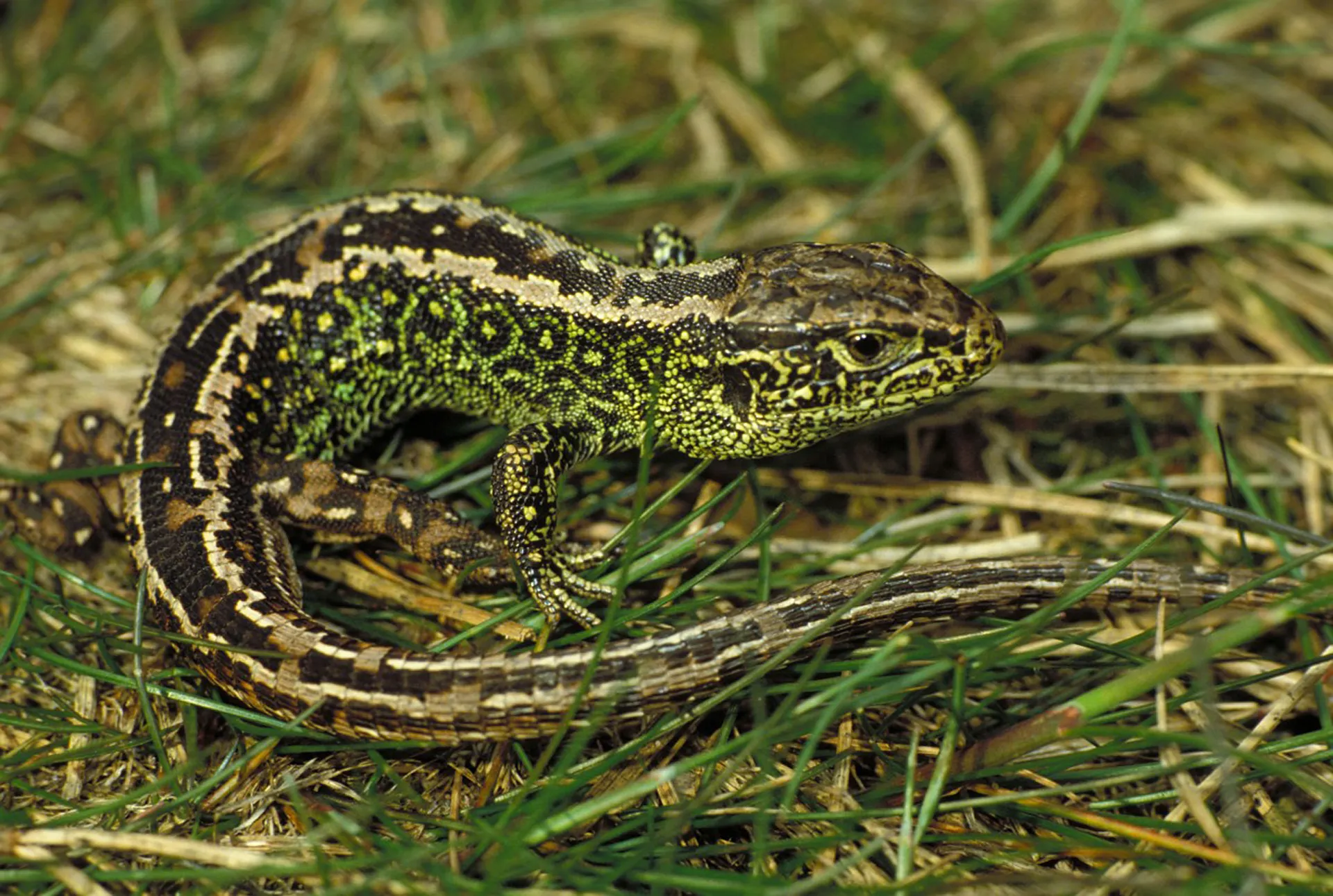
The Sand Lizard is a stocky lizard with a short, deep head and relatively short legs. Adults usually measure just over 20 cm including the tail, and females are slightly larger than males. The back is brown, with a row of darker spots along the middle, and pale bands run along each side of the back.
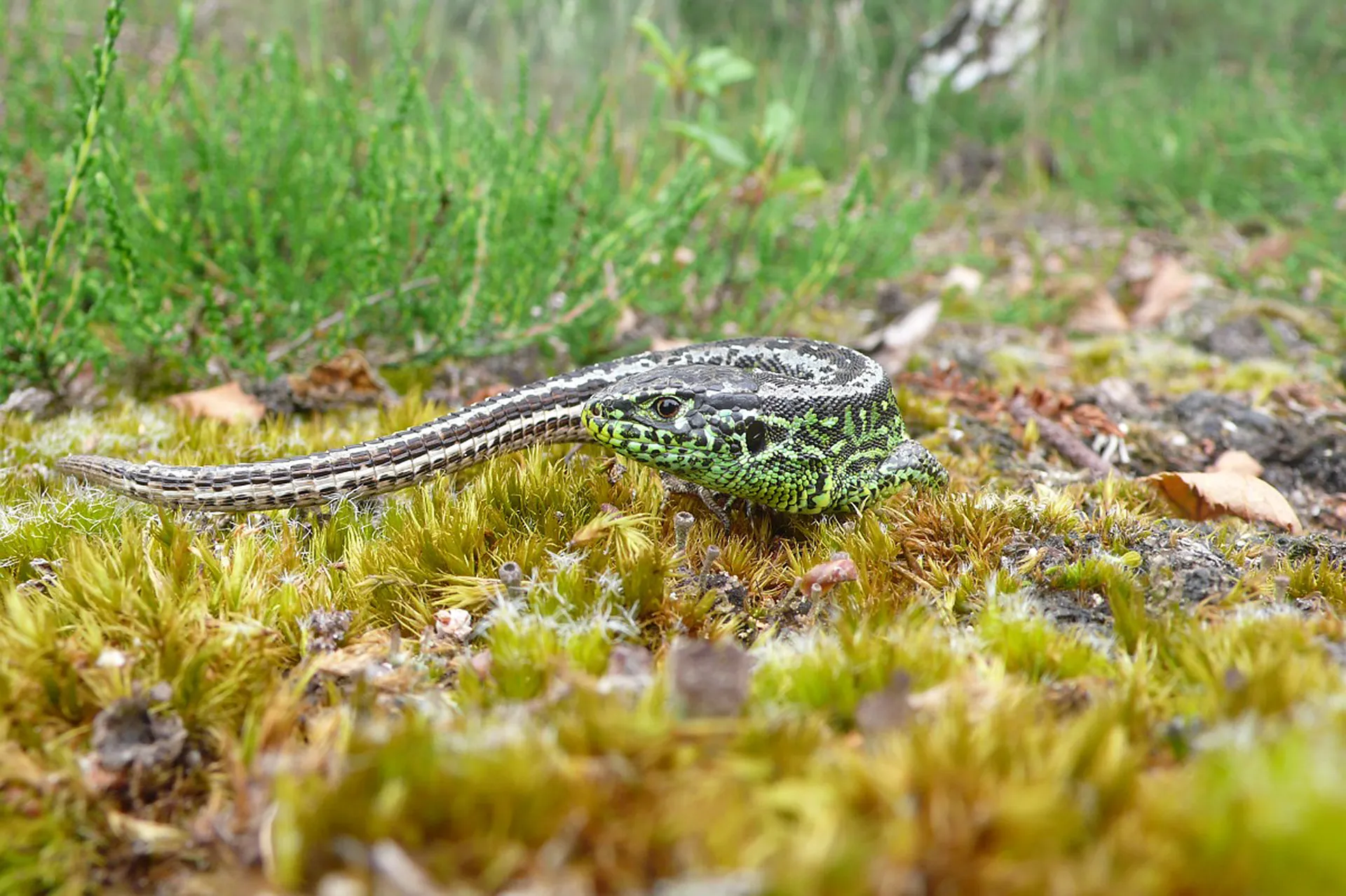
The flanks carry ocelli: black spots with a pale center. In the breeding season males have green flanks, often very bright, while females usually stay brown. Color varies a lot, and some individuals are almost entirely green or uniformly reddish brown without spots.
On the sand of the Danube Delta it can be confused with the Steppe Runner, which is smaller, grayish and very fast, with rows of pale eye-spots, and has a thinner tail. Young Sand Lizards can resemble other small lizards, but the combination of a heavy body, the pale dorsolateral lines and the ocelli on the flanks is typical.
Sand Lizards in the Danube Delta
The Sand Lizard is widely distributed in Romania, up to about 1,400 m altitude. In the Danube Delta it lives on the higher, drier ground: the sandy marine levees, the dunes along the coast and the edges of the forests on the levees. Zsolt Török’s monitoring guide for reptiles of community interest lists sites such as Letea forest and the area between C.A. Rosetti, Letea and Periprava, Crișan, Grindul Perișor, Grindul Flămânda, Grindul Sărăturile near Sfântu Gheorghe and the southern part of Grindul Chituc.
In the southern Danube Delta it is also found around Lake Nuntași and the ancient city of Histria, and at Beștepe, on the edge of the Dobrogean mainland. On the Caraorman levee it shares the sand with the Steppe Runner.
On the mainland of northern Dobrogea, Török found that Sand Lizards occupy narrow, linear habitats: river and stream valleys such as those of the Taița and Telița, and the edges of some roads. He also recorded them near Sinoe and Baia, and an isolated population on the bank of the Danube between Tulcea and Nufăru.
A subspecies from the Danube Delta
In 1964 Ion Fuhn and Ștefan Vancea described Lacerta agilis euxinica from the Danube Delta and the nearby Black Sea coast. Some authors consider it a synonym of Lacerta agilis chersonensis, the subspecies of the steppes farther east, while others, including Zsolt Török, treat it as valid. If you search older literature for the Sand Lizards of the Danube Delta, it is worth looking for both names.
Daily life and breeding
Sand Lizards need warmth but also some humidity. They spend the morning basking in the sun near cover, then hunt insects, spiders and other small invertebrates among the plants. When disturbed they run into dense grass, under bushes or into burrows in the sand. They rarely go deep into forests.
Mating takes place in spring, when males are at their brightest. Females lay their eggs in loose, sunny soil or sand, usually in early summer, and the young appear in late summer. Hatchlings are brown, with small pale spots, and they are often the most visible lizards on the levees in August and September.
Conservation and responsible observation
The Sand Lizard is assessed as Least Concern globally and was assessed as Least Concern for Europe and the EU in the 2009 European Red List; it is not among the threatened reptiles in the 2025 revision. It is listed in Annex IV of the EU Habitats Directive, as a species of community interest requiring strict protection, and in Romania it is protected under Annex 4A of Government Emergency Ordinance 57/2007.
Locally it can suffer from the loss of grassy dunes, intensive grazing, burning of vegetation and the growth of settlements on the levees. When photographing, approach slowly, do not lift the lizards or chase them from their basking spot, and stay on the tracks so the dune vegetation stays intact.
Photographing it on our tours
On our multi-day photo tours in the Danube Delta, the sandy levees offer good chances for close portraits of Sand Lizards, especially on calm, sunny mornings in May and June, when the males show their green flanks. A long lens and a low, patient approach give the most natural results.
See it with us
Slow open boats, small groups and a guide who knows the places and the wildlife. From a few hours on the water to a week in the Danube Delta and Dobrogea.
Keep reading
Keep reading
More from the blog
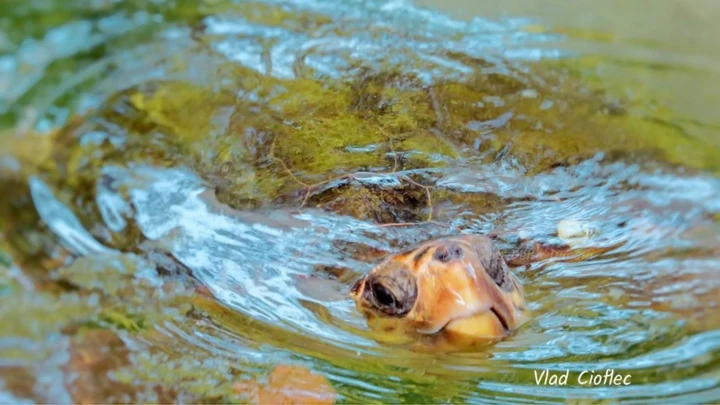
4 min read
Loggerhead Sea Turtle (Caretta caretta) in the Black Sea
The Loggerhead Sea Turtle reaches the Black Sea only by chance. How to identify it, the only two records from Romania, both on Danube...
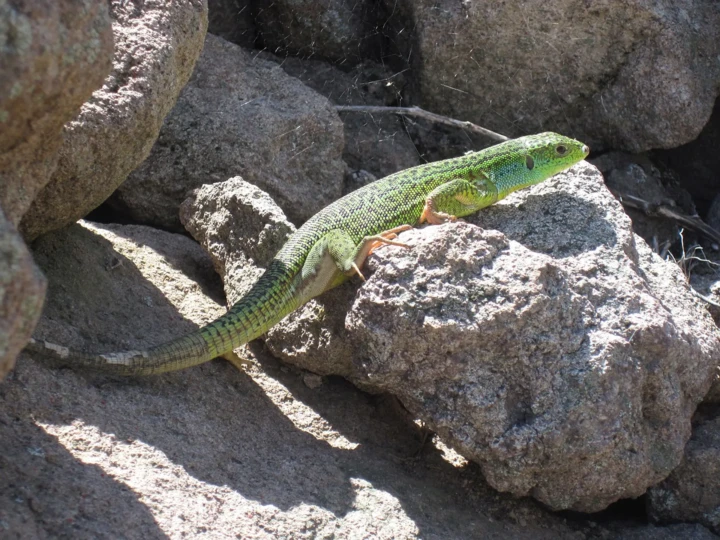
5 min read
Balkan Green Lizard (Lacerta trilineata) in Dobrogea
Meet the Balkan Green Lizard, the largest lizard in Romania, found only in Dobrogea near the Danube Delta: identification, where it lives, behavior, taxonomy...
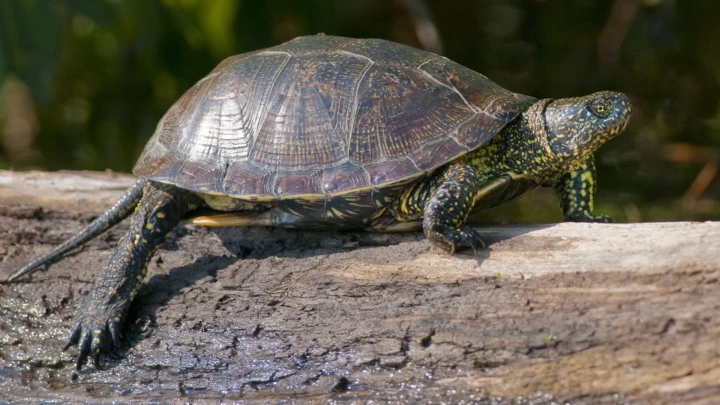
5 min read
European Pond Turtle (Emys orbicularis)
The European Pond Turtle is one of the most frequently encountered reptiles in the Danube Delta. Discover how to identify it, why it spends...