


No. 158 on our checklistGreat White Pelican (Pelecanus onocrotalus)
The Great White Pelican, symbol of the Danube Delta, home to its largest European population: identification, team fishing, colonies, migration.
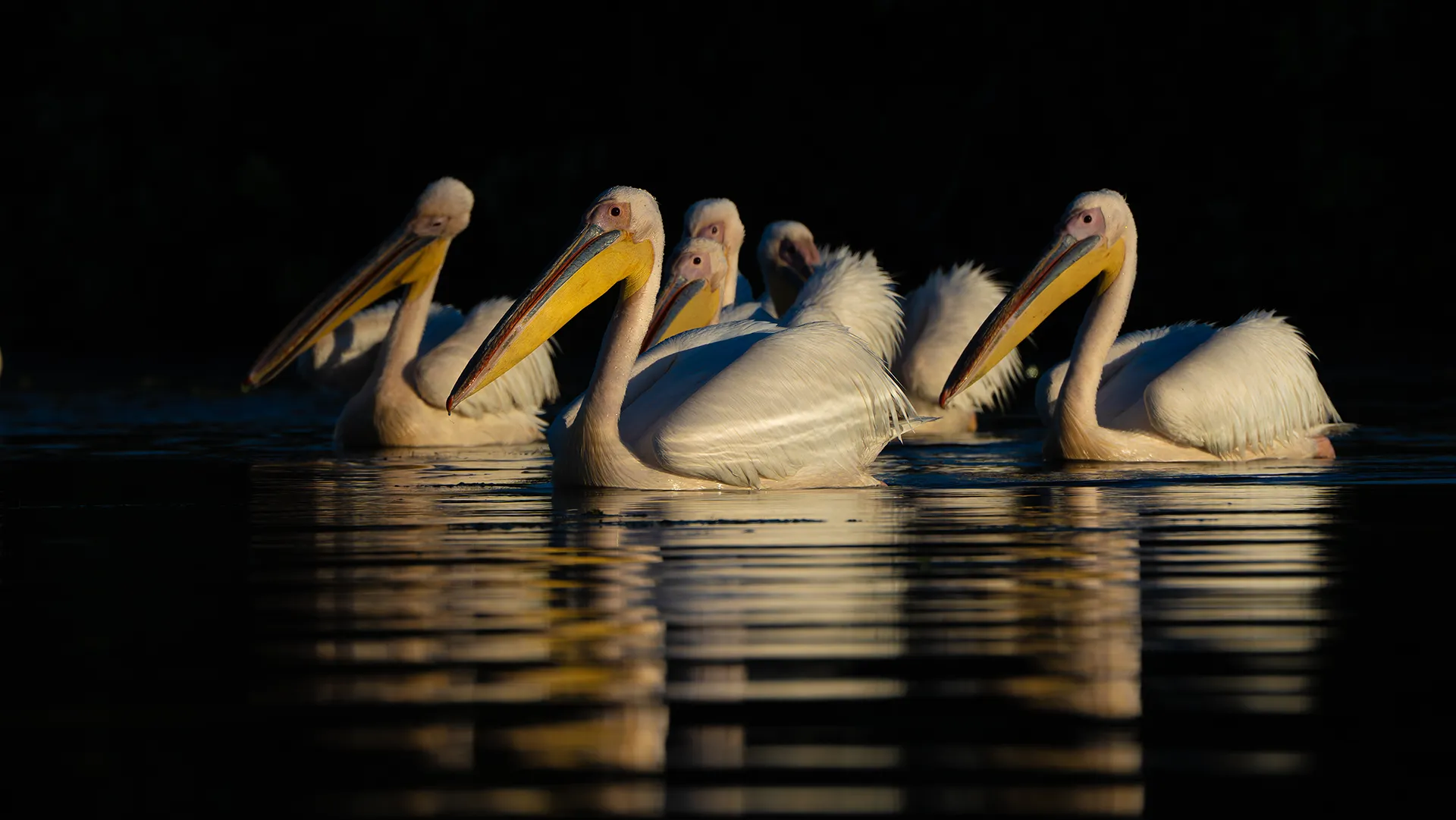
A flock of Great White Pelicans fishing together is one of the great natural spectacles of Europe. Dozens of white birds, each weighing around 10 kilograms, swim in a semicircle, beat the water with their wings and plunge their bills at the same moment, as if on a signal. The Danube Delta holds the largest breeding population of the species in Europe, and the pelican has rightly become its symbol.


Quick facts
- Scientific name Pelecanus onocrotalus
- Family Pelecanidae, order Pelecaniformes
- Length 140-175 cm
- Wingspan 245-295 cm
- Weight males 9-15 kg, females 5.5-9 kg
- In the Danube Delta summer visitor, April to October
- Conservation status Least Concern (LC) on the IUCN Red List; strictly protected in the European Union
When to see it in the Danube Delta and Dobrogea
- JanAbsent
- FebAbsent
- MarAbsent
- AprModerate
- MayModerate
- JunModerate
- JulModerate
- AugModerate
- SepModerate
- OctModerate
- NovAbsent
- DecAbsent
- Status here
- Summer breeder. Common in the Danube Delta (approx. 5500 nesting pairs).
- IUCN Red List
- Least Concern
- Our checklist
- No. 158 of 385 · see the full checklist
Identification
The adult is white, and in spring the plumage takes on a pinkish tinge, which comes from the secretion of the preen gland that the bird spreads over its feathers. The bare skin around the eye is yellowish pink, the eye dark and the legs pinkish orange. On the forehead the feathering comes down to a sharp point towards the bill. In the breeding season it has a short crest on the nape and a yellowish patch on the breast. The sexes differ when breeding: the male has yellower facial skin and is clearly larger, the female has orange facial skin.
In flight, seen from below, it shows the strongest contrast of any pelican: the flight feathers are black and the rest of the wing white. Juveniles are greyish brown, with brownish wings, and take three to four years to turn white. The differences from the Dalmatian Pelican are explained in detail in the article about that species.
Fishing as a team
Unlike the Dalmatian Pelican, which mostly fishes alone, the Great White Pelican is a social fisher. Groups of dozens of birds form a semicircle or horseshoe, advance towards the shallows, beat their wings and dip their bills in unison, driving shoals of fish into a spot with no escape. The throat pouch works like a landing net: it fills with water and fish, then the bird contracts it, drains the water and swallows the prey. An adult needs about 1-1.2 kg of fish a day, mostly Prussian carp, rudd, perch and bream.
Cormorants often join these groups: they dive and drive the fish towards the surface, where the pelicans catch them. It is a feeding association you often see on the lakes of the Danube Delta.
Nest and young
Great White Pelicans nest in very dense colonies, on floating reed islands or on low islets, far from people. The nest is a heap of reeds and aquatic plants on the ground. The female usually lays two eggs, incubated by both parents for 29-36 days. After a few weeks the chicks gather in crèches, large groups of young guarded by a few adults, and the parents recognise their own chick by its voice when they come back with food. The young fly at 65-75 days and become independent soon after.
Breeding sites are extremely sensitive: a disturbance of just a few minutes flushes the adults off their nests, and gulls take eggs and small chicks almost immediately. That is why the colonies lie in strictly protected zones where no one enters.
Migration
The Great White Pelicans of the Danube Delta arrive at the end of March and in April, hungry after the journey, and leave in September and October. They winter in Africa, mainly in the Nile basin and the Sahel. Being very heavy birds, they migrate by soaring on the thermals rising over land and avoid crossing the sea: they pass over the Bosphorus, through Türkiye and the Middle East, where tens of thousands are sometimes seen in a single day.
Where and when to see it in the Danube Delta
From April to September you see them on the large, open lakes, fishing in groups or resting on sandbanks and floating islands, and flying over in squadrons, in lines or V formations. At sunrise and in the evening, when they fly between resting and feeding areas, they are easiest to see. In autumn the young of the year come out on the lakes with their parents and learn to fish. Our guides know how close the boat can get to a feeding flock without flushing it, so you watch them fishing, not fleeing. You see them on almost any day trip or holiday with us.
Interesting facts
- Pink from its own gland. The pinkish tinge of the spring plumage does not come from food, as in flamingos, but from the secretion of the preen gland, which the pelican spreads over its feathers when preening.
- One of the heaviest flying birds. A large male weighs more than 10 kg and has a wingspan of nearly three metres. To take off from water, it runs across the surface with its feet and beats its wings hard.
- Chick crèches. In the colonies the older chicks gather together, and adults returning with food find their own chick in the crowd by its voice.
- The old name. Onocrotalus comes from Greek and means roughly “braying donkey”, after the deep calls of adults in the colonies.
Status and threats
The Great White Pelican breeds from southeastern Europe to Central Asia and in Africa and is listed as Least Concern (LC) by the IUCN, but in Europe it breeds in only a few places, and the Danube Delta holds by far the largest population. The threats are disturbance at breeding sites, reed fires, power lines, which such large birds collide with or are electrocuted on, and persecution by those who see it as a competitor for fish.
In the Danube Delta today, the greatest threat to nature is fast boats. Their waves reach the floating reed islands, and their noise flushes feeding or resting flocks off the water; every forced flight costs energy for a 10 kg bird. That is why our boats go slowly on the channels.
See it with us
Our birding guides are biologists and ornithologists who are on the water every day of the year. Small groups, open boats, the best hours of the day.
Keep reading
Keep reading
More from the blog
4 min read
Gadwall (Mareca strepera)
Meet the Gadwall, a plant-eating dabbling duck that steals food from coots: identification, breeding in the Danube Delta, autumn migration and status.

4 min read
Eurasian Penduline Tit (Remiz pendulinus)
A tiny masked bird that weaves a hanging nest like a felt bottle at the tip of a willow branch over the water.
2 min read
Black-tailed Godwit (Limosa limosa)
A long-billed wader with a bold wing stripe. Black-tailed Godwit occurs on passage and is a very rare breeder in the Danube Delta region.