

No. 156 on our checklistGlossy Ibis (Plegadis falcinellus)
Dark brown in the shade, green and bronze in the sun: the only ibis that breeds widely in Europe, and the Danube Delta is its stronghold in Romania.
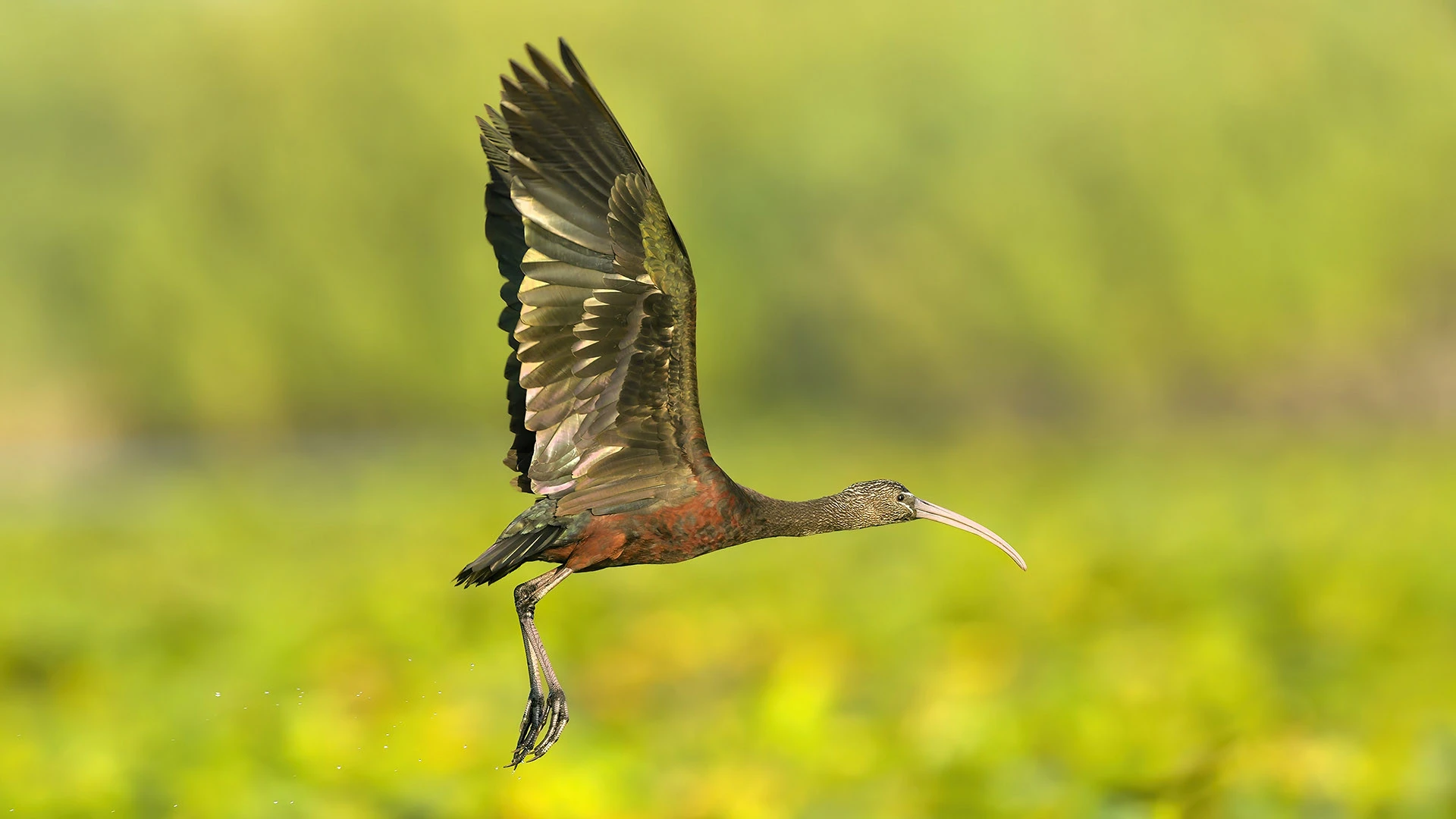
In the shade, the Glossy Ibis looks like a plain dark bird with a long curved bill. The moment the sun reaches it, the feathers light up in green, bronze and purple. It is the only ibis that breeds widely in Europe, and the Danube Delta holds at least four fifths of all the pairs that nest in Romania.
Quick facts
- Scientific name Plegadis falcinellus
- Family ibises and spoonbills (Threskiornithidae)
- Length 55 to 65 cm
- Wingspan 88 to 105 cm
- Weight 630 g
- In the Danube Delta summer visitor, April to September
When to see it in the Danube Delta and Dobrogea
- JanAbsent
- FebAbsent
- MarAbsent
- AprModerate
- MayModerate
- JunModerate
- JulModerate
- AugModerate
- SepModerate
- OctAbsent
- NovAbsent
- DecAbsent
- Status here
- Summer breeder.
- IUCN Red List
- Least Concern
- Our checklist
- No. 156 of 385 · see the full checklist
How to recognise it
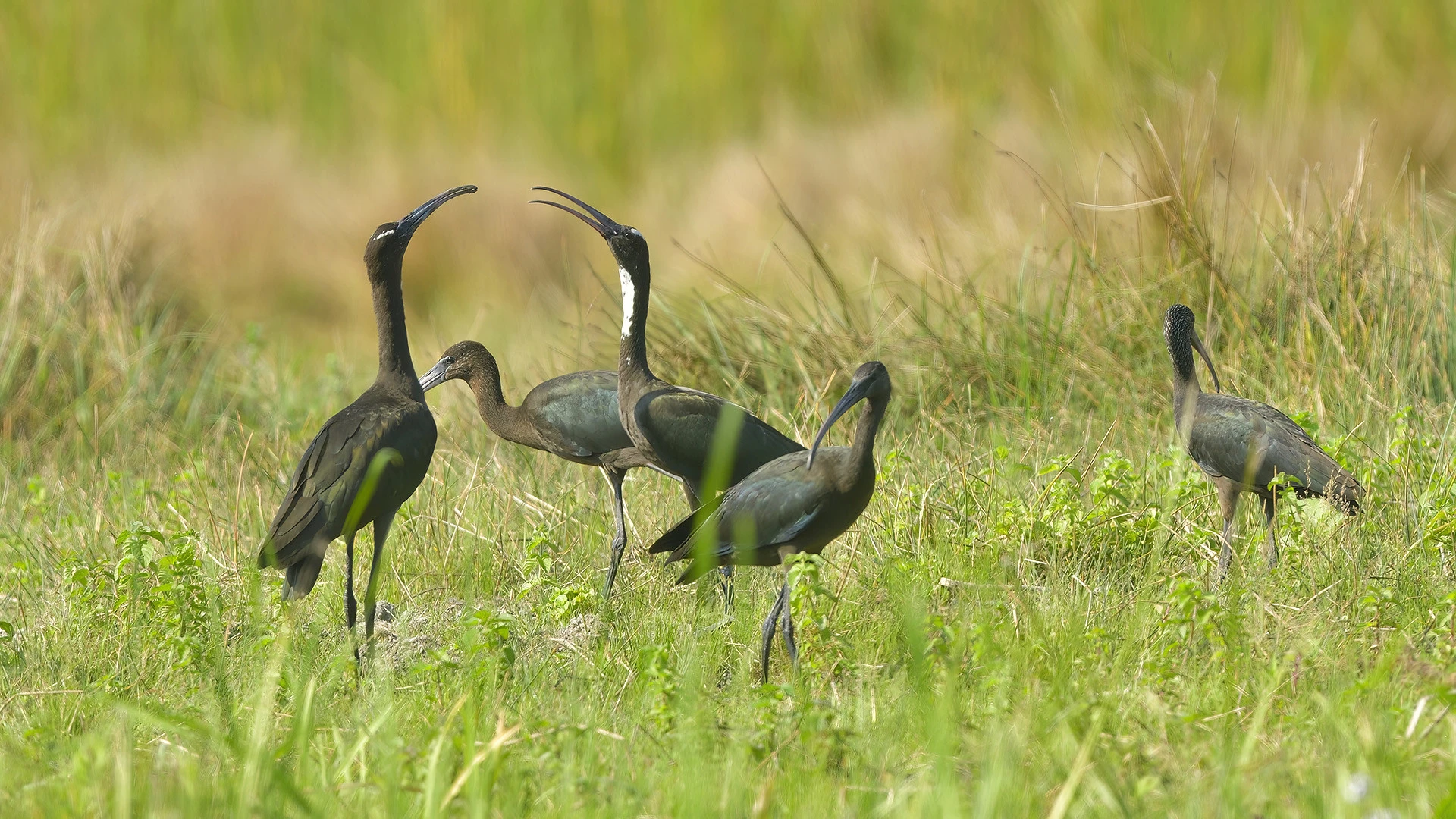
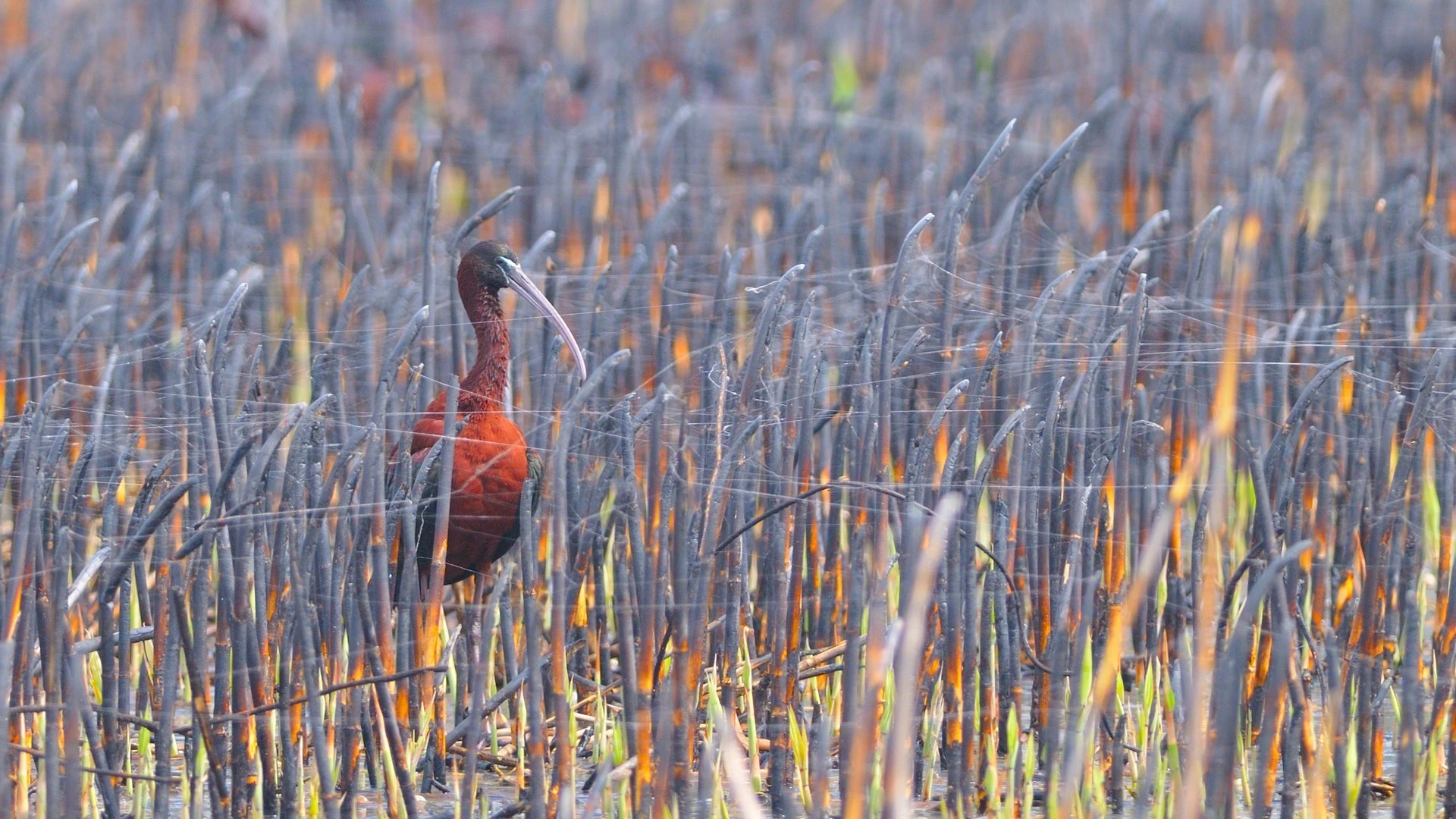
An adult in summer has a deep chestnut body and neck, and wings that shine metallic green and bronze in good light. The bill is long, olive brown and curved down like a sickle, and the legs are long and dark. In the breeding season a thin pale blue and white line borders the bare skin between the bill and the eye. Male and female look the same; the male is only a little larger, with a longer bill. Young birds and adults in autumn are duller, with fine white streaks on the head and neck and much less gloss.
In flight it stretches the neck forward and the legs back, and alternates quick wingbeats with short glides. Small flocks fly in lines or loose V shapes, low over the reeds. At a distance a line of ibises can pass for cormorants, until you see the curved bills. No other bird of the Danube Delta has this shape.
Feeding and nesting
The Glossy Ibis feeds by walking slowly through shallow water and soft mud, probing with its bill. It looks for food in wet meadows, open patches in the reed beds, on the floating vegetation along the lake shores, and in rice fields wherever they are flooded. A study of birds from the Danube Delta showed that insects make up about two thirds of what it eats, followed by plant matter, snails, frogs and very little fish.
It nests in colonies, together with herons, egrets and cormorants. In the Danube Delta most nests are built in grey willow bushes growing among the reeds, usually 1 to 2.5 m above the water, and some in white willows in the flooded forests; nests in the reeds themselves are rare. The colonies of the Danube Delta are large, hardly ever under 100 pairs, and they move from one year to the next, sometimes by more than 3 km. The female lays usually three or four eggs, and both parents incubate them for about three weeks.
Where to see it in the Danube Delta
The first Glossy Ibises arrive in March, the colonies fill from mid April, and most birds leave for Africa in September. Most colonies are in the central part of the Danube Delta, the area of the large lakes, which is exactly where our boat trips from Mila 23 go. The best moments are early morning and evening, when flocks fly in lines between the colonies and their feeding places, and when birds feed on the floating vegetation at the edge of the lakes. Our checklist marks it moderate from April to September.
You can see it on almost any summer trip with us: a private 4 hour birdwatching trip, a small group birdwatching tour in the Danube Delta, or a wildlife photo tour from Mila 23.
Interesting facts
- From 12,000 pairs to 525. The Danube Delta held a maximum of about 12,000 pairs in 1977. Two years later there were about 6,000, and by 1983 only 525. Between 2008 and 2017 the Danube Delta held 8 to 10 colonies with an estimated 500 to 3,000 pairs.
- Canned in Sulina. As the old fishermen and hunters of the Danube Delta told us, in the communist years hunters had to deliver Glossy Ibises to the canning factory in Sulina. The breast meat was canned and exported to Italy, and the hunters were paid in shotgun cartridges. The archives of that time are still waiting to be studied, but in the Danube Delta this story is remembered.
- Colonies disturbed on purpose. In the late 1970s and early 1980s, campaigns to “optimise the populations of fish eating birds” were carried out in the Danube Delta. The disturbance in the mixed colonies made many birds abandon their nests in the middle of the breeding season.
- A fish eater that eats insects. Although it nests side by side with herons and cormorants, fish is only about 2% of its diet in the Danube Delta. Insects are about 65%.
- What good wetlands can do. In Doñana, in southern Spain, the Glossy Ibis came back to breed in 1996 with 7 pairs. By 2017 there were more than 10,000 pairs.
Status and threats
The Glossy Ibis breeds in southern Europe, Asia, Africa, Australia and the Americas, and is listed as Least Concern by the IUCN. In Romania it was common in all the large wetlands of the south and east at the beginning of the 20th century. Its decline came with the loss of those wetlands: the floodplain of the Danube was drained for agriculture, the polders inside the Danube Delta covered more than 950 square kilometres by 1990, and the water became richer in nutrients and poorer in life. Today the Danube Delta is its last real stronghold in the country.
In the Danube Delta today the greatest threat to nature is speed boats. The Glossy Ibis nests in willow bushes at the edge of the lakes and feeds on the floating vegetation along the shores, exactly where their noise and waves reach first. This is why our boats move slowly in the channels.
See it with us
Our birding guides are biologists and ornithologists who are on the water every day of the year. Small groups, open boats, the best hours of the day.
Keep reading
Keep reading
More from the blog
6 min read
White Stork (Ciconia ciconia)
Nests on village poles, bill-clattering pairs and long journeys to Africa: the White Stork in the Danube Delta and Dobrogea, from March to September.
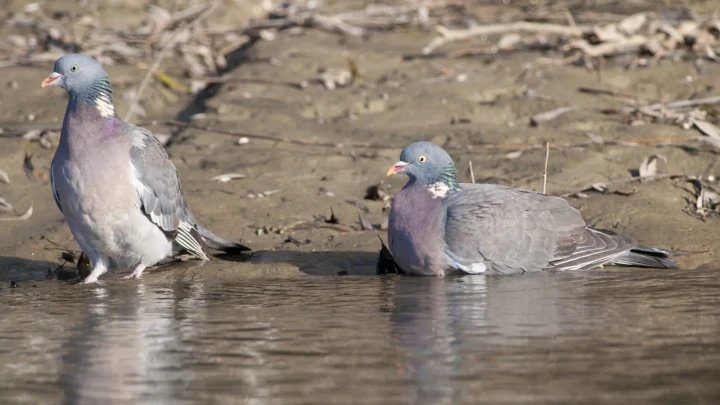
5 min read
Common Wood Pigeon (Columba palumbus)
The Common Wood Pigeon, Europe's largest pigeon, in the forests and fields of the Danube Delta and Dobrogea: identification, breeding, migration and status.
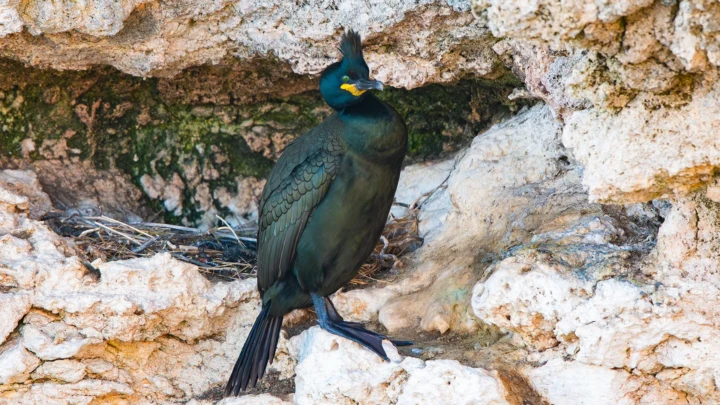
3 min read
European Shag (Gulosus aristotelis)
The European Shag, the cormorant of the sea: how to tell it from the Great Cormorant, its deep dives, and where to see it...